
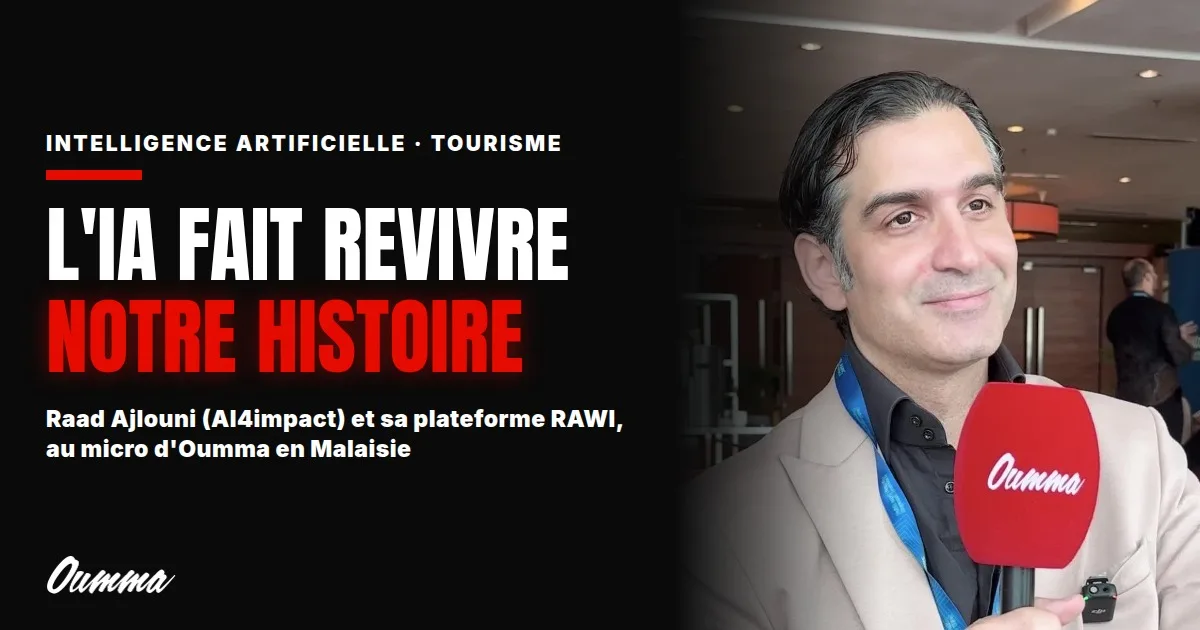
AI: Raad Ajlouni brings Muslim history to life
Interviewed by Oumma during the fifth World Islamic Tourism Conference, organized on November 5 and 6, 2026 in Kuantan, Malaysia, Raad Ajlouni explains how generative artificial intelligence can bring the great figures of Muslim history back to life, and make them a driving force for tourism. Swiss and Jordanian, trained in France, this entrepreneur runs AI4impact, a company that supports businesses and governments in the adoption of AI.
From IT consulting to artificial intelligence
Raad Ajlouni launched a strategy consulting and IT development company in 2011. Digital transformation has been his job for fifteen years. “For three or four years, with the rise of AI, we have used more or less the same processes, it’s just that we have accelerated through AI,” he summarizes.
His current company, AI4impact, of which he is the founder and director, presents itself as a consulting, training, development and business creation company in artificial intelligence. It is aimed at governments, large companies, innovation ecosystems and entrepreneurs. At the end of September 2026, it signed a cooperation agreement with Terminal İstanbul, a Turkish innovation hub. Raad Ajlouni also founded Ruh Academy, a spiritual guidance program that combines the Islamic framework of the soul, AI and science.
RAWI, the “storyteller” who brings Mat Kilau back to life
RAWI was born within the AI4impact incubator. “Rawi, in Arabic, means storyteller,” explains Raad Ajlouni: the storyteller, the one who transmits the story. The platform uses generative AI to stage moments of Islamic history on video, create emotion, then extend this digital experience with a physical experience, on the spot. He talks about “figital”, the meeting of the physical and the digital.
In Kuantan, the organizers broadcast a video made by his team on Mat Kilau, a figure of resistance to British colonization at the end of the 19th century, popular hero of the state of Pahang, the same state which hosted the conference. “It allowed us to get closer to their culture, and for them to see that we can use technology to highlight historical and cultural heritage,” he says.
The screening opened doors beyond Malaysia: he says he initiated discussions with people from Cambodia, Uzbekistan, Vietnam and Thailand. The idea he submitted to them: work with the ministries of Tourism to revive legendary stories, and activate an entire tourism ecosystem around them.
Ibn Battuta, Emir Abdelkader: heroes to revive
The principle can be transposed everywhere. Raad Ajlouni quotes Ibn Battuta: take in detail the stays of the great North African traveler and draw “micro-stories” from them, which would make inhabitants want to rediscover their own country and Muslims elsewhere to follow in his footsteps. Emir Abdelkader in Algeria could experience the same treatment. “What’s interesting with AI is that we can bring these characters back to life. We no longer have limits at the temporal, physical or geographical level. »
The story also serves to elevate what he calls the “tourist culture” of a population, to better promote local and international tourism. A message to the authorities of Arab countries and the Maghreb, slips the interviewer from Oumma, and Raad Ajlouni acquiesces.
Islamic tourism, between spirituality and business
What struck him at the conference was the place given to the sense of travel. He recalls that in Islam, leaving can be an act of faith, and cites the Koranic verse according to which men were made “peoples and tribes” so that they would know each other. “When you change your mindset in relation to this aspect, your whole journey will change. »
Commerce follows. Discovering villages and rural regions, far from Kuala Lumpur, puts travel agencies, transporters and drivers to work: “it activates an entire ecosystem”. And in Malaysia as in Indonesia, where Islam has spread through trade and example, trust remains, according to him, the pillar of business.
What Europe can learn from Malaysia
Malaysia is a world benchmark for Islamic tourism. For Raad Ajlouni, the challenge is not to copy it, but to understand its tools and its successes to adapt them to Muslim communities in Europe, and to create bridges between the two regions. He cites honeymoon trips: offers designed between Europe and Malaysia, then comparable formulas to be built in Europe.
