
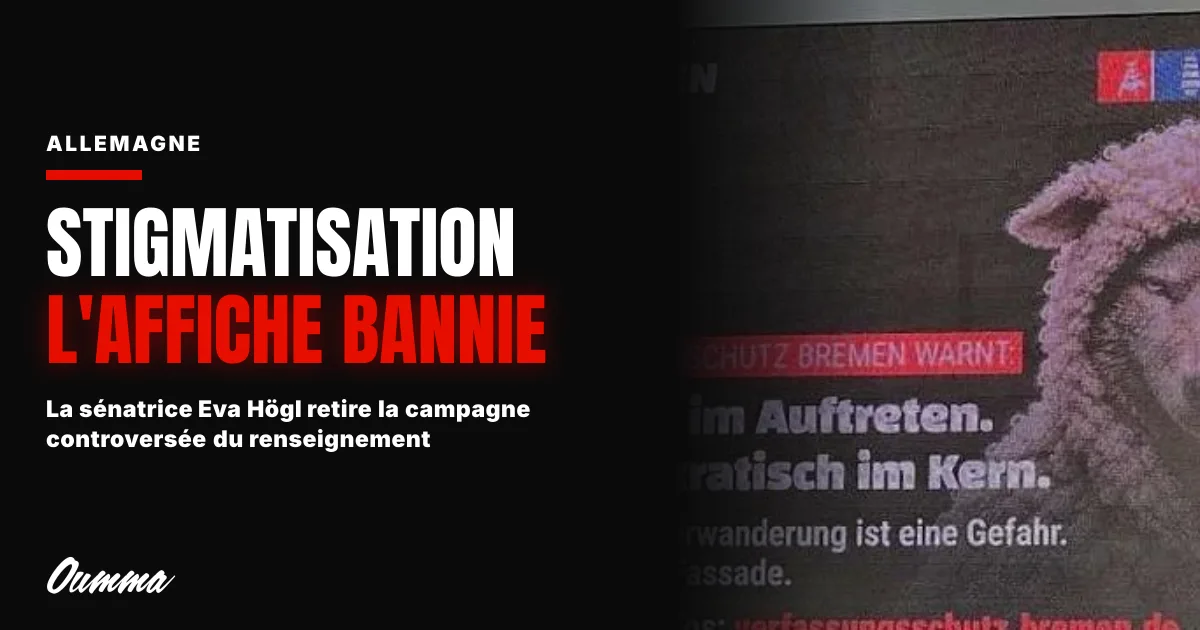
Germany: Bremen removes poster targeting
Since November 4, Bremen residents could see a wolf in sheep’s clothing on city signs. The text of the poster warned against people who, beneath a friendly exterior, would pursue objectives hostile to democracy. As reported by the German daily Die Weltthe domestic intelligence services of Bremen and Lower Saxony had designed the campaign together. Only Bremen had planned to broadcast it in its streets.
At the launch of the campaign, the intelligence services specified that they were targeting so-called “legalist” Islamism. By this term, they designate organizations which use the means of action offered by democracy to influence institutions, while pursuing a project contrary to democratic principles. Bremen senator Eva Högl cited the Muslim Brotherhood networks. According to her, Muslims themselves are among the first to be affected, as these groups seek to speak and act on their behalf.
When the simple act of dialoguing becomes suspicious
In the street, passers-by saw the wolf and the warning, but had little information to understand who was being targeted. It is this discrepancy that the Schura of Bremen, a local Muslim organization, denounced. In a press release published on November 13, she mentioned Muslim residents who give their time to an association, take responsibility in their neighborhood or participate in political life. Does a resident who engages in this way risk being suspected of hiding his intentions, even when he seeks dialogue?
The Schura recalls that the Muslim communities of Bremen took years to establish relationships of trust with the security services. She fears that the poster will weaken these links. The organization called for the removal of the posters, a public apology and a discussion with the affected communities.
Eva Högl recognizes an error in the choice of poster
On November 14, the day after the Schura press release, Eva Högl, member of the Social Democratic Party, admitted an error. According to the German regional daily Kreiszeitungthe senator estimated that if many Muslims had felt collectively targeted, the authorities bore responsibility for the way in which they had designed their campaign. She expressed her regrets and recalled the role that Muslim residents play in the associations and social structures of Bremen and Bremerhaven.
Eva Högl believes that intelligence services must continue to monitor anti-democratic networks. She wants to involve the Muslim communities of Bremen in this work. For the Schura, the difficulty lies in the message that residents could read in the street. The authorities said they were targeting specific organizations, but the poster gave no examples of their methods. With the image of the wolf in sheep’s clothing, it risked passing off as a ruse the gesture of a Muslim resident who, in his neighborhood, is simply seeking to initiate dialogue.
Subscribe to the Oumma letter: our articles, our analyzes and our new programs arrive directly in your mailbox.
Free. One-click unsubscribe. Everything you need to know about Umma’s letter
