The Muslim 500: the most influential Muslims
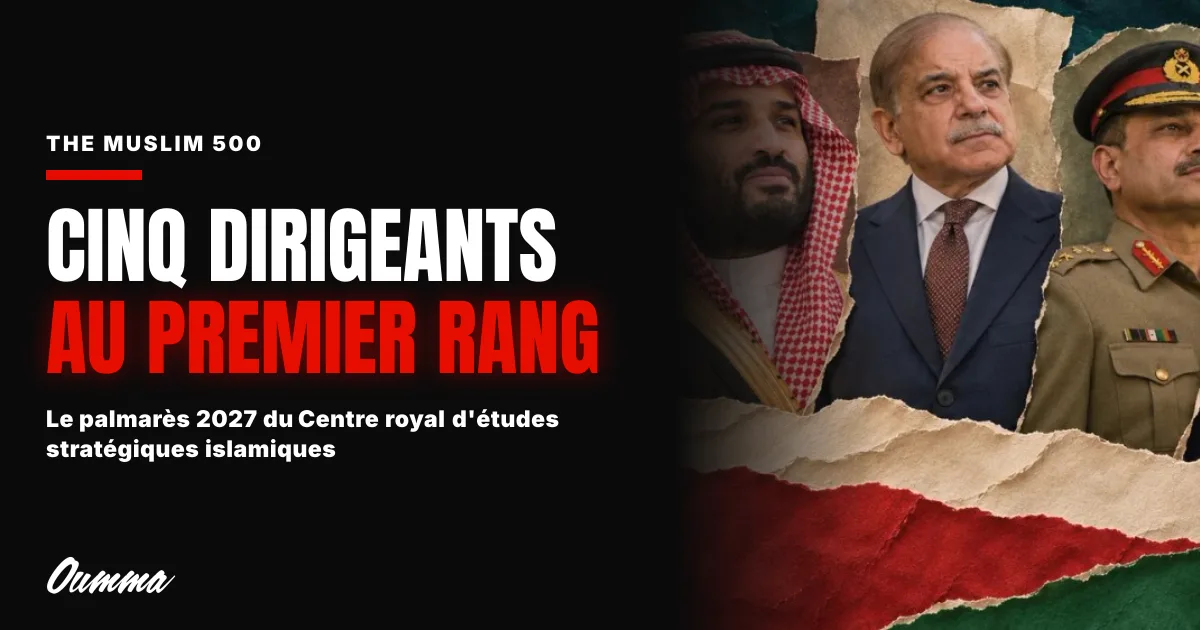
In Amman, Jordan, the Royal Center for Islamic Strategic Studies released the 2027 edition of The Muslim 500his directory of the 500 Muslim personalities he considers the most influential in the world. For the first time, five leaders share the top spot: the king and crown prince of Saudi Arabia, the prime minister and army chief of Pakistan, and the president of Turkey. This choice is explained by the defense agreement which commits the three countries to consider an armed attack against one of them as an attack against all three.
The Muslim 500 is the title of an annual publication. Behind this list is the Royal Center for Strategic Islamic Studies, a research organization based in Amman and attached to the Royal Aal al-Bayt Institute for Islamic Thought. Its authors are interested in a question: which personalities, through their decisions, their work or their commitment, have a concrete effect on the lives of Muslims? This criterion explains why a head of state, a teacher and a doctor can appear in the same edition.
Each year, the center opens a call for proposals for one month. To establish its selection, it examines the names submitted by the public, collects expert opinions and takes into account visibility indicators. He specifies that a work carried out over a lifetime carries more weight than a single year of news. Of the 500 personalities selected, only the first fifty receive a rank. The other 450 are presented in thirteen sections, including media, charity and religious affairs.
An alliance at the top of the rankings, a Gaza doctor distinguished
The choice of the first five dates back to August 7, 2026. On that day, Saudi Arabia, Pakistan and Turkey signed the Mecca defense pact, after the American strikes against Iran and the Iranian responses in the Gulf. According to the authors of the list, the scope of this agreement is due to the means that the three partners can bring together: Saudi financial resources, Turkish industrial and technological capabilities and Pakistani military power.
In Gaza, it is the commitment to the sick that caught the attention of the authors. Dr. Hussam Abu Safiya, pediatrician and former director of Kamal-Adwan Hospital in the northern Gaza Strip, enters the ranking at 50th place. By also designating him “man of the year,” the publication salutes his decision to stay with his patients during the hospital siege. Two other Palestinians appear in the top 50: Palestinian President Mahmoud Abbas and Professor Mustafa Abu Sway.
The 2027 ranking: the first places and the three Palestinians in the top 50
The top five are grouped into three entries, one per country. Each ranks first, which explains the direct move to fourth place. The list includes the first thirteen places, then those of the three Palestinian personalities.
1st tie
Salman bin Abdulaziz and Mohammed bin Salman
King of Saudi Arabia and Crown Prince, also Prime Minister
1st tie
Shehbaz Sharif and Asim Munir
Prime Minister and Chief of Armed Forces of Pakistan
1st tie
Recep Tayyip Erdoğan
President of Türkiye
4th
Mojtaba Khamenei
Supreme Leader of Iran
5th
Abdullah II
King of Jordan
6th
Tamim bin Hamad Al-Thani
Emir of Qatar
7th
Muhammad Taqi Usmani
Pakistani Mufti, a scholar authorized to give opinions on Muslim law
8th
Habib Omar bin Hafiz
Founder and director of the Dar al-Mustafa Institute of Islamic Education, Yemen
9th
Ahmed Al-Tayeb
Grand Imam of Al-Azhar, Egyptian religious and academic institution
10th
Abdallah ben Bayyah
President of the Forum for the Promotion of Peace in Muslim Societies
11th
Ali Al-Sistani
Grand Ayatollah, one of the main Shiite religious authorities in Iraq
12th
Mohammed bin Zayed Al-Nahyan
President of the United Arab Emirates
13th
Anwar Ibrahim
Prime Minister of Malaysia
45th
Mahmoud Abbas
Palestinian President
47th
Mustafa Abu Sway
Palestinian academic, specialist in Islamic thought
50th
Hussam Abu Safiya
Palestinian pediatrician and former director of Kamal-Adwan Hospital in Gaza
