
Funerals, repatriation: takaful Sakina foresight
The director of SAAFI presents foresight in accordance with Islamic principles, in a very regulated funeral contract market.
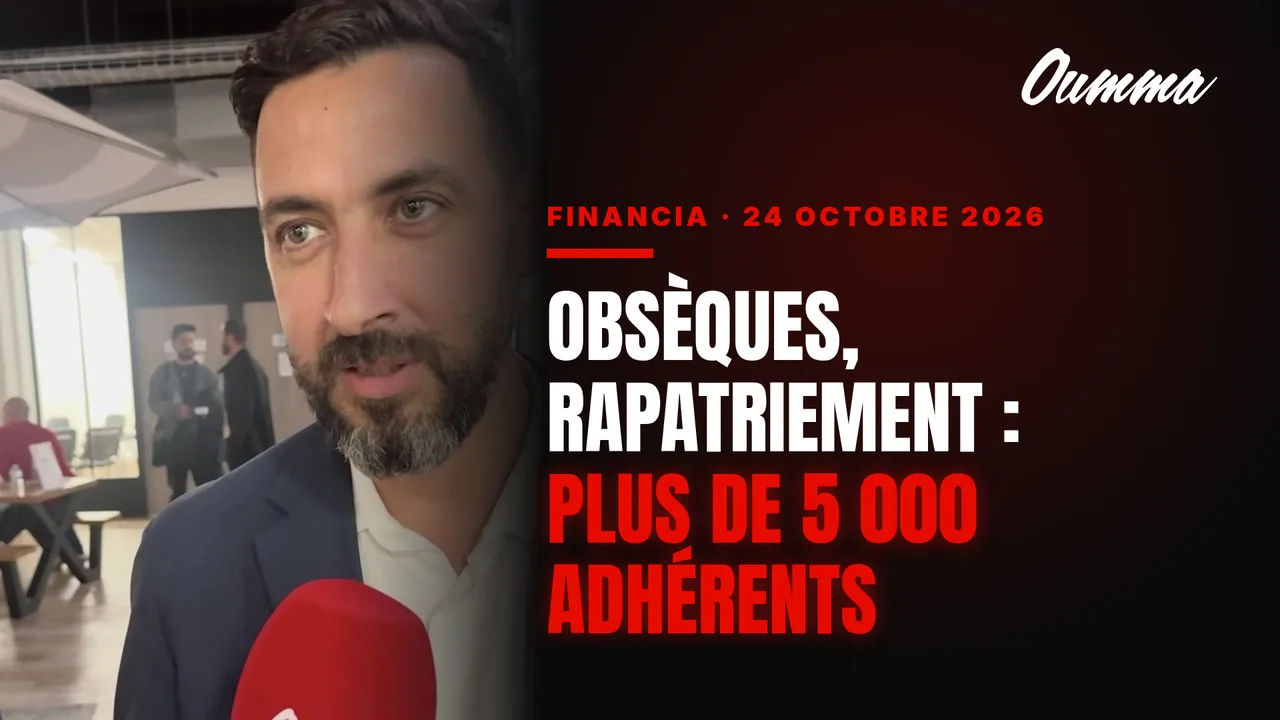
Who will pay for the funeral, and where will the deceased be buried? For many Muslim families in France, the question arises urgently, at the time of mourning. Ezzedine Ghlamallah, a teacher at the Financia Business School for five years, has devoted part of his entrepreneurial activity to it. Interviewed by Oumma on October 24, 2026, during the “Leading with your values, ethical journey & Islamic finance” day organized by the students of the 8th promotion of the Certificate of Islamic Finance, he presented Sakina Funérailles, a foresight solution to finance funerals and the repatriation of bodies.
A Marseille broker and dedicated insurance
“As far as I am concerned, I developed a company called SAAFI,” explains Ezzedine Ghlamallah. “It is a financial investment consulting and insurance brokerage firm. » According to the official business directory, SAAFI is a simplified joint stock company created in 2015 in Marseille, which he chairs, and whose declared activity is insurance brokerage.
The firm developed Sakina Funérailles, “intended to finance funerals and the repatriation of bodies to the countries of origin of the various Muslim diasporas in France”. Oumma presented the project in 2019, under the name Sakina Takaful. At its launch, the offer provided guarantees from 12 to 85 years, without medical questionnaire, and four levels of capital, from 2,000 to 7,000 euros. The capital could be paid directly to the funeral directors. These conditions may have changed since then.
The leader now claims “a little more than five thousand members, spread throughout France”. They come, he says, from “all communities: Moroccan, Algerian, Senegalese, Malian, Yemeni, etc. »
Repatriation, a still very widespread choice
There are no official statistics on the burial places of Muslims in France. However, estimates converge towards a large majority of repatriations. In April 2020, Mohammed Moussaoui, then president of the French Council of Muslim Worship (CFCM), estimated in an AFP dispatch that around 80% of the deceased are normally buried in their country of origin. Oumma already noted the same proportion in 2009, in an article on the long procession of burials in their native land.
This choice has a cost, and it assumes that the borders remain open. The pandemic has shown this. According to the same AFP report, Morocco and Tunisia had suspended the repatriation of bodies in spring 2020. Families found themselves without a solution, while the Muslim squares were already running out of space.
Burial in France: limited deadlines, rare places
Ezzedine Ghlamallah notes a new request: “We even have converts who wish to have a solution to finance the burial, not repatriation, but local burial, in France. » French law guarantees a burial. According to article L2223-3 of the General Code of Local Authorities, the municipality owes it in particular to people who have died on its territory and to those who are domiciled there.
The deadlines are set by article R2213-33 of the same code. Burial takes place at least twenty-four hours after the death and, since July 2024, no later than the fourteenth calendar day following. The prefect may grant exemptions. This setting matters to families who want a quick burial.
There’s still room. In 2020, the president of the CFCM estimated the number of Muslim squares at around 600, out of some 35,000 cemeteries. Some municipalities are expanding their spaces, such as Bourg-en-Bresse, which opened a square with 800 places in 2021. Elsewhere, saturation is causing drama, such as in Tours in 2022, where a child waited seventeen days before being buried.
What the law imposes on funeral contracts
Sakina is part of an already large market. According to an opinion from the Financial Sector Advisory Committee (CCSF) of October 8, 2024, France had around 5.3 million funeral insurance contracts in 2023. They cover around 190,000 deaths per year, or almost 30% of deaths. Contributions reached 1.8 billion euros in 2023, for around 0.74 billion in benefits paid, according to figures from France Assureurs taken up by the CCSF.
The law regulates these products. The capital must be allocated to carrying out the funeral, up to their cost (article L2223-33-1 of the General Code of Local Authorities). A contract which provides for services in advance must detail and personalize them (article L2223-34-1).
The CCSF also noted points for vigilance. The main one is the waiting period: from 3 to 24 months depending on the contracts, most often between 12 and 24 months. Death from illness during this period generally only gives rise to the reimbursement of contributions. Insurers have committed to limiting it to one year for contracts sold from July 1, 2025. Comparing these conditions remains the first precaution before any subscription, whatever the offer.
Takaful, insurance based on mutual assistance
What distinguishes SAAFI’s offering is its reference to takaful, insurance consistent with the principles of Islamic finance. As Oumma explained during the launch, takaful is based on mutualist and participatory principles: the offer is intended to be based on mutuality and solidarity between members.
Sakina was thus intended to cover funeral costs and, if necessary, repatriation, by integrating religious rituals and respecting the last wishes of the deceased. The designated beneficiary can be a loved one or directly a funeral home.
“We don’t have an actor who meets all needs”
Ezzedine Ghlamallah does not present Sakina as an answer to everything. “We don’t have an actor who meets all needs,” he admits. “There are a multitude of players who provide specific solutions to different needs. And so it goes from real estate financing to savings, including funeral planning. »
The observation echoes that of the other speakers of the day: the compliant offer exists in France, but it is split between small specialized players. For funerals, the question is all the more concrete as it affects all families, and is often resolved within a few days.
Find the full report and the other speakers of the day in our article Leading with its values: Islamic finance at the service of business leaders.
