Law 21 in Quebec: the Supreme Court rules on the hijab
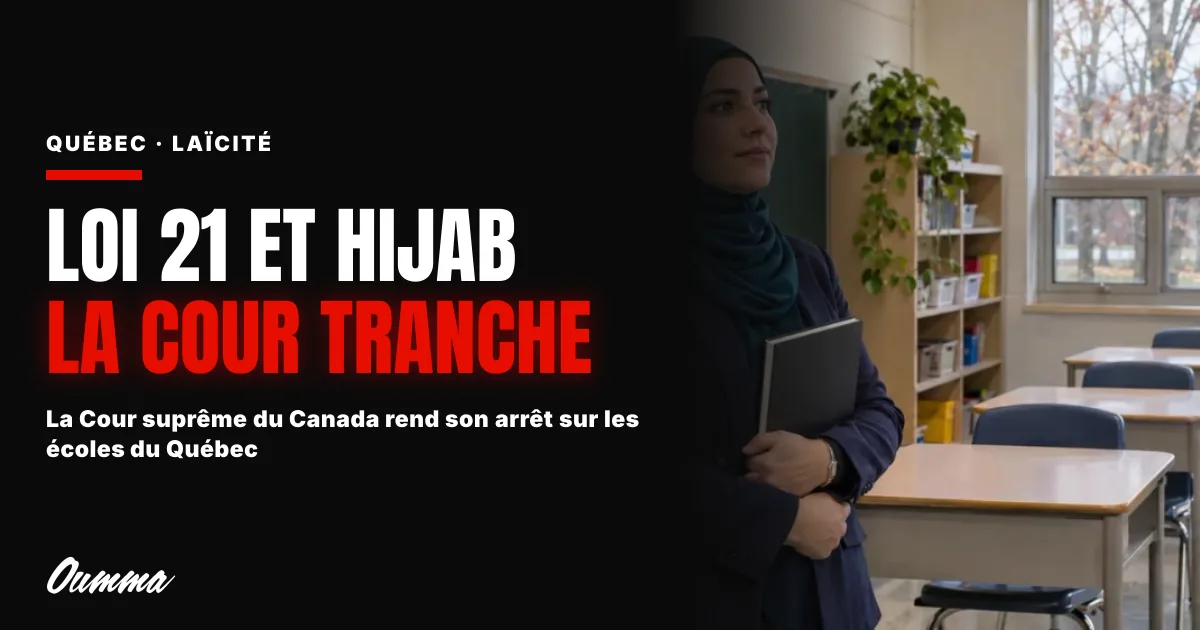
The Supreme Court of Canada must render its decision this Friday at 3:45 p.m. Paris time on Bill 21, which notably prohibits teachers in public schools in Quebec from wearing religious symbols in class. For Muslim women who wear the hijab, this ban compromises access to positions in public education. The ruling is expected across Canada, because it must also clarify the extent to which a province can derogate from rights protected by the Constitution.
In a notice published on November 20, the Supreme Court set the publication of its decision at 9:45 a.m. Canadian Eastern time. The country’s highest court heard the arguments of the parties from March 23 to 26, 2026. Seven years after the adoption of the law, it must rule on several appeals brought together in the same file.
What the law has changed in public schools
Adopted on June 16, 2019, the Law on State Secularism establishes the principle of the religious neutrality of the Quebec state. It prohibits the wearing of religious symbols in the exercise of their profession by several categories of public agents, including teachers, police officers and certain state lawyers. The hijab, the Sikh turban and the kippah are among the signs concerned. In France, the General Civil Service Code also imposes religious neutrality on public officials in the exercise of their functions. In December 2021, in Chelsea, western Quebec, Fatemeh Anvari was removed from her class because she wore the hijab. She taught in an English-speaking primary school. She remained at the facility, where she was assigned to a reading and diversity awareness project, according to The Canadian Press, a national news agency.
The National Council of Canadian Muslims, which defends the rights of Muslims in Canada, is contesting the law with the Canadian Civil Liberties Association, an organization defending civil liberties, and Ichrak Nourel Hak, who wanted to become a teacher in Quebec. According to them, the text has particularly serious consequences on the employment of women who wear the hijab. The government of Quebec, for its part, defends the validity of the law, as recalled in the summary of the case published by the Supreme Court.
To what extent can Quebec deviate from the rights guaranteed by the Charter?
To protect the law from certain challenges, Quebec invoked section 33 of the Canadian Charter of Rights and Freedoms, called the “notwithstanding clause”. This provision allows a province to enforce a law despite certain rights guaranteed by the Charter, including freedom of religion and the right to equality. The exemption is valid for a maximum of five years and can be renewed. Quebec renewed it in June 2024.
The Supreme Court must in particular say whether a court can find an infringement of these rights even when an exemption allows the law to continue to apply. The response will set the rules for all Canadian provinces that use this mechanism. The judges must also examine a question specific to Quebec, that of the recruiting power of the organizations that manage English-speaking public schools. The English Montreal School Board, which administers English-language public schools in Montreal, invokes the constitutional right of the English-speaking minority to manage its establishments. She won her case at first instance in 2021 on this point. But on February 29, 2024, the Quebec Court of Appeal ruled that the hiring rules set by Bill 21 did not infringe this right. This Friday’s ruling will say whether Quebec can, under this law, impose a ban on the wearing of religious symbols on teachers in English-speaking public schools.
Subscribe to the Oumma letter: our articles, our analyzes and our new programs arrive directly in your mailbox.
Free. One-click unsubscribe. Everything you need to know about Umma’s letter
