
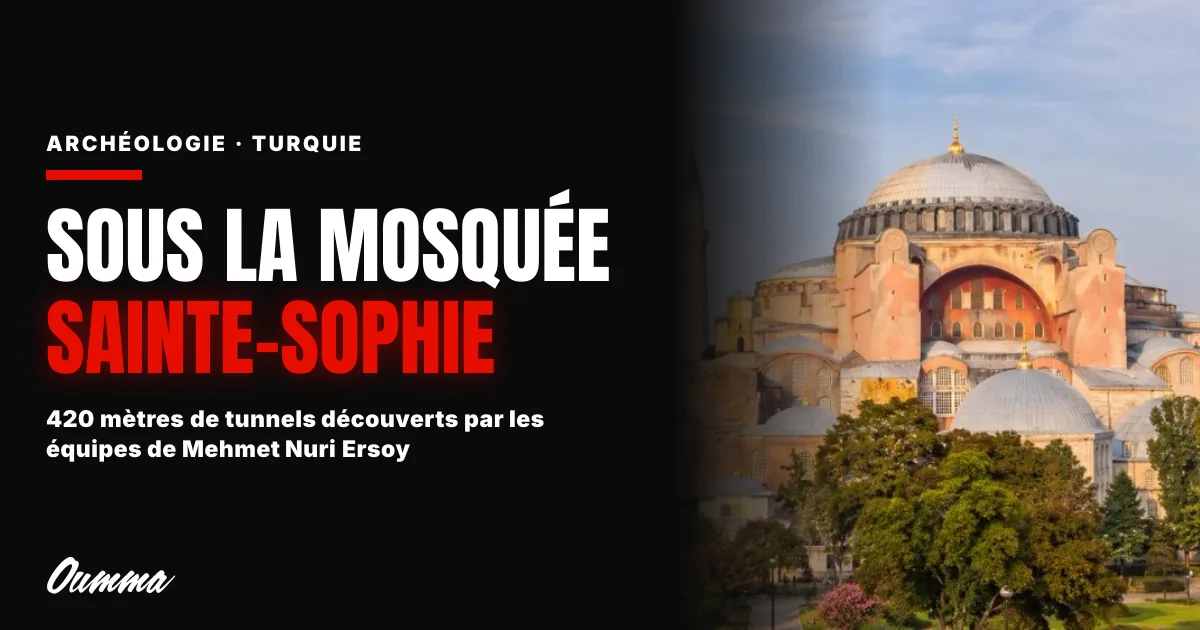
Hagia Sophia: 420 meters of tunnels discovered
By removing nearly 3,000 tonnes of fill from beneath the Hagia Sophia Mosque in Turkey, restoration teams have cleared a network of galleries, rooms and water pipes. Presented on November 20 by the Turkish Minister of Culture and Tourism, the results of these excavations provide new clues on the way in which water circulated in ancient Constantinople, today Istanbul. The ministry plans to open certain galleries to the public.
Remains unearthed under the ancient courtyard of Sainte-Sophie
The underground passages of Hagia Sophia have fueled stories for centuries and researchers already knew part of them. In the 1940s, excavations notably revealed a Roman funerary complex of four rooms, according to CNN. Current work makes it possible to identify new spaces and understand how they relate to those already studied.
The underground work began at the beginning of 2025 in the vaulted cellars of the old entrance courtyard, which has now disappeared. In one of the cellars, the rubble made it seem as if the room had stopped. The clearing revealed that it continued. In a study published in March 2026, researcher Hasan Fırat Diker, member of the scientific committee of Hagia Sophia, explains that laser surveys make it possible to draw plans of the rooms and galleries as they are cleared.
Teams located nine tunnels and six rooms. The mud, earth and rubble removed occupied approximately a thousand cubic meters. Some of these materials had been used to fill spaces where the vault had collapsed, in order to level the ground on the surface.
Under the so-called “Vizier’s” garden, the cleaning of an ancient underground tomb revealed remains which could be older than the current building, according to the ministry. Researchers are also studying a gallery that runs along the entrance facade of the Hagia Sophia. According to the minister, this passage, cleared for around 180 meters, could be linked to an old Roman road.
Clues to the circulation of water in Constantinople
According to Mehmet Nuri Ersoy, the underground network was used to distribute water and evacuate rainwater. One of the galleries leads to the Basilica Cistern, an ancient underground reservoir located nearby. Ahmet Güleç, member of the scientific committee of Hagia Sophia, explained to the press that water still circulates under the monument. It could come from an underground source or from the city’s old distribution network, of which the Valens aqueduct was part.
The current building was inaugurated in 537, under the Byzantine emperor Justinian. Initially a church, Hagia Sophia became a mosque in 1453, after the capture of Constantinople by the Ottoman Sultan Mehmed II. Opened as a museum in 1935, the monument has been a mosque again since 2020. It is one of Istanbul’s historic areas listed as UNESCO World Heritage Sites. The underground work is taking place in parallel with the restoration of the dome, the reinforcement of which should better protect the building against earthquakes.
The ministry plans to study opening certain galleries to visitors. The choice of accessible spaces will depend on their state of conservation and the arrangements necessary to accommodate the public in safety. No opening date has been announced.
Subscribe to the Oumma letter: our articles, our analyzes and our new programs arrive directly in your mailbox.
Free. One-click unsubscribe. Everything you need to know about Umma’s letter
