
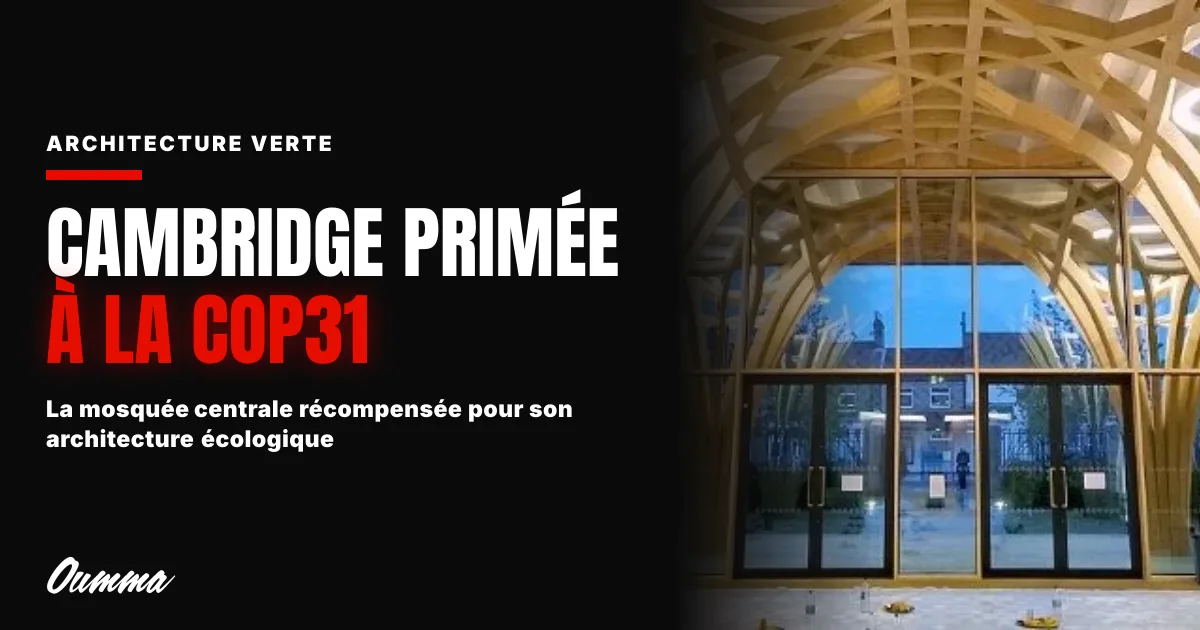
Cambridge Mosque: an ecological prize awarded
The Central Mosque of Cambridge, England, won an international award in the “green building” category on November 12 in Antalya, Turkey, during COP31, the United Nations climate conference. This distinction rewards both the design of the place of worship and its daily operation. From the roof which lets in light to the garden watered with rainwater, the mosque shows how a religious building can limit its energy and water needs.
Zeynep Coşkun Koç and Erdem Arıoğlu, both board members of the Cambridge Mosque Trust, the body responsible for the mosque, received the award on behalf of the establishment. The Turkish Ministry of Environment, Urbanization and Climate Change organized the ceremony within the conference grounds.
According to Zeynep Coşkun Koç, interviewed by the Turkish news agency Anadolu, this distinction brings to 24 the number of awards awarded to the mosque since its opening in 2019. The administrator hopes that this recognition will give other Muslim communities, beyond the United Kingdom, the opportunity to discover the project and be inspired by it.
Rainwater for the garden, natural light for prayer
To explain the choices that guided the construction, Zeynep Coşkun Koç takes the example of water. She cites a hadith, a word reported from the prophet Muhammad, which invites us to avoid waste. In Cambridge, this concern found a simple application. The mosque collects and stores rainwater. Once treated, it is used in particular to water the garden. The facility also uses reclaimed water for cleaning.
In the prayer room, dome-shaped openings bring in daylight and limit the use of electric lighting. The building, whose construction makes large use of wood, also benefits from natural ventilation. Sensors track indoor temperature and air quality.
The roof fulfills several functions. Solar panels produce part of the electricity consumed on site. A plant cover composed of sedums, low plants, contributes to the insulation of the building. For heating, heat pumps recover the heat present in the outside air. According to Erdem Arıoğlu, this equipment meets two interrelated objectives, reducing the mosque’s energy consumption and the carbon emissions associated with its operation.
A mosque born from cooperation between the United Kingdom and Turkey
The mosque was born out of cooperation between the Turkish Diyanet Foundation and the Muslim Academic Trust, a British organization headed by Abd al-Hakim Murad. According to Erdem Arıoğlu, administrators from the two countries worked together during the construction and then the opening of the place of worship. Their collaboration continued once the faithful were welcomed, to ensure the functioning of the mosque.
Seven years after its opening, the building also occupies a place in the cultural life of Cambridge, believes Zeynep Coşkun Koç. Tourists come to discover the architecture. Residents can also come through its doors for health awareness meetings.
The ecological commitment extends to young people, to whom the mosque offers to participate in voluntary actions in favor of the environment. The faithful also provide food aid to families in difficulty. For these Cambridge residents, the distinguished mosque in Antalya is also a place to find food for their homes.
