
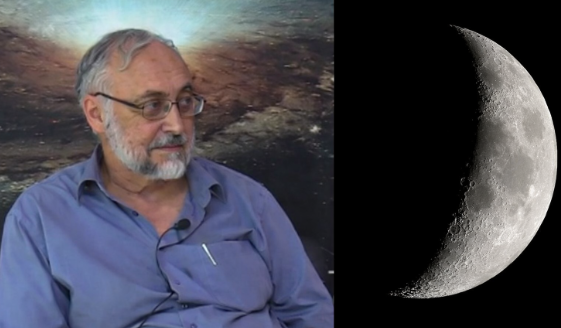
Eid el-Fitr 2026: what are the probable dates? Interview with eminent astrophysicist Jamal Mimouni
- Understanding the differences in Eid dates.
- Discover the role of astrophysics in determining dates.
- Explore the relationship between science and religious tradition.
As the end of Ramadan approaches, a question comes up every year with particular urgency: why do the dates of Eid still differ from one country to another, even though science today makes it possible to calculate the cycles of the Moon with extreme precision? This question is all the more acute in 2026 since, according to astronomical data, Eid al-Fitr should be celebrated in France on Friday March 20, while other countries could celebrate it on Saturday March 21.
Behind these persistent discrepancies, the entire relationship between scientific knowledge, religious tradition and community practices is posed. To shed light on this debate, which is both technical and deeply rooted in the realities of the Muslim world, the Oumma editorial team interviewed the eminent astrophysicist Jamal Mimouni(1). A recognized specialist in questions related to celestial mechanics and committed to the dissemination of scientific culture, he provides a rigorous and accessible look at the differences between the astronomical “birth” of the Moon and its real visibility, on the reliability of modern calculations, as well as on the issues of a possible harmonization of the Muslim calendar.
Between scientific precision and the diversity of legal approaches, this interview allows us to better understand why, despite advances in astronomy, the unity of dates remains a challenge for Muslim communities around the world.
What is the scientific difference between the astronomical “birth” of the Moon and its actual visibility with the naked eye, which remains the traditional method in many Muslim communities?
The astronomical birth of the Moon corresponds to the moment of conjunction, that is to say when the Earth, the Moon and the Sun are practically aligned in space. This event is a purely astronomical phenomenon that can be calculated and predicted with precision, because it results from the celestial mechanics governing the movement of these bodies. The alignment is usually not perfectly exact, otherwise it would produce a total solar eclipse, but it occurs every month as a conjunction, marking the astronomical start of a new lunar cycle.
The visibility of the crescent is a different reality: it depends on the moment when, after sunset, the very thin lunar crescent actually becomes observable near the horizon. This observation constitutes the traditional method adopted by classical Islamic jurisprudence to determine the beginning or end of lunar months. Thus, the astronomical birth is a calculable and universal event, while the visibility of the crescent is an observational phenomenon dependent on local conditions and serving as a practical basis for deciding the beginning or end of Ramadan and the celebration of Eid.
How do astronomical calculations make it possible today to precisely determine the birth of the lunar crescent which marks the end of Ramadan?
The determination of the astronomical birth of the Moon is based on celestial mechanics, based mainly on Newton’s laws of motion and their application to gravitational interactions between the Sun, Earth and Moon. The problem of the movement of the Moon is actually a three-body problem, more complex than that of two bodies, because the Earth’s orbit is strongly perturbed by the gravitational influence of the Moon, much more than the disturbances linked to the planets.
Thanks to theoretical progress made at the beginning of the 20th century, in particular with the work of the astronomer Ernest W. Brown, then to the introduction of modern numerical calculation methods, it is today possible to model this movement with very high precision. Astronomical ephemeris thus makes it possible to determine the exact moment of the conjunction to within a few seconds, that is to say the precise moment when the three bodies are aligned. This determination concerns only the astronomical birth of the crescent and not its visual observation, which depends on other factors.
Do current astronomical models make it possible to reliably anticipate the date of Eid several years in advance, or are there still uncertainties?
Modern astronomical models go beyond simple calculation of conjunction. They also make it possible to estimate the observability conditions of the lunar crescent, that is to say the probability that it can be seen from a given region of the globe. To do this, they take several parameters into account: the age of the Moon after conjunction, its height above the horizon at sunset, the angle of separation between the Moon and the Sun, as well as, in certain cases, atmospheric factors.
These models therefore make it possible to predict with great reliability in which regions of the world the crescent can be observed first, and whether this observation will be possible with the naked eye or only with optical instruments for each region. However, there remain small uncertainties linked in particular to atmospheric conditions and the physiological limits of human vision. Despite this, the different observability models used today by astronomers give very similar results and generally converge towards the same conclusions regarding the regions and times when the observation is most likely.
According to astronomical calculations, what should be the date of Eid in 2026 in most Muslim countries and in France?
The year 2026 presents a somewhat special situation, because the visibility of the crescent strongly depends on the regions of the world. In much of Asia and the Near East, astronomical conditions indicate that the crescent should not be visible on the evening of March 19, either with the naked eye or even with a telescope. In these regions, it will therefore be necessary to complete the month of Ramadan to thirty days, which would lead to celebrating Eid on Saturday March 21.
In the Maghreb countries, such as Algeria or Morocco, the situation is more marginal: calculations indicate a very low but not completely zero possibility of observing the crescent on the evening of March 19 in particularly favorable atmospheric conditions. If this observation is confirmed by the official observation committees, Eid could be celebrated on Friday March 20. However, from an astronomical point of view, this observation would be very difficult and it is more likely that these countries also complete the month at thirty days, which would place Eid on Saturday March 21st.
From an astronomical point of view, will the lunar crescent be visible on March 19, 2026 in certain regions of the world or in Europe?
Calculations show that the visibility of the crescent that day will vary greatly depending on the region of the globe. In the majority of countries in Asia, the Middle East and much of Africa, the crescent will either be impossible to observe or extremely difficult to detect, even with optical instruments. In the Maghreb and certain neighboring regions, visibility will remain marginal and will strongly depend on atmospheric conditions.
On the other hand, conditions will be much more favorable in North America, where the crescent should be visible relatively easily on the evening of March 19. Countries where communities, which will have started Ramadan on the same day as North Africa, will therefore be able to observe the crescent and celebrate Eid on Friday March 20 (read CFCM press release). South America, due to its different geographical position and the configuration of the Moon in relation to the horizon, will not benefit from the same favorable conditions. Overall, in Europe and in most regions of the Muslim world, visibility will remain difficult or marginal.
Why do we still observe differences in dates for Eid between certain Muslim countries, when science is capable of very precisely predicting the phases of the Moon?
These differences do not come from scientific uncertainty about the phases of the Moon, because they can be calculated with very high precision. Rather, they result from the methodologies adopted by different countries and their crescent observation committees, which are based on varying interpretations of Islamic jurisprudence.
Some countries require direct visual observation with the naked eye, others accept the use of optical instruments such as telescopes, while some also take into account observations made in other regions of the world. These approaches have evolved over time: for example, the use of observation instruments is now accepted in certain countries whereas it was not previously. Science can therefore predict lunar phases and observability conditions, but it cannot impose a single date as long as the legal and methodological criteria remain different from one country to another.
7- Do you think that a global harmonization of the Muslim calendar, based on astronomical calculations, is scientifically possible today?
From a scientific point of view, the establishment of a unified lunar calendar is entirely possible today, because astronomical calculations make it possible to accurately predict the phases of the Moon and the conditions of observability of the crescent for all regions of the globe. However, the establishment of such a calendar would above all require a consensus between the different religious and legal authorities in the Muslim world. The fundamental condition is that it is both functional and without any ambiguity in the dates it indicates.
A unified calendar will be based not only on the astronomical conjunction, but also on criteria for the observability of the crescent, that is to say the real possibility of seeing it under certain conditions. This is the stumbling block of certain calendars, in particular that of the so-called Saudi Umm al-Qura which does not do it adequately and which the Saudi authorities are often singled out as de facto arranging the acceptance of observation reports so that they agree with this calendar. Several proposals exist, notably those resulting from international conferences such as that of Istanbul in 1977, which attempted to define consensual criteria. The astronomers Mohamed Odeh from Jordan, Nidhal Guessoum from Algeria and Muhammed Ilyas from Malaysia in particular, have contributed greatly to this question. If an agreement were found between jurists and astronomers on these criteria, it would then be possible to establish a practical global Islamic calendar allowing the beginning and end of each month to be determined in advance, while remaining consistent with the classical principles linked to the observation of the crescent.
Comments collected by the Oumma editorial staff
(1) Jamal Mimouni is an Algerian astrophysicist, doctor in particle physics from the University of Pennsylvania (United States), where he defended his thesis in 1985. A committed researcher and intellectual, he actively participates in debates on the relationships between science, society and culture in the Muslim world, while working to spread scientific culture.
He is also president of the Sirius Astronomical Associationa very active structure in the popularization of astronomy in Algeria. Alongside his scientific activities, he is interested in the interactions between science and religious thought.
Jamal Mimouni is co-author, with the physicist Nidhal Guessoum, of a popular science work in Arabic, The history of the Universe: from ancient conceptions to the Big Bangand also contributed to the collective academic work Science and Religion in Islam.
