Islamic finance: the British model according to Omar Khaliel
Riba Free Foundation leader describes UK Islamic finance market; the numbers show what the state has put in place there.
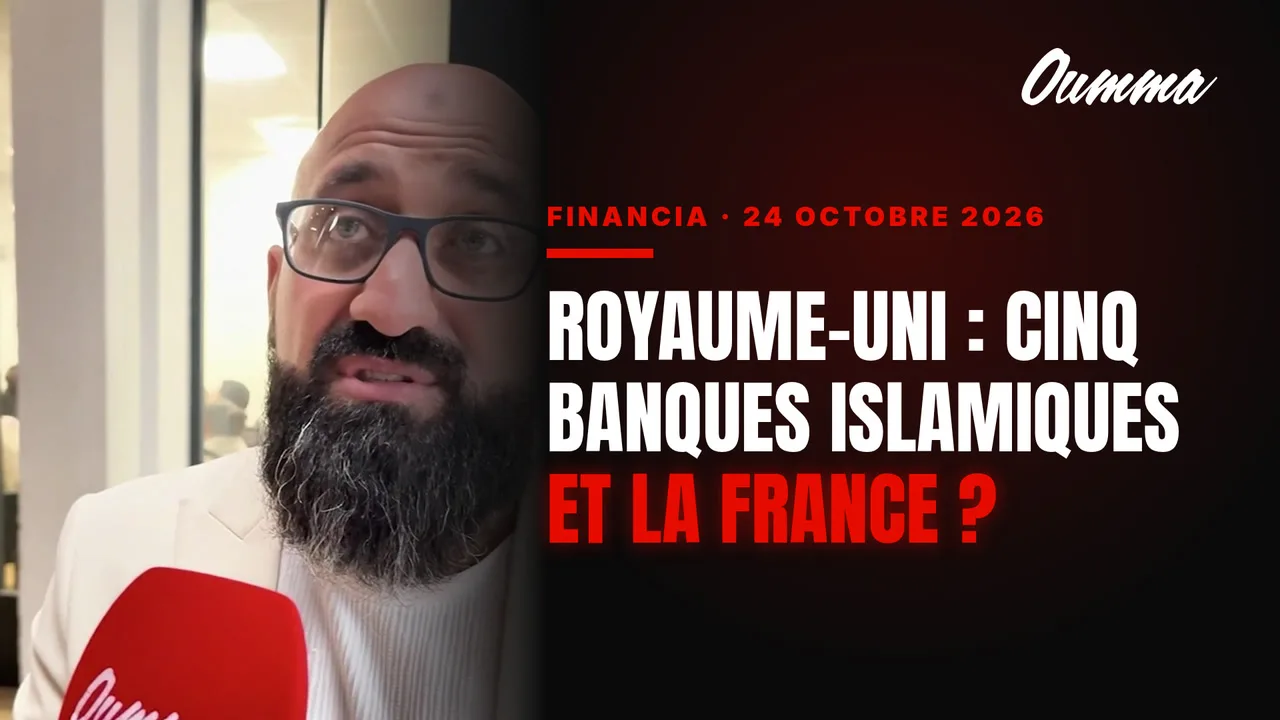
Guest of honor at the graduation ceremony for the Islamic Finance Certificate at the Financia Business School on October 24, 2026 in Paris, Omar Khaliel came from London. He runs the Riba Free Foundation, a UK charity which helps individuals live interest free. In front of Oumma’s camera, he outlined the state of the British market: Islamic banks, “windows” in traditional banks and a wave of fintechs. France, he said, is “only at the very beginning”. His remarks, spoken in English, are translated by the editorial staff.
“The most Western Islamic finance market in the world”
The Riba Free Foundation has been registered with the Charity Commission, the regulator of charities in England and Wales, since January 19, 2024. Its mission, according to the register: to help people of all faiths, or no religion, live free of interest and usury, through education, advocacy and referral to suitable products. Omar Khaliel signs his first annual report as general manager.
For him, the United Kingdom is “arguably the most Western Islamic finance market in the world”. It has existed there, he says, “for perhaps thirty, almost forty years”. History proves him right. According to the Pakistani daily Business Recorder, the Al Baraka bank opened a branch on Whitechapel Road, in east London, in 1987, before surrendering its banking license in June 1993.
The real start dates from 2004. In August of that year, the financial authority at the time, the FSA, granted its license to the Islamic Bank of Britain, the country’s first Islamic retail bank, reports Arab News. Having become a subsidiary of the Qatari group Al Rayan (formerly Masraf Al Rayan), it is today called Al Rayan Bank UK.
Five banks, windows and a still modest weight
“Today in the UK we have five Islamic banks. We have two or three Islamic windows backed by conventional banks. » A window is a sharia-compliant service housed in a traditional bank, with its own products and its own religious oversight.
The count varies depending on the sources. The Fitch rating agency, which rates only two British Islamic banks, reports that news has emerged in 2024: the former Ahli United Bank (UK) has become Kuwait Finance House. The Bank of England, in an October 2025 presentation, clarifies that this bank is still in transition to full Sharia compliance. Fitch also notes that Gulf investors are the main shareholders of all British Islamic banks.
Their weight remains low. According to Fitch, assets of UK Islamic banks reached $11.4 billion at the end of 2024, up 38% year-on-year. But they represent only 0.1% of the country’s banking assets.
A “very promising” Islamic fintech
The most visible growth comes from technology. “More than twenty fintechs offer a whole range of services: auto financing, real estate financing, stocks, investments, insurance, and so on. » Fitch even has more than 50, including a fully digital Islamic bank. For Omar Khaliel, the explanation is simple: technology “opens up wider access to products and services that were not accessible to the general public before”.
The market also moves through buyouts and launches. According to Fitch, Offa took over Bank of Ireland’s Islamic real estate financing portfolio at the end of 2024, and Europe Arab Bank launched an Islamic banking offering in May 2025. On the savings side, Islamic funds domiciled in the United Kingdom managed more than $12.5 billion at the end of June 2025, up 22.1% year-on-year, 84% invested in equities.
What the British state has put in place
This landscape was not born from the market alone. The public authorities have amended the law so that Islamic finance is not penalized. The Finance Act of 2003 resolved a concrete problem: in Islamic real estate financing, the property changes hands twice (the bank buys it, then resells it or transfers it to the client). According to the HMRC manual, transfer duty is only paid once, as with a traditional loan. In 2006, home purchase plans, these Islamic real estate purchases, entered the field of financial regulation, recalls the firm Norton Rose Fulbright.
The doctrine is contained in a formula, pronounced in November 2007 by Callum McCarthy, then president of the FSA and reported by WealthBriefing: no obstacles, but no particular favors.
The State is also committed on its own behalf. In June 2014, the United Kingdom became the first Western country to issue a sovereign sukuk: 200 million pounds, against a demand of around 2.3 billion, according to the British Treasury. A second issue of 500 million pounds followed in March 2021, maturing on July 22, 2026. Fitch indicates that no new issuance is planned for 2025-2026.
There remained a technical obstacle. A bank must keep liquid reserves, often deposited with the central bank against interest. In December 2021, the Bank of England opened an interest-free liquidity facility, backed by Islamic Development Bank sukuk. It extended it in 2025, from 200 to 550 million pounds. The government is finally preparing a Sharia-compliant student loan, starting in the 2026-2027 academic year, according to Fitch. The London Stock Exchange accounts for more than 40% of global sukuk listings in hard currencies.
“Not yet the infrastructure or the products”
The contrast with France is clear. The Muslim community is nevertheless important there, Omar Khaliel underlines this. As of the 2021 census, 3.9 million people identified as Muslim in England and Wales, or 6.5% of the population, according to the Office for National Statistics (ONS). France does not list religions. The Trajectories and Origins survey by INSEE and INED gives an order of magnitude: in 2019-2020, 10% of 18-59 year olds in mainland France declared themselves Muslim.
On the infrastructure side, the gap is measured point by point. In 2009 and 2010, France published tax instructions on murabaha, sukuk, ijara and istisna. It has even adjusted the registration fees for real estate murabaha: the purchase by the bank falls under the purchase-resale regime, taxed at a reduced rate, according to the Official Bulletin of Public Finances. But the article of law which was to facilitate the issuance of sukuk was censored by the Constitutional Council in October 2009, for procedural reasons, and was not taken up again. The State has never issued a sukuk. A thesis defended in 2025 at the University of Tokyo notes that no Islamic bank has received approval in France, and that Chaabi Bank, a subsidiary of the Moroccan group Banque Populaire, remains the only significant retail offering there.
The subject is not new in our columns: Oumma already headlined “Paris dumped by London”, and asked the question “Islamic banking in France, dream or reality? “. The promises of Islamic banks in France have remained unfulfilled. London, for its part, continues to attract players in the halal economy.
Omar Khaliel insists on one word: “not yet”. He says he is encouraged by the passion he sees in student promotions, and predicts that France can “explode” in this market within five to ten years. On October 24, more than twenty-five graduates received their certificate or Executive MBA in Islamic finance.
Find the full report and the other speakers in our article Leading with your values: Islamic finance at the service of business leaders.
