
Jawdat Saïd, the “Muslim Gandhi”: another path for Islam
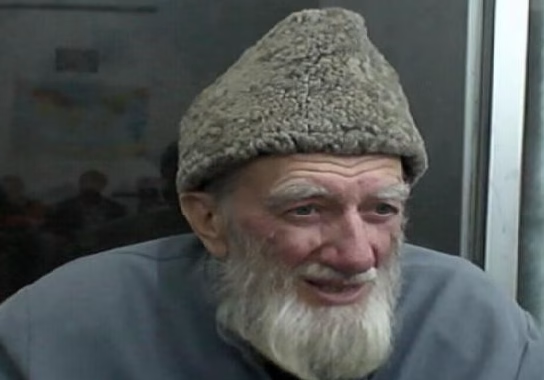
- Discover Jawdat Saïd’s unique vision on non-violence.
- Explore his call for individual responsibility and knowledge.
- Understand the importance of his thought in the current context of Muslim societies.
Disappeared in 2022 in Istanbul, Jawdat Saïd remains a unique figure in contemporary Muslim thought. Little publicized, often marginalized, he nevertheless carried a strong idea throughout his life: non-violence is not foreign to Islam, it is an essential dimension. In a world marked by conflicts, dominations and identity tensions, his thoughts appear today to be extremely relevant.
Born in 1931 in the village of Bir Ajam, on the Syrian Golan Heights, Jawdat Saïd grew up in a rural environment marked by simplicity and a sense of community. Very early on, he turned to religious studies before leaving for Al-Azhar, in Cairo, one of the largest institutions in the Muslim world. It is there that he forms part of his thinking, discovering both the riches of the Islamic tradition and the limits of certain fixed readings. Marked by the great reformist figures, but also by the political upheavals of the Arab world, he developed original thinking, centered on individual responsibility, knowledge and the refusal of violence. Back in Syria, he leads a discreet life, between writing, transmission and working the land, refusing the logic of power such as media promotion. This trajectory, both humble and deeply coherent, illuminates the strength of its message: an Islam experienced as an ethic of inner transformation, in the service of human dignity, and not as an instrument of confrontation.
A reading of the Koran oriented towards responsibility
Jawdat Saïd follows in the tradition of Muslim reformist thinkers, but with a very direct and accessible approach. For him, the main problem of Muslim societies is not the religion itself, but the way in which it is understood, transmitted and instrumentalized. He emphasizes the idea that change cannot come only from the outside, nor be imposed by force. It is based on a central principle of the Quran: “God does not change the state of a people until they change what is in themselves. » This verse, according to him, expresses a universal law: no lasting transformation is possible without inner work. This means that societies must first evolve in terms of thought, education and values before claiming to transform their political or social reality. It is an invitation to move away from the logic of victimization and reflexes of domination.
In this perspective, Jawdat Saïd gives a central place to knowledge. He considers that the backwardness of the Muslim world is not due to a deficit of faith, but to a deficit of understanding. Religion, according to him, must never serve as an alibi for violence or domination, but be a lever for elevation, lucidity and responsibility.
Non-violence as an Islamic principle
One of Jawdat Saïd’s strongest contributions lies in his radical rereading of the question of violence. Contrary to certain preconceived ideas, it does not draw on external references, but directly on the Koranic text. He particularly highlights the story of Adam’s two sons, where one refuses to respond to violence with violence: “If you stretch out your hand to kill me, I will not stretch out my hand to kill you. » For him, this passage is not anecdotal. It carries a fundamental orientation: violence is neither a religious obligation nor a historical inevitability. It is a human choice — and, very often, a dead end. He sums it up in a clear formula: “Ignorance is the cause of violence. »
In other words, the further a society moves away from knowledge, reflection and ethics, the more it falls into brutality. Conversely, knowledge, education and understanding open the way to fairer, more dignified and more effective forms of engagement.
A necessary thought today
Jawdat Saïd has always refused to legitimize violence, whether that of authoritarian regimes or that of movements claiming to be Islam. He rejected the idea that power could be won or maintained by force. For him, violence only perpetuates what it claims to fight. This position caused him to be marginalized for a long time. In a media space often dominated by the loudest and most radical speeches, voices calling for patience, domestic reform and non-violence are rarely heard. However, his influence is real. In Syria in particular, certain activists have attempted to build forms of peaceful resistance inspired by his thinking, despite a context of extreme brutality.
Today, rediscovering Jawdat Saïd is not a simple intellectual exercise. It’s a necessity. His thinking opens a path that is demanding but deeply faithful to the spirit of the Islamic message: a path that rejects the inevitability of violence and rehabilitates human responsibility.
Jawdat Saïd may not have been a media figure. But he asked an essential question, disturbing and liberating at the same time: what if real change really started with ourselves?
