“Under this tree there never sat but a prophet. » Well before the Revelation, a monk from Syria uttered this sentence upon seeing Mohamed. A servant hears it and reports it to his mistress in Mecca. Her name is Khadija. And it is she who will ask Mohamed to marry her.
A woman who makes men work
At this time, at the end of the 6th century, Mecca lived on trade: the people of Quraysh1 are merchants. Khadîja, daughter of Khuwaylid2is one of them. She is noble, she is rich, and she is a trader.
She does not drive the caravans herself. She hires men, entrusts them with her goods and gives them a share of the profits.3.
A name often comes to his ears: that of a young man from Quraysh, Mohamed. They say he never lies. They say we can entrust him with everything. He is also said to have a remarkable character.
Khadîja sends for him. She offers to lead a caravan to Syria4with better conditions than those of all its other agents. One of his servants, Maysara5will accompany him. Mohamed accepts.
The monk’s tree
In Syria, Mohamed stops in the shade of a tree. Nearby is a monk’s hermitage6.
The monk calls out to Maysara: “ Who is this man sitting under the tree? »
“ A man of Quraysh, people of the sanctuary »7Maysara replies.
The monk continues: “ Under this tree there never sat but a prophet. »
The monastery of Saint Moses the Abyssinian (Deir Mar Musa), in the desert mountains north of Damascus, Syria, photographed in 2010. The text does not say where the monk in the story lived: the image shows a place of monastic life in Shâm. Photograph by Bernard Gagnon, CC BY-SA 4.0, via Wikimedia Commons.
Two shadows on the road home
Mohamed sells his goods and buys what he came for. Then the caravan takes the road to Mecca.
It is there, according to what is said, that Maysara sees a strange thing. At the hottest time of the day, when Mohamed advances on his camel, two angels overshadow him.8
In Mecca, Khadîja resells the merchandise brought back. She doubles her stake, or almost.
Maysara tells him everything: the monk’s words, then the two angels he saw protecting Mohamed from the sun.
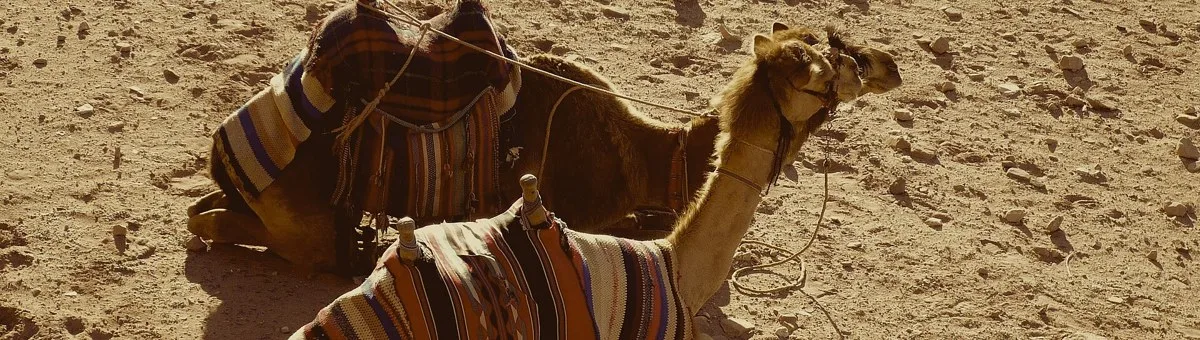
Saddled camels resting in the desert, in 2008. The camel was the animal of the caravans which linked Mecca to Shâm. Photograph by Bruno Befreetv, CC BY-SA 3.0, via Wikimedia Commons.
The request
Khadîja is a determined, noble and intelligent woman. And God reserves great honor for him. After Maysara’s story, she calls for Mohamed. According to tradition, she speaks to him like this9 :
“ Cousin, I like you. For our kinship, for the rank you hold among yours, for your honesty, your good character and your frankness. »
Then she asks him to marry her.10
There is nothing trivial about the proposal. Khadîja is then the best-born, most respected and richest woman of Quraysh. All the men in her clan would have wanted to marry her, if they could.
The wedding
Mohamed tells his uncles about it. One of them, Hamza11accompanies her to Khuwaylid, Khadîja’s father, to ask for her hand. The marriage is concluded.12
Mohamed is twenty-five years old13. He offers Khadîja a dowry14 twenty young camels.
Khadîja is his first wife. As long as she lives, he will marry no other15.
A family
All the children of the Prophet will be born to Khadija, except one.
They will have three sons: al-Qâsim, al-Tayyib and al-Tâhir. The eldest, al-Qâsim, will give the Prophet his nickname, Abû al-Qâsim16. The three boys will die before Islam17.
They also had four daughters: Ruqayya, Zaynab, Umm Kulthûm and Fâtima. All four will know Islam. They will convert and emigrate with their father18.
The only child who is not from Khadîja, Ibrâhîm, will be born much later to Mary the Copt19. She came from a village in Egypt, and al-Muqawqis20 offered it to the Prophet.
Waraqa’s impatience
There remains one person to whom Khadîja entrusts everything: her cousin Waraqa ibn Nawfal21. He is a Christian and knows the Scriptures.
She repeats to him what Maysara saw and heard. Waraqa responds:
“ If this is true, Khadîja, then Mohamed is the prophet of this people. I knew a prophet was expected. His time has come. »
These are his words, or almost.
Then time passes. Waraqa gets impatient: “ Until when? »
He makes a poem out of it. He hopes that Mohamed will become the guide of his people and bring light to the world. He wishes to still be alive that day, to be the first to follow him, even against the advice of Quraysh.
According to the Sira of Ibn Hisham (chapter “The marriage of the Messenger of God with Khadîja”), itself taken from the biography of Ibn Ishaq. Story adapted into modern French: the chains of transmission and the genealogies have been removed, Waraqa’s poem is summarized; no facts were added to the story. The editorial notes provide context.
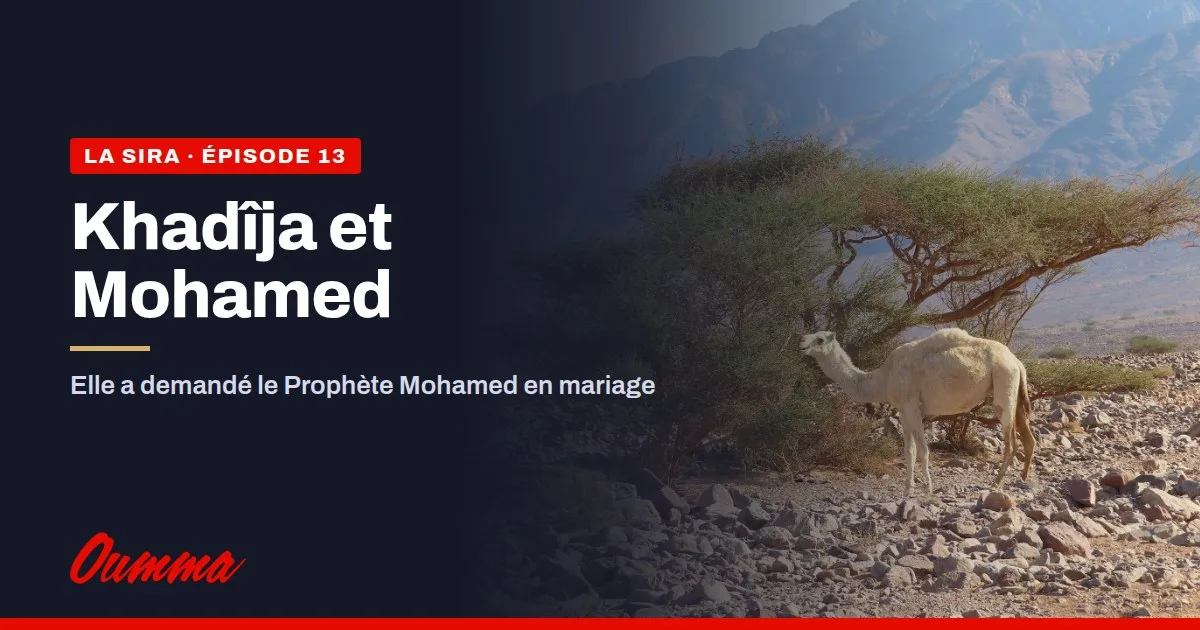
Cover image: A camel under an acacia tree in Wadi Araba, Jordan, 2021, photograph by Fallaner (CC BY-SA 4.0, via Wikimedia Commons), adapted by Oumma.
Muhammad
Muhammad is a visionary thinker and passionate writer who has been contributing to Understanding Islam for several years.