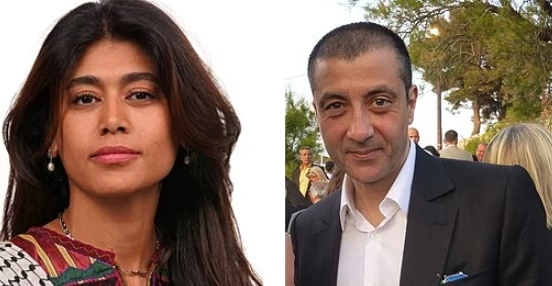
The controversy surrounding Rima Hassan highlights media tensions regarding pro-Palestinian voices.
WHY READ:
- Analysis of Mourad Boudjellal’s comments on the media treatment of Rima Hassan.
- Reflection on freedom of expression and pluralism in France.
- Context of positions taken in favor of Palestine in public debate.
The controversy surrounding Rima Hassan continues to provoke strong reactions in public debate, in a context where positions in favor of Palestine are increasingly targeted. Indirectly invited into the discussions of the show Les Grandes Gueules, her situation was raised following her custody, at the heart of a media frenzy revealing a criminal treatment that has become recurrent against dissident voices. On the set, Mourad Boudjellal delivered a remarkable intervention (see video at the end of the article), calling for the controversy to be put into perspective. If he says he does not share all of Rima Hassan’s positions, he nevertheless insists on the legitimacy of his commitment : “Even if his fight, I don’t agree with everything, I understand it. A fight for a Palestinian state, of course. » For him, the heart of the problem lies elsewhere: in the way in which certain public figures are exposed and targeted. He warns against a caricatured reading : “In this fight, she cannot support anyone, anything, on that I agree. But that doesn’t justify everything we see today. »
“A disturbing origin”
In a straightforward statement, Mourad Boudjellal also points out what he considers to be a deep bias in media treatment. :“Rima Hassan, she has a big flaw: she is of Palestinian origin. And today, in this country, it is not good. »According to him, this reality directly influences the way in which certain speeches are received. He also criticizes a dominant view of the conflict:“We decided that certain deaths were almost legitimate… because we would be the good guys and they would be the bad guys. »
Inverted priorities and variable geometry outrages
The columnist goes further by denouncing a questionable hierarchy in publicized scandals. He compares Rima Hassan’s situation to other cases that he considers more serious:“I am more shocked to see someone with an arrest warrant from the International Criminal Court strutting in the media than to see Rima Hassan. »Referring to Benjamin Netanyahu, he continues:“I am also more shocked by elected mayors with rape cases than by Rima Hassan who has CBD in her bag. »
For him, this controversy reveals a profound imbalance in the processing of information: “Honestly, in the current context, this is not what shocks me the most. There are much worse things in the country. »
Beyond the individual case of Rima Hassan, this sequence highlights a climate of neo-McCarthyism around speeches linked to Palestine. Between accusations, amalgamations and media pressure, many voices denounce an implicit restriction of the debate. Mourad Boudjellal also warns of a risk of double standards in public spaces : “If we reversed certain comments heard in the media, some would fall within the scope of the law. » The columnist’s intervention is thus part of a broader criticism: that of a media space where certain opinions become difficult to hear, not only for what they say, but for what they embody.
In a landscape crossed by deep fault lines, the Rima Hassan affair therefore appears to be the symptom of a more global malaise, questioning the real place of pluralism and freedom of expression in France.