
Ramadan 2026: according to astronomical data, fasting begins on Thursday February 19
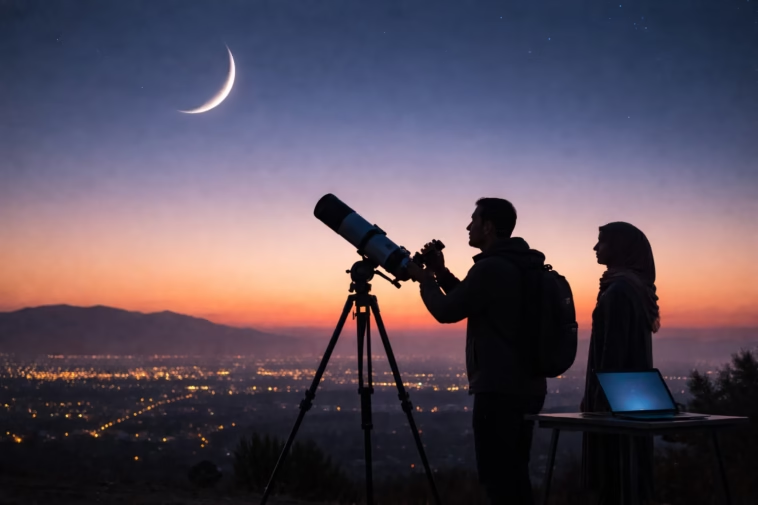
- Understand the scientific basis of the start of Ramadan.
- Discover the role of the CFCM in determining dates.
- Understand the importance of lunar observation in the Muslim calendar.
As Ramadan 2026 approaches, astronomical data provide decisive details on the start date of the month of fasting. Scientific calculations show that it will be impossible to observe the lunar crescent on the evening of Tuesday, February 17, 2026, which excludes the start of Ramadan on Wednesday, February 18 in countries that rely on the actual observation of the crescent.
Ramadan is one of the most important months in the Muslim calendar. It is marked by daily fasting, as well as strong spiritual, family and social practices. Its start date is based on the Hijri calendar, a lunar calendar in which each month begins with the appearance of the new crescent moon.
What the astronomical data says
For Ramadan 1447H, the lunar conjunction — moment when the Moon and the Sun are aligned — will take place on Tuesday February 17, 2026 during the day. This information appears in the official ephemeris published by theParis Observatorythrough the Astronomical Data Guide 2026scientific reference in France for the lunar phases and the positions of the stars:
However, the astronomical existence of the new moon does not mean that the crescent is visible. THE astronomical data of rising and setting of the Moonavailable in particular via the lunar phase tables for France, show that on the evening of February 17, the Moon will be too young, too close to the Sun and will set almost at the same time as it, making any observation impossible:
Scientific models of the visibility of the crescent confirm that neither naked eye nor instrumental observation is possible that evening. This impossibility is reinforced by the occurrence of a annular solar eclipse on February 17, 2026a sign of an almost perfect alignment between the Moon and the Sun, as documented in international astronomical publications.
The first evening favorable to observation
According to all of the astronomical crescent visibility datathe first evening where the observation becomes realistic is the Wednesday February 18, 2026 in the eveningwhen the Moon is old enough and further away from the Sun. Crescent visibility tables, used by many religious and scientific institutions, clearly indicate that the crescent can only be observed from this date: Based on this, countries that require effective observation of the lunar crescent should complete 30 days of the month of Shaabane and begin Ramadan on Thursday February 19, 2026.
The position adopted in France
In France, the French Council of Muslim Worship relies on astronomical calculation while taking into account the official astronomical data and the reality of lunar visibility. French scientific references, in particular those from the Paris Observatory and the historical publication Knowledge of the Timesconfirm that observing the crescent is impossible on February 17 and possible from the evening of the 18th:
On this basis, the CFCM announced that the first day of Ramadan 2026 in France will be Thursday February 19consistent with established scientific data and the majority of the Muslim world.
THE official astronomical data provide total clarity: a start of Ramadan on Wednesday February 18, 2026 is excluded according to the visibility criteria of the lunar crescent. Accordingly, Ramadan 2026 will begin on Thursday February 19in France as in the vast majority of Muslim countries. This convergence illustrates the central role of astronomical knowledge in informing religious decisions, on solid and verifiable scientific bases.
