
Recognition of the Palestinian state: the United Kingdom, Canada, Australia and several other countries will take the plunge
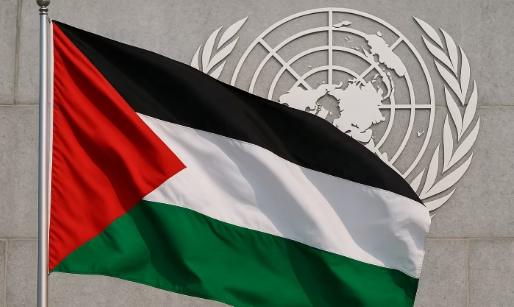
The noose tightens around Israel. After Spain, Ireland and Norway, ten new countries announced their intention to recognize the Palestinian state at the next UN general assembly in September. These are Australia, Canada, New Zealand, Finland, Luxembourg, Portugal, Saint-Marin, Malta, France and Belgium. This international mobilization, carried out in particular by a Franco-Saudi initiative in New York, marks a major diplomatic turning point.
Even the United Kingdom, long subservient to Israeli positions, announces a change of course. Prime Minister Keir Starmer said London will recognize Palestine’s state in September, unless Israel takes clear commitments, starting with an immediate cease-fire in Gaza, the end of the Cisjordan annexed projects and the acceptance of a real peace process. The British government also demands that Israel will allow the return of UN humanitarian aid to the besieged Gaza Strip. London thus follows the steps in Paris, confirming the emergence of a Western front which no longer wants to cover war crimes by diplomatic silences.
Faced with this dynamic, Israel adopts the posture of denial and threat. His UN ambassador, Danny Danon, violently castigated these states, accusing them of “Legitimize terrorism”as if recognizing the rights of an occupied people was a moral fault. An expected reaction, which especially shows the growing isolation of a state which locks itself up in a colonial, violent and inflexible logic. But the tone changes on the international scene. The Luxembourg Minister for Foreign Affairs, Xavier Bettel, recalled a truth that many no longer dare to say: “Israel only understands the pressure.” An observation shared by his Irish counterpart, Simon Harris, who sees in this recognition a way of relaunching a peace process that Tel Aviv has been trying for years to bury under the rubble of Gaza and the checkpoints of West Bank.
While some Asian countries such as Japan, Singapore or South Korea have abstained, their support in principle to the two -state solution remains intact. As for Australia, it conditions its commitment to the exclusion of Hamas from the future Palestinian government – a requirement which, if it may seem pragmatic, mainly reflects a diplomatic reluctance which does not resist the urgency of the situation. By recognizing the Palestinian state, these countries send a clear message: the time of compromises with the colonial state responsible for the current genocide in Gaza is over. It is no longer the Palestinians to prove their right to exist, but the international community to enforce it.
