Religious demographics: more Muslims
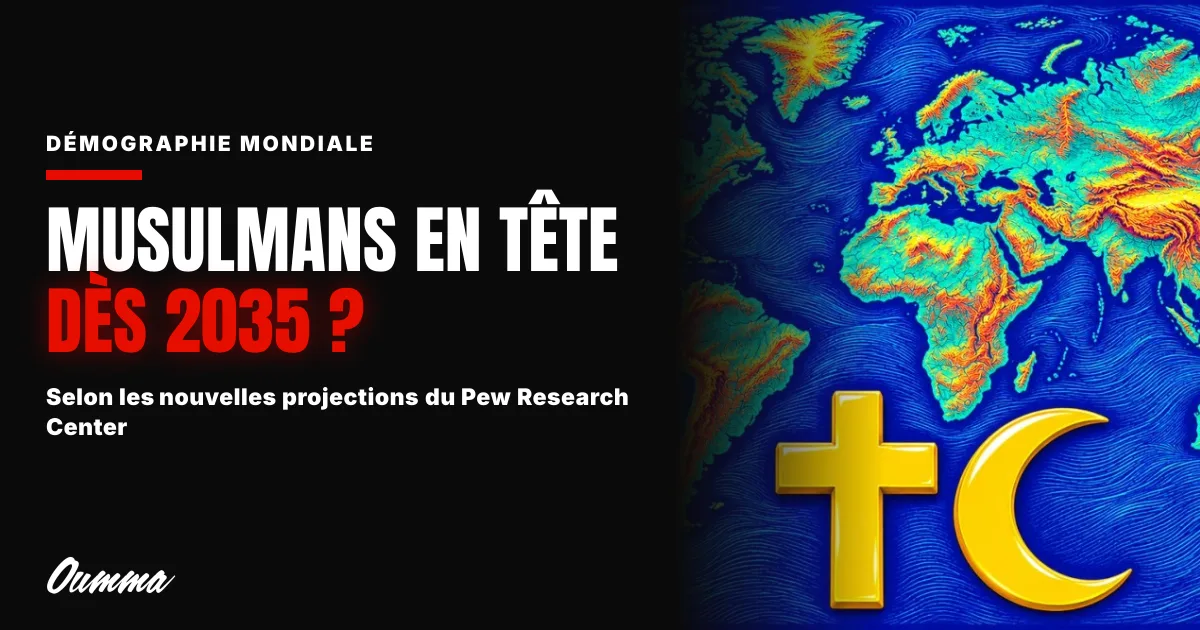
In 2020, Christians were the largest religious group in the world, with approximately 250 million more people than Muslims. According to the study published on November 18 by the Pew Research Center, Muslims could become more numerous as early as 2035, even as the Christian population continues to grow. The youth of the Muslim population largely explains this development, which will play out in particular in South Asia and sub-Saharan Africa.
Why is the Muslim population growing faster?
The Pew Research Center studies changes in society using surveys, censuses and demographic data. For this study, its researchers started from the estimated numbers in 2020, i.e. 2.27 billion Christians and 2.02 billion Muslims. They then calculated how these populations might change by taking into account age, births, deaths, migrations and changes in religion over the lifespan.
Age is one of the elements that weighs the most in this calculation. In 2020, half of the world’s Muslims were under 24 years old. Among non-Muslims, half of the population was under 33 years old. Among Muslims, the generations reaching the age to found a family are therefore particularly numerous. Added to this is a fertility gap. For the period 2020-2025, researchers estimate the global average at 3.1 children per Muslim woman and 2.5 per Christian woman, with significant differences from one country to another.
By 2070, Pew predicts that fertility among Muslim women will decline to 2.2 children per woman. How then can we explain the 80% increase announced over fifty years? When young adults are very numerous, the total number of births can remain high, even if each family has fewer children on average than the previous generation.
If these projections come true, in 2070 the world would have some 3.6 billion Muslims and nearly 3 billion Christians. Around 36% of the planet’s inhabitants would then be Muslims, compared to 26% in 2020. The share of Christians would remain close to 29%, their number growing at approximately the same rate as the world population.
Pakistan in the lead, nearly a billion Muslims in sub-Saharan Africa
In 2020, Indonesia was the country with the most Muslims, with 239 million people, ahead of Pakistan and India. In 2070, Pakistan could occupy the first place with 461 million Muslims. India would come in second place with 334 million, followed by Nigeria. By then, around one in two Muslims in the world would still be living in the Asia-Pacific.
Sub-Saharan Africa would also experience a major evolution. The number of Muslims there would increase from 369 million in 2020 to 980 million in 2070, or around a quarter of the world’s Muslims. The same demographic dynamics would also modify the geography of Christianity. The Democratic Republic of Congo could thus overtake the United States and become the country with the most Christians.
The 2035 deadline remains an estimate. In particular, researchers assume that people who leave their childhood religion or adopt another will continue to do so at the rate observed in recent years. Over several decades, an evolution of these behaviors can significantly modify the results.
Beyond the number, the essential thing remains to live in good understanding, with respect for the faith of each person and the freedom of those who do not believe. Muslims, Christians and followers of other religions experience, depending on the country, the experience of being a majority or a minority. Mutual respect is also measured by what one is prepared to defend for one’s neighbor. A Muslim should be able to go to the mosque as freely as a Christian to church or a Jew to the synagogue, regardless of their number in the country where they live.
