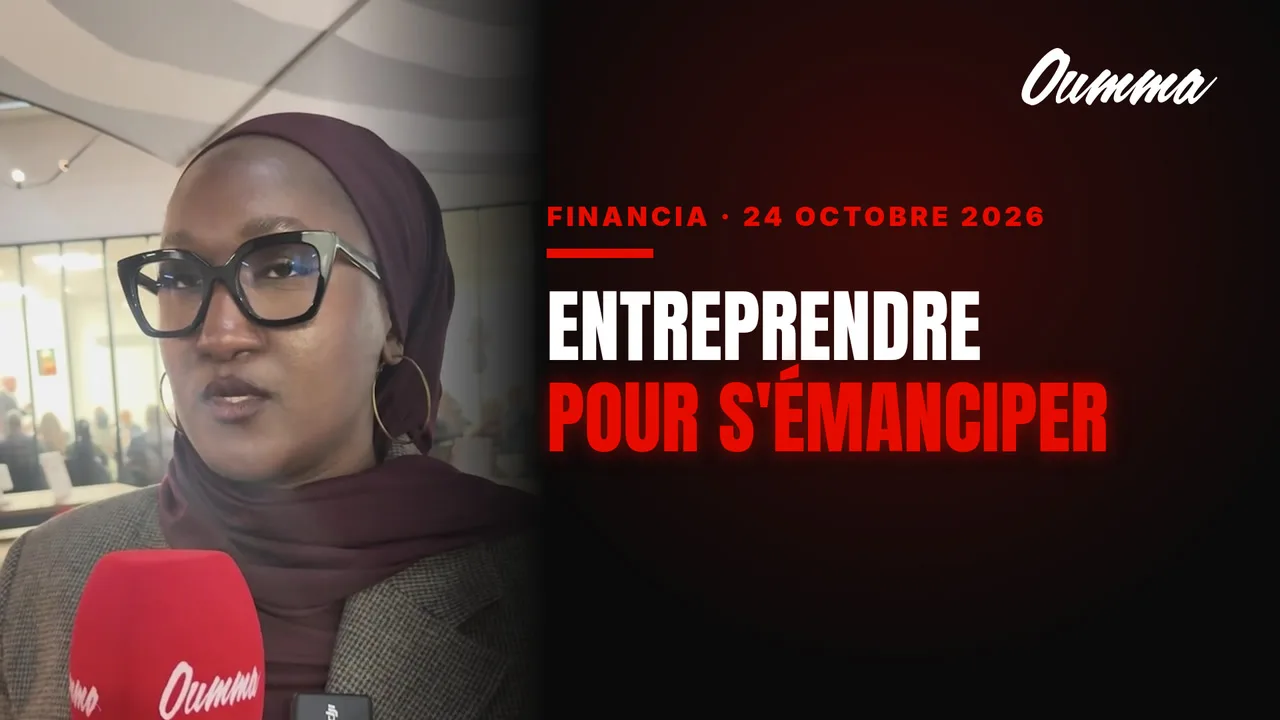
Tako Fofana: undertaking to emancipate yourself
The founder of Mansa Consulting talks about how she built her firm on values that are also those of Islamic finance.
Starting your own business can be a way of working according to your own rules. This is the journey of Tako Fofana, a chartered accountant specializing in corporate group taxation, who founded her firm four years ago. Oumma met her on October 24, 2026 at the Financia Business School (Paris 15th), during “Leading with your values, ethical journey & Islamic finance”, a day organized by the students of the 8th promotion of the Certificate of Islamic Finance. She spoke about values, vision and emancipation.
An accountant who became a business manager
“I am Tako Fofana, a chartered accountant specializing in corporate group taxation,” she introduces herself. “I created the accounting and tax agency Mansa Consulting four years ago. » According to the official business directory, Mansa Consulting was registered on September 1, 2022 in Paris, with an accounting activity, and Tako Fofana is the manager.
His specialty is technical. Group taxation concerns companies organized into several companies, a parent company and its subsidiaries. The best known regime is tax integration, provided for by article 223 A of the General Tax Code. A parent company that holds at least 95% of the capital of its subsidiaries can pay corporate tax alone for the entire group. The profits of one subsidiary can thus offset the losses of another.
His firm supports managers “in the development of their business, with the aim of securing, but above all, being able to achieve their objectives through their vision”. Securing is the classic role of the accountant. But Tako Fofana insists on the second part of the sentence: vision.
A profession that is slowly opening up to women
Creating your own accounting firm for a woman remains less common than for a man. According to the National Council of the Order of Chartered Accountants, women represented 32% of chartered accountants in 2025, and 60% of firm employees. The progress made is real: in 1989, the Order had 600 women registered on the roll, or 5% of the 12,000 professionals.
The same imbalance is found in business creation in general. According to INSEE, 44% of individual businesses created in 2025 were created by women. Their share falls to 33% in financial and insurance activities. However, the year 2025 broke a record, with 1,165,800 businesses created in France, all forms combined.
“Entrepreneurship is a way to emancipate yourself”
For Tako Fofana, supporting a leader is not limited to numbers. “And in support, for me, there is also the notion of emancipation,” she says. She first applies it to her own career: “Because when I decided to start a business, it was also because I had a vision of my profession as an accountant that I wanted to carry forward. »
Then she expands: “But there is also the fact that entrepreneurship is a means of emancipation. And so the idea is: how we emancipate ourselves by being ourselves. » The question is not specific to France. A review of the scientific literature, presented by Oumma in July 2026, already focused on the way in which cultural, religious and institutional norms weigh on the careers of women entrepreneurs in Islamic contexts.
Selected values, which are also those of Islamic finance
Tako Fofana does not talk about financial products, but about values. She describes her firm as built on “values that I have determined, which are also those of Islamic finance, those that I decide to put forward in my business”. Then comes the practical question: “And how do I respect them and have a whole ecosystem which, through these values, will allow me to realize the vision of my company”.
On the same day, consultant Anouar Hassoune summarized the principles of Islamic finance: no interest, no speculation, no illicit sectors of activity, and sharing of profits and losses. For a business leader, these principles affect very concrete choices: how to finance your activity, with whom to associate, which clients and which suppliers to retain.
Financing is often the first obstacle. Uninteresting solutions exist for creators, outside of any religious reference. The Initiative France network, for example, grants zero-interest honorary loans, with no guarantee required, for an average amount of 10,000 euros according to its site. Business financing consistent with Islamic finance remains underdeveloped in France: the speakers of the day recognized this, particularly for SMEs.
An ecosystem to build
The word comes back in his mouth: the ecosystem. For Tako Fofana, values only hold if the company’s partners share them. It is this set that should allow him to “serve through my vision, which is that of supporting leaders”.
Networks are structured in this direction. The Support Muslim Business Forum, a network of Muslim entrepreneurs born in the United Kingdom, launched its French branch in October 2025. And the question of whether French entrepreneurs know how to seize the halal market has already been asked in our columns.
Tako Fofana sums up her approach in one sentence: “This is how I develop my business, but also how I use the principles of Islamic finance in my business. » The accountants, notaries, lawyers and wealth management advisors present that day formed, in their own way, part of this ecosystem.
Find the full report and the other speakers of the day in our article Leading with its values: Islamic finance at the service of business leaders.
