
The prestigious medical journal The Lancet devotes its front page to the “healthocide (health genocide)” in Gaza. »»
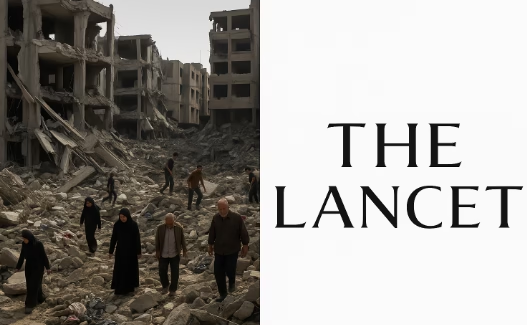
The prestigious medical journal The Lancet Publish a open letter entitled “Gaza’s Healthocide: Medical Societies Must Not Stay Silent” (Gaza: health genocide – Medical societies should not remain silent). This letter rises against what the authors describe as a systematic destruction of the health system in Gaza.
The authors qualify the situation in Gaza as a real humanitarian disaster, highlighting the intentional targeting of medical infrastructure and nursing staff. They show an operation made extremely precarious: habits half -destroyed, lack of equipment, endangering teams, shortages of drugs, anesthetics, electricity and safety.
The figures given in the letter are terrifying:
-
at least 772 attacks identified against health structures in Gaza;
-
94 % Gaza hospitals being damaged or destroyed;
-
more than 1,500 health workers killedwhich is the heaviest assessment ever recorded for this type of staff in a conflict.
The authors also denounce silence, or too cautious positions, medical and surgical societies in the world. They judge that this silence weakens the ability of institutions to defend the right to universal health and to condemn violations.
The letter clarifies that‘No neutral independent organization has, to date, brought credible evidence that Gaza hospitals were systematically used as human shields by the Hamas group, and recalls that even if such evidence existed, they cannot never justify generalized attacks against the health system. The authors call to recognize that human life is not conditioned by nationality, religion or political affiliation. They challenge the international medical community: the principle of medical neutrality is not equivalent to indifference. To ignore the effects of war policies on access to care is to leave populations without protection permanently.
In conclusion, the letter launches a moral, ethical and professional call: “that we remember us for our solidarity, not for our silence”. It is a clear invitation to commitment from doctors, researchers, learned societies and institutions.
