
Fake news and defamation: Francesca Albanese demands an apology from French diplomacy
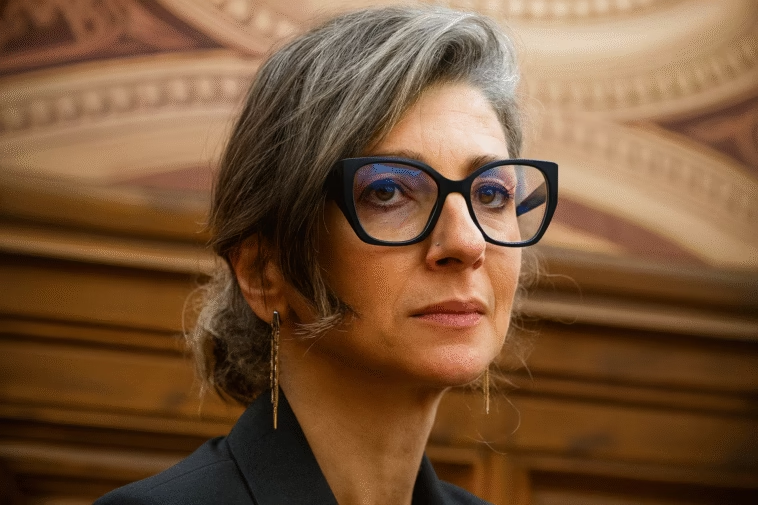
Francesca Albanese demands an apology from French diplomacy following accusations of fake news concerning her.
WHY READ:
- To understand the tensions between Francesca Albanese and French diplomacy.
- To explore the implications of fake news on the public debate regarding Israel and Palestine.
- To analyze the role of international organizations in protecting the rights of Palestinians.
The UN special rapporteur on the Palestinian territories, Francesca Albanesedeclared during a press conference that she took “note” of the remarks of the French ambassador to Council of Drsrights of manbelieving that French diplomacy had “changed its mind”, while saying it was waiting for “a word of clarification and apology” after attacks that she judged “virulent” and “unacceptable”.
“I heard (…) what the French ambassador said within the Council and I say that I take note of the fact that French diplomacy has finally changed its mind”she declared, adding that she would have “also expected a word of clarification and apology because they insulted me in a virulent, unacceptable way”. The Italian lawyer affirmed that in France, certain actors had publicly attributed to her comments that she “never said”. This widely reported quote has since been refuted and established as false. According to his entourage and several observers, this is fake news constructed from distorted or invented elements, then presented as authentic in public debate.
Beyond the controversy, Francesca Albanese reaffirmed the line she defends within the framework of her mandate at the United Nations. “Criticizing Israel for what it does does not mean criticizing Israel for what it is”she insisted. “Israel can profess any religion it wants. The problem is not with what Israel is, but with what Israel does.”she continued, referring to “patent violations of international law”.
She notably denounced what she considers to be serious and repeated attacks on the rights of Palestinians in the occupied territories, believing that her mandate consists of documenting specific legal facts. Assimilating, according to her, any criticism of Israeli policies to identity-based hostility amounts to disqualifying in advance any denunciation based on law.
Beyond his personal case, this sequence illustrates, for his supporters, a broader climate where factual truth seems secondary to communication strategies. While several international NGOs, independent experts, jurists specializing in international law as well as UN officials have considered that the constituent elements of the crime of genocide in Gaza were present or seriously plausible – a qualification today examined before the International Court of Justice — disinformation campaigns and fabricated quotes appear, according to its defenders, as instruments aimed at delegitimizing those who make this accusation on the legal ground. In this context, manipulation is sometimes elevated to media truth, at the risk of stifling debate and trivializing defamation against critical voices.
Francesca Albanese finally called for “opening the discussion” on the organizations which, according to her, “manufacture false information” and carry out “defamation” against UN officials working on the Palestinian question.<
Francesca Albanese would have liked an apology from French diplomacy after the dissemination of fake news concerning her. pic.twitter.com/Pu5s6Hgn0T
— Oumma.com (@oumma) February 27, 2026
/p>
