
Iran: for Dominique de Villepin, the intervention poses the risk of a hardening of the regime and a jungle world
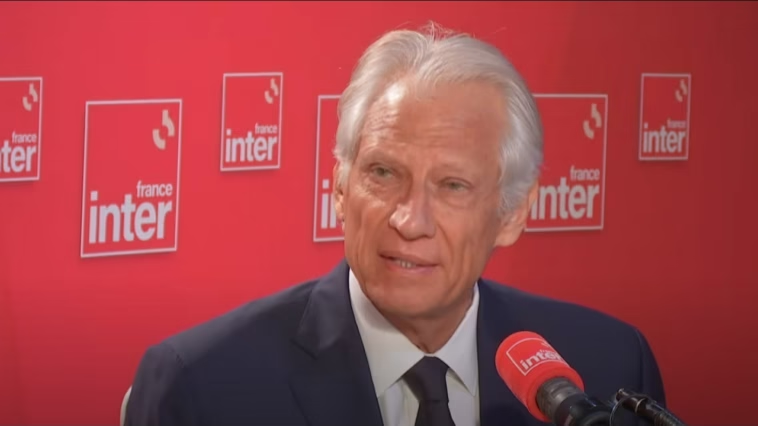
Guest of France Inter, Dominique de Villepin delivered a harsh analysis of the current international situation, denouncing the growing temptation of certain leaders to relegate international law to the background in favor of an assertive use of force.
“The best guarantee of one rule for all”
The former Prime Minister says he hears “this growing question”: has international law become obsolete in the face of power relations? For him, the answer is unambiguous. “International law is the affirmation of a rule, unless we aspire to a jungle world,” he said. According to him, renouncing this common framework would amount to accepting the law of the strongest. However, he insists, “we all have an interest in continuing to defend international law because it is the best guarantee of a rule for all”.
Dominique de Villepin also sees it as a mechanism for “depersonalization of issues”, making it possible to remove crises from the logic of revenge or individual rivalries to place them within the field of principles and norms. “There are principles and rules that must continue to apply,” he insists. In his eyes, France and Europe have a particular responsibility: “It is the vocation of a country like France, it is the vocation of a country like Europe. We still need to have a voice, a vision, a policy. »
The United States faces the “price” of intervention
Asked about the ongoing military intervention in the region, he believes that the United States “will pay very dearly for this forgetting of an international order”. According to him, Washington is part of “a logic of intervention which cannot now stop”.
For what result? “Is the world safer today? », he questions. Certainly, he recognizes that a regime “which shot against its children” and which is “the cause of the suffering of the Iranian people” finds itself weakened. He hopes that a “political exit point” can be found.
But the current intervention, he warns, is a “gamble”.
The “bet” and the “trap”
This bet consists, in his words, of “strike from above in the hope that when the time comes the people at the bottom will have the strength, will have the means to react and take power to rule themselves”. A hypothesis which is more of a wish than a guaranteed strategy. Because behind this bet lies a “trap”: that of a tightening of the regime. “We eliminate an Iranian leader. He is immediately replaced,” he observes. Added to this is the risk of civil war and the disintegration of the Iranian state.
For Dominique de Villepin, the elimination of a leader alone never resolves a structural crisis. He cites several precedents:
-
The elimination of Osama bin Ladenfollowed by the emergence of Islamic State.
-
The fall of Saddam Husseinwhich plunged Iraq into chaos.
-
The intervention against Muammar Gaddafifollowed by the collapse of Libya.
“It’s not that simple,” he insists, invoking a “principle of responsibility”. “We are not in this region today in front of a video game. »
The specter of an asymmetrical war
Finally, the former head of diplomacy warns of indirect consequences for Europe. As conventional war is no longer “in the range of possibilities” for Iran, the risk would be that of an asymmetrical war: recourse to indirect means, destabilizing actions, terrorism. A scenario which “changes the nature of the conflict” and could have repercussions even on European soil, particularly in terms of public order. Dominique de Villepin’s intervention is striking for its lofty perspective. The former minister places himself neither in the emotion of the moment nor in partisan logic. He speaks as a strategist, as a statesman experienced in the mysteries of international relations.
His constant reminder of international law is not incantatory. He is part of a coherent trajectory, that of a political leader who, from the Iraqi crisis to current tensions in the Middle East, has always favored international legality as his compass. His analysis of past interventions — from Iraq to Libya — testifies to diplomatic memory and a keen understanding of geopolitical sequences.
In a debate often dominated by immediacy and posturing, his words recall what that of an enlightened and wise statesman can be: a voice which knows the deep roots of the balance of power, which measures the weight of historical precedents and which knows that the stability of the world rests less on raw power than on the force of law.
For Dominique de Villepin, the message is clear: the return to international law is not a moral luxury, but a strategic necessity. “We will return to international law. It’s in everyone’s interest. »
Iran: for Dominique de Villepin, the intervention poses the risk of a hardening of the regime and a jungle world
“We are not in this region today in front of a video game. » pic.twitter.com/qBv3flSqwn— Oumma.com (@oumma) March 2, 2026
