
Israel–Lebanon–Gaza: on France 5, Ziad Majed says what many media keep silent
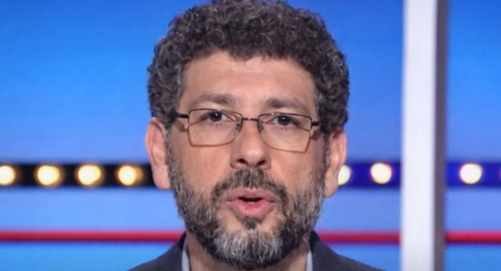
- To discover an often overlooked perspective on the Israeli-Lebanese conflict.
- To understand the impact of past violence on the current situation.
- To reflect on the dehumanization of victims in media discourse.
In a media landscape often filled with quick comments and shortcuts, certain speeches really stand out. That of Ziad Majed, Franco-Lebanese political scientist, professor and researcher, in the show C this evening on France 5, is clearly one of them. With calm and precision, he recalled a reality that we hear very little: for many Lebanese today, the priority is not ideological or political. It is simple and urgent: stop the war and Israeli aggression against Lebanon.
And above all, his words do something rare: they shake up Israeli propaganda that is often repeated over and over again in the media, without hindsight or putting it into context.
A historical reality that we too often forget
Ziad Majed clearly points out: to reduce the situation at Hezbollah is to miss the point. Whether you are for or against this movement, the Lebanese reality is broader. Israeli relentlessness against Lebanon does not date from today, nor even from the creation of Hezbollah. It dates back several decades.
He particularly mentions the invasions of 1978 and 1982, which left nearly 20,000 Lebanese and Palestinian civilians dead. This story of violence and impunity has existed for a long time, even if it is rarely recalled on TV sets.
Israel–Lebanon–Gaza: on France 5, Ziad Majed says what many media keep silent pic.twitter.com/KijW1NjpIA
— Oumma.com (@oumma) April 10, 2026
Gaza, a precedent that changes everything
To understand what is happening today, we also have to look at Gaza. For more than two years, he explains, the world saw the massive destruction of a territory and its population, in almost total silence. Today, Gaza is largely in ruins, with residents forced to survive in extreme conditions. In this context, what is happening in Lebanon is not surprising. Ziad Majed speaks of a real “politics of ruin”. The idea is no longer just to wage war, but to permanently destroy: cities, infrastructures, but also lives and landmarks.
And rebuilding does not mean going back to what existed before. A destroyed neighborhood never regains its habits, its connections, its daily life. An entire collective life is disappearing.
Behind the words, human lives
He also criticizes the term “collateral damage”. For him, this word serves to trivialize the death of civilians, especially in this region of the world. But behind these words, there are people, lives, stories that stop. These are not abstract damages, they are human beings. Lebanon is today divided and weakened. But there remains a society that holds together, that resists. Ziad Majed evokes a form of resilience, a desire to continue despite everything, supported in particular by civil society.
In a context where many speeches go round and round, Ziad Majed’s words do some good. It puts things into perspective, brings depth and forces us to look reality in the face. A rare word, and above all necessary.
