
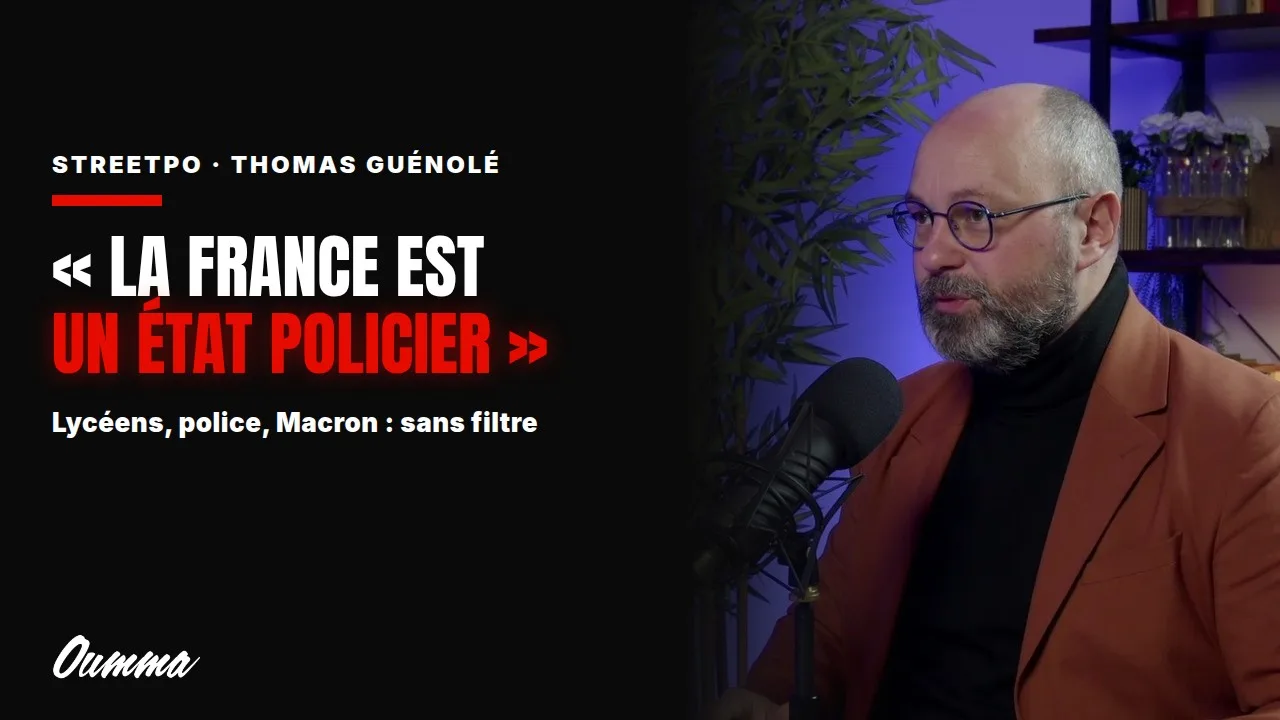
Thomas Guénolé: “France is a police state”
In StreetPo, the new Oumma TV show presented by Chekib, political scientist Thomas Guénolé came to talk about the youth movement that has been shaking France since the end of September. Recorded on November 9, the interview was to cover four chapters: the high school movement, the series of racist attacks, the presidential election and international politics. It lasted an hour and a half, and only exhausted the first one. Strike, police, Emmanuel Macron, media, integration: Thomas Guénolé defends clear-cut positions, which we have confronted with the facts.
“October 26”, a movement he says he saw coming
Doctor in political science, former executive of La France insoumise which he left in 2019, founder in 2024 of the Extreme Right Resistance Network, he recently launched his YouTube channel, “Guénolé Thursday 8 p.m.”. Thomas Guénolé immediately suggests a name for the period: “October 26”, echoing May 68. He claims to have anticipated the movement. During a summer debate on clichés aimed at Generation Z, he said: “If it turns out, they’re going to make us the next May 68. And a month later, here we are. »
The movement left on September 21 from a high school in Créteil, according to Amnesty International, before reaching Lille, Lyon, Marseille, Tours and Bordeaux. The high school students denounced dilapidated buildings, overcrowded classes, teachers not replaced and Parcoursup. The Ministry of the Interior counted more than 5,000 arrests in twelve days, 85% of which were minors. On October 6, more than 250,000 people marched. The movement then expanded: three Saturdays of mobilization against the high cost of living in October, then an inter-professional strike on November 5, at the call of the inter-union.
For Thomas Guénolé, the game is already won. “The high school movement has already won,” he says, citing the Parcoursup reform and investments in high schools. On October 26, the government of Sébastien Lecornu announced that a new system would replace Parcoursup in 2028, as well as 4 billion euros in reduced-rate loans to communities, over four years, to renovate middle and high schools. Loans, not grants: Public Senate calculates the real expenditure of the State at around 1.35 billion euros in 2027. “It’s not as much as what they asked for”, recognizes the political scientist, who nevertheless invites the activists to “accept their partial victory”, like that of the yellow vests.
“The general strike is the most effective non-violent method”
Chekib asks him if the strike would not be more effective than the parades. Thomas Guénolé acquiesces, but suggests renaming the “general strike” into an “economy blocking strike”: “The important thing is not that we are all there. The important thing is that the economy stops. » He takes the example of May 68, “the largest workers’ strike in the history of France”. The Grenelle agreements then increased the minimum wage by 35%, from 2.22 to 3 francs per hour, and wages by 7% on June 1 then by a total of 10% in October. He also recalls the flight of General de Gaulle to Baden-Baden on May 29, 1968, and the paid leave of 1936, absent from the Popular Front program and granted under the pressure of the strike.
According to him, the demonstrations retain one virtue: they unite a generation. “High school students now are politicized until the end of their days. »
Black blocs, self-defense and injured police officers
On the evening of October 8, Thomas Guénolé wrote on social networks: “I ask for the intervention of the black blocs to protect our children.” An “obviously provocative formula”, he admits, intended to alert people to police violence that he considers illegal. He said he then proposed something “more reasonable”: that the firefighters intervene, which some did.
He bases his position on the law. Violence committed by a person holding public authority is much aggravated by the Penal Code (article 222-13), and the self-defense of others exists (article 122-5). But this presupposes an “unjustified attack”: faced with a legal use of force, resisting an agent amounts to rebellion. Self-defense against a police officer is only permitted in the face of a manifestly illegal act, and it is assessed on a case-by-case basis, before a judge.
The political scientist also attacks the count of injured law enforcement officers, 715 according to the Ministry of the Interior as of October 6, compared to 215 students according to Matignon. He reports that an officer spoke of “respiratory tract injuries”, and deduced that a good number of these police officers and gendarmes were injured by their own tear gas. The ministry does not detail the nature of the injuries, but two investigations point to it. On October 15, CheckNews (Libération) documented police officers in Paris who were victims of their own explosive grenade. On November 13, Mediapart revealed the internal file of CRS injured in October: out of 1,233 agents, 1,167 (94.6%) are classified as “slightly injured”, 126 had a work stoppage, and the origin of the injury is only noted for around twenty of them, including 12 clearly caused by a third party. The Minister of the Interior, Laurent Nuñez, nevertheless announced 1,580 police officers and gendarmes injured on November 5. He also mentions “agents provocateurs” infiltrated among the thugs. In Reims, on October 4, the prosecutor confirmed that the man filmed throwing a projectile towards high school students was a police officer, while considering that he was acting within the framework of maintaining order.
Maïssa, and “if it were in Iran”
Chekib mentions Maïssa, 17, injured in the eye on October 17. She did lose the sight in one eye that day, according to Politis, but in Mulhouse, and she had just started university. Witnesses describe a tear gas grenade; the Metz prosecutor says he cannot yet determine the projectile. The General Inspectorate of the National Police (IGPN) is contacted. Before her, Maël, 16, had lost the use of an eye in Tours on September 30, and a 15-year-old high school student lost a hand in Lens on October 5.
“If we had had the same thing, but in Iran,” notes the host, the affair would make the headlines. Thomas Guénolé sees the effect of an audience: that of the big media, old and well-off. He also attacks the vote of those over 60 “who have assets and savings”, and launches a combat proposal: that “pensions can no longer exceed 2,500 euros”. No previous publication of his details this idea. According to Drees, the average direct pension was 1,752 euros gross per month at the end of 2024, and around 8% of retirees received more than 3,000 euros gross at the end of 2020.
“France is not a dictatorship, but France is a police state”
The formula sums up his current reading. For him, the country remains a democracy, with “roughly pluralist” elections, but fundamental rights would no longer be protected against the police. He cites the individual identification number (RIO), obligatory since a 2013 decree but often hidden, and the police and gendarmerie inspections, made up according to him of “people who have been police officers and who will become so again”. He considers the confiscation of swimming goggles or physiological serum from demonstrators illegal. On this point, the courts reached a divided decision: the administrative court of Versailles suspended an order from the prefect of Yvelines which prohibited protective equipment around high schools, while the Council of State validated a similar ban elsewhere, with reservations.
Emmanuel Macron’s message to the French boils down, according to him, to “shut up. Shut up, I’ll do what I want.” This is his reading, not a quote from the president. He cites the lists of grievances, the great debate, the citizens’ conventions and the use of 49.3. More unexpectedly, he judges that “François Hollande has done more harm to the rule of law than Nicolas Sarkozy”, due to the state of emergency, the repression of demonstrations against the labor law and the plan for forfeiture of nationality. The state of emergency lasted from November 2015 to November 2017, with approximately 4,469 administrative searches and 754 house arrests. François Hollande renounced the forfeiture of nationality on March 30, 2016.
He goes so far as to assert that the Fifth Republic was born from “a military coup” in 1958, citing Operation “Resurrection”. The plan did exist: a parachute drop on Paris, prepared at the end of May then canceled. But most historians describe a return to power by De Gaulle under the threat of a putsch, followed by a legal investiture by the Assembly on June 1 and a Constitution adopted by referendum.
Former columnist for “Touche pas à mon poste!” », Thomas Guénolé refuses to say what Cyril Hanouna and Pascal Praud, whom he knows, really think: “I am not a snitch”. He defends the right of each media outlet to an editorial line, and wants a left-wing public audiovisual sector to balance a private landscape that he judges to be right-wing. He accuses France Info of “overtaking CNews from the right”. Arcom, however, criticized Radio France for the opposite last June: its formal notice concerned the insufficient presence of the National Rally during the day.
The last third of the interview concerns the comments of Édouard Philippe, who spoke of an “over-representation” of French people with immigrant backgrounds among the October rioters, comments criticized by Dominique de Villepin and Raphaël Glucksmann. Thomas Guénolé distinguishes the sociological analysis (black and North African populations are over-represented in the poorest neighborhoods, where poverty “predisposes to looting”) from the label “from immigration”, which according to him makes these French people people from “outside”. A descendant of Polish immigrants on his mother’s side, he notes that he was “never” presented that way.
He then contrasts assimilation, “a demographic process” over two or three generations, slowed down according to him by thirty years of mass unemployment, to integration, which he defines as “adherence to the social pact”. According to this criterion, Éric Zemmour is in his eyes “very poorly integrated”, just like Sarah Knafo. Same logic for Emmanuel Petit, 1998 world champion, who launched on October 19, in a video published on X: “Go back to where you came from”. “Zinedine Zidane is more French than Emmanuel Petit,” concludes the political scientist.
A second episode to come
The other three chapters will be the subject of a future episode. At the opening, Thomas Guénolé presented Eiffel Edena comic strip published by Glénat on September 30, which he signed as a screenwriter under the name Gwenn, with the designer Dario Tallarico. It tells of a Paris submerged up to the first floor of the Eiffel Tower, a caste society and a youth who learn “the right and the duty to revolt”, but also what it costs. Out in the middle of high school, the coincidence still amuses her. A former passenger in the flotilla for Gaza in 2025, from which he made the show “A Boat for Gaza”, he says he found among these high school students the question he had asked himself under the Israeli drones: “do we continue or do we stop”.
