Islamic finance: “a market within a market”
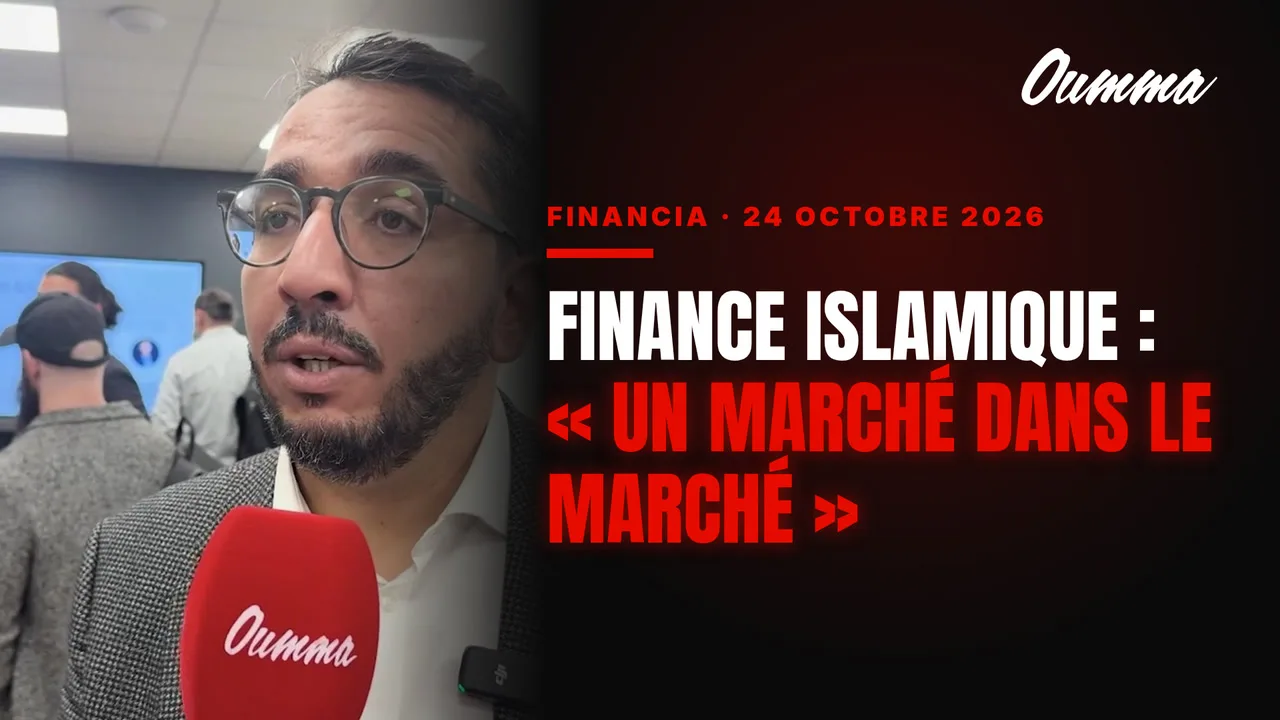
On October 24, 2026, the Financia Business School hosted in Paris “Leading with your values, ethical journey & Islamic finance”, a plenary and three masterclasses organized by the students of the 8th promotion of its Certificate of Islamic Finance. Among the speakers interviewed by Oumma, Mohamed Mosbahi, wealth management advisor and founder of the Amana Patrimoine firm. He describes Islamic finance as “a market within a market”: small on the scale of global finance, but continually growing. The numbers prove him right on both counts.
From an Executive MBA to the creation of a firm
Mohamed Mosbahi discovered the subject at the school which hosted the conference. “Financia is where I learned my first things about Islamic finance,” he says. He completed his Executive MBA there, and it was there that “the idea of creating Amana Patrimoine matured and blossomed”.
His firm presents itself on its site as an independent wealth management consultancy, specializing in Islamic finance, which is aimed at individuals, business leaders, liberal professions and athletes. It indicates that it is a member of ANACOFI (for financial investment brokerage and advice), registered with ORIAS, and works with external auditors to verify the compliance of its solutions with the standards of the AAOIFI, the Bahraini organization which publishes the main standards of Islamic finance.
His presence at the conference was self-evident, he said: “Leading with your values and convictions is what ultimately every Muslim entrepreneur must do. »
“A market within a market”
Mohamed Mosbahi does not inflate the weight of his sector. “Islamic finance, in a few words, is a market within a market. We are really a small part of everything that is happening today in the world of conventional finance. »
International data confirm this observation. According to the IFSB, the standardization body for Islamic financial services based in Kuala Lumpur, global Islamic finance assets reached $3,880 billion at the end of 2024. The Financial Stability Board (FSB), for its part, estimates all global financial assets at just over $500,000 billion at the same date: non-bank finance alone weighs $256,800 billion, or 51%. Islamic finance therefore represents less than 1% of the total.
This small market is also very concentrated. According to the IFSB 2026 report, the Gulf countries and East Asia (Malaysia and Indonesia in the lead) hold 75% of assets. The Europe and Central Asia zone, which includes Turkey, accounts for only 4.9%. And banking dominates everything: almost 70% of assets are deposits and bank financing. Islamic investment funds, the core business of a wealth manager, represent only 4.1% of the sector.
Growth that cannot be denied
Small, the market is growing quickly. “This is an element that has only been developing for many years now,” underlines Mohamed Mosbahi. The IFSB agrees: global assets increased by 14.9% in 2024, then by 13.4% in 2025, to reach $4.4 trillion. Sukuk, these securities backed by real assets which play the role of bonds, now exceed $1,000 billion in assets.
For comparison, Oumma recalled in 2024 that the sector’s assets had increased sevenfold between 2000 and 2021, from 400 to 2,800 billion dollars according to Refinitiv. Growth continues at a rate close to 15% per year.
In France, fifteen years of legal framework
“The market has been developing and expanding for more than fifteen years, and our whole interest is to be able to participate and contribute,” continues the advisor. In France, the dates match his estimate.
In July 2007, the Financial Markets Authority (AMF) published a position (DOC-2007-19) on the extra-financial criteria for asset selection, which takes as an example funds declaring themselves compliant with Islamic law. The AMF sets a requirement: the selection criteria must be objective and verifiable. The tax administration followed in 2009 and 2010. Its instructions of February 25, 2009 and August 24, 2010 describe the tax treatment of four operations: murabaha (purchase-resale with margin known in advance), sukuk, ijara (rental with purchase option) and istisna (financing of a property to be built). They were included in 2012 in the Official Bulletin of Public Finances (BOFiP).
The products followed. In 2009, Crédit Agricole Asset Management launched its first mutual fund compatible with Sharia law. In 2014, “Sharia compatible” life insurance contracts made their debut in France. These contracts are important for wealth advice: according to the Cercle de l’Épargne, which uses figures from France Assureurs, life insurance totaled 2,107 billion euros in assets at the end of 2025, more than 30% of household financial savings.
What a “compliant” wealth advisor does
Mohamed Mosbahi’s job is framed like that of any advisor. To recommend financial investments, you need the status of financial investment advisor (CIF). According to the AMF, France had 7,013 at the end of 2024. Each must be registered with ORIAS, the register of intermediaries, and join one of the four professional associations approved by the AMF: ANACOFI-CIF, CNCEF, CNCGP and La Compagnie CIF. The AMF reminds that a CIF is not itself “AMF approved”: the saver checks his registration on the ORIAS website.
Specialization in Islamic finance adds a filter. An investment must first exclude prohibited sectors: alcohol and tobacco, pork, gambling, weapons, conventional financial services, among others. It must then respect financial ratios. According to the AAOIFI standards, as used by the Muscat Stock Exchange (Oman) for its Sharia index, a company remains eligible if:
- its interest-bearing debts remain below 30% of its average market value over twelve months;
- its interest-bearing investments remain below 30% of this same value;
- its income from non-compliant activities remains below 5% of its turnover.
The portion of the dividend that comes from these non-compliant income must be “purified”, that is, given to charity. It is this work of sorting and monitoring, line by line, which distinguishes compliant management from traditional management. The same criteria also attract non-Muslim investors, who see it as a discipline against excessive debt, as Oumma noted in September: why Islamic finance is now also of interest to non-Muslims.
A market still without an Islamic bank in France
The “market within the market” remains incomplete in France. No fully Islamic bank is approved there, although Germany has had one since 2015, KT Bank, a subsidiary of the Turkish Kuveyt Türk. French solutions therefore involve funds, life insurance contracts, real estate operations set up with notaries and specialized companies. This is the area that firms like that of Mohamed Mosbahi work on: assembling existing bricks rather than waiting for a bank. However, the movement exists on a regional scale: according to the IFSB, it is particularly in the Europe and Central Asia zone that Islamic insurance (takaful) is accelerating the most, driven by regulatory developments.
Find the full report and the other speakers in our article: Leading with your values: Islamic finance at the service of business leaders.
