Gaza: Andy Burnham admits UK’s moral failure
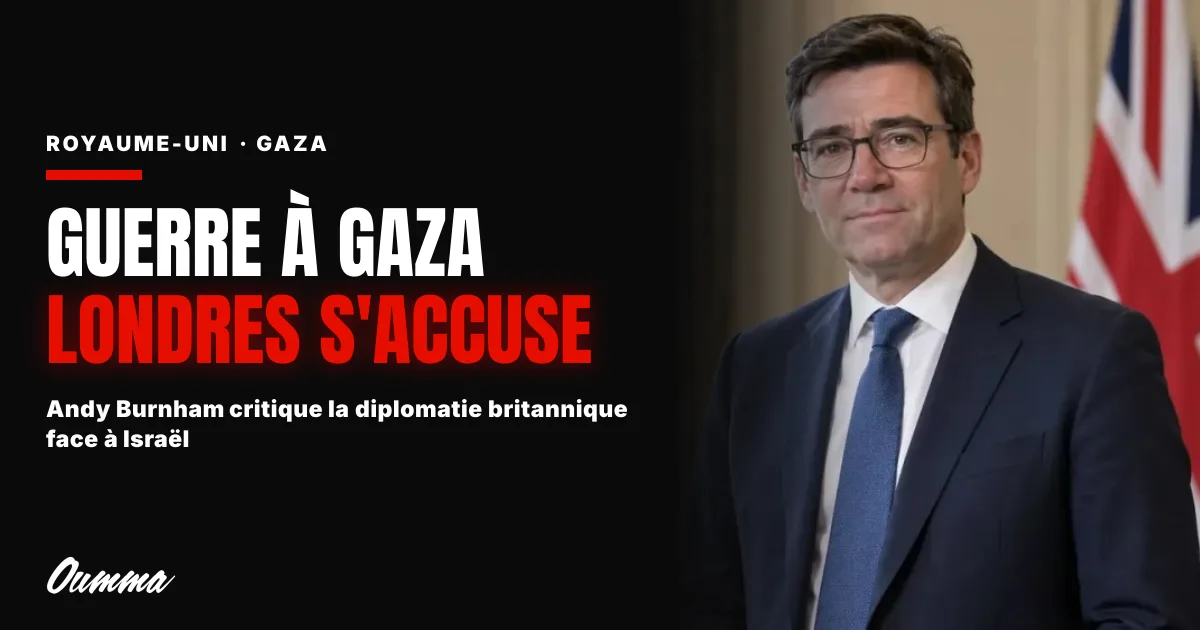
In front of diplomats and representatives of the financial world gathered Monday evening in London, Andy Burnham recognized that the British reaction to the war in Gaza had damaged his country’s credibility. He said the UK was right to condemn Hamas attacks, but its response to subsequent Israeli operations had cast doubt on the principles it stood for. The Prime Minister thus distances himself from his Labor predecessor, Keir Starmer, whose statements on the siege of Gaza had divided his own party.
The memory of a question about water and electricity in Gaza
Andy Burnham chose the annual banquet of the Lord Mayor of the City, the financial district of London, to return to this episode. At this meeting where the head of government traditionally presents his foreign policy, he used the first person plural. After the October 7, 2023 attacks in Israel by Hamas, the Palestinian movement, “our response to what followed in Gaza led many to question our moral compass,” he said.
Four days after the attacks, a very concrete question had crystallized the British debate. On October 11, 2023, on LBC radio, a journalist asked Keir Starmer, then leader of the Labor opposition, whether Israel had the right to cut off water and electricity in Gaza. His response was understood as approval of these cuts. Local Labor elected officials had publicly expressed their disagreement and some had resigned.
On October 20, Starmer clarified that he was talking about Israel’s right to defend itself. He added that water and electricity must be restored and humanitarian aid must be allowed to reach Gaza residents. Three years later, Burnham extended the criticism to the whole of the British response. In his eyes, the positions taken by the leaders gave abroad the impression that the country had changed, while the convictions of the population, he believes, remained the same.
Colonies and humanitarian aid, the conditions imposed on Israel
Coming to power in July, Andy Burnham initiated measures aimed at ending trade with Israeli settlements in the occupied West Bank. These settlements are Israeli settlements built on Palestinian territory. For the Prime Minister, their extension risks making the “two-state solution” impossible, that is to say the creation of a Palestinian state alongside Israel. According to him, a dozen countries have rallied to the British position.
The head of government also clarified his position on Iran. London supports mediators who are seeking an agreement to end the war, reopen the Strait of Hormuz and prevent Tehran from acquiring nuclear weapons. Burnham linked the reopening of this maritime passage to a concern of British households, the price of energy, which according to him the continuation of the conflict contributes to increasing.
Aid to Gaza: Burnham calls on Israel to let in enough to meet residents’ needs
Regarding Israel, Burnham leaves open the possibility of working with the new government. He asks him to end the violence against the Palestinians and to stop building settlements on their land. For Gazans, his third condition is the most immediate. It also concerns the volume of humanitarian aid authorized to enter the territory. The criterion stated by the Prime Minister is that of the needs of the population, without quantity or timetable specified in his speech.
Subscribe to the Oumma letter: our articles, our analyzes and our new programs arrive directly in your mailbox.
Free. One-click unsubscribe. Everything you need to know about Umma’s letter
