Anouar Hassoune: Islamic finance, ethical finance
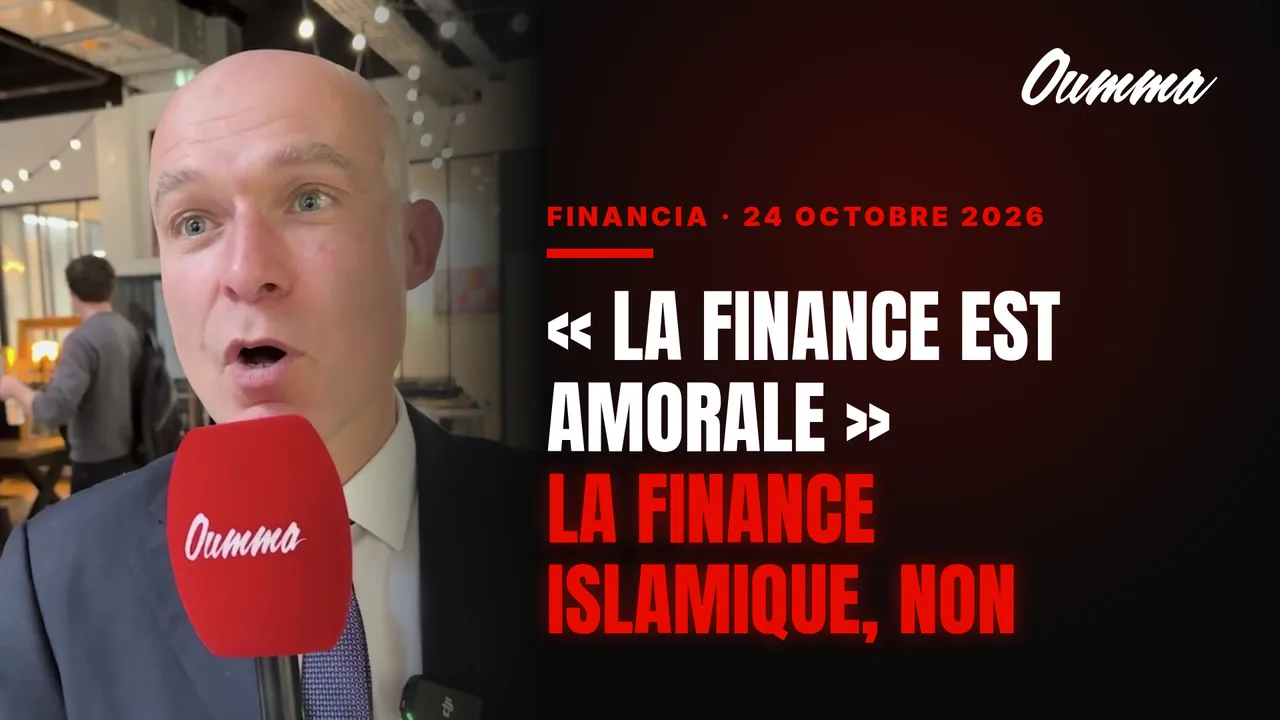
On October 24, 2026, the Financia Business School, in Paris, hosted “Leading with your values, ethical journey & Islamic finance”, a plenary and three masterclasses put on by the students of the 8th promotion of its Certificate of Islamic Finance. Anouar Hassoune, consultant in Islamic finance for twenty-five years, gave his definition of the discipline. It comes down to a distinction: finance is not immoral, it is amoral. Islamic finance chooses to have morality.
“That doesn’t mean he’s immoral.”
Anouar Hassoune knows conventional finance from the inside. He worked, he says, “in a rating agency and in a bank”. According to the biography published by Financial Afrik in 2019, he was an associate director at Standard & Poor’s from 2001 to 2008, then vice-president of Moody’s from 2008 to 2011, where he rated Islamic banks and emerging countries. He also teaches Islamic finance at several schools, including Dauphine, HEC and Sciences Po.
Its starting point is a clarification. “You know that finance is a perfectly amoral sector of activity. That doesn’t mean he’s immoral: it means he doesn’t care about morality. » A conventional banker judges a file on risk and return. What the money finances does not enter into the calculation, unless prohibited by law.
Islamic finance adds a question to this calculation. It is, he says, “ethical in the sense that it must respect a certain number of values and principles”. Hence his formula: “Islamic finance is a compartment of ethical finance. »
Four principles, four filters
Anouar Hassoune cites four: “no interests, no speculation, no terrible sectors. And then sharing profits and losses with its stakeholders. »
The prohibition of interest (riba) is based on the Koran: “Allah has made commerce lawful, and interest unlawful. » (S.2, 275). An Islamic bank therefore does not lend money for money. She buys a property and resells it with a margin known in advance (the murabaha), rents it (the ijara) or joins the project.
The refusal of speculation targets contracts where uncertainty is excessive and bets on price variations unrelated to a real asset. Oumma has devoted an analysis to the question: is Islamic finance really protected from speculative risk?
“Awful sectors” are the excluded activities. In France, the Financial Markets Authority (AMF) gives examples in its position DOC-2007-19: companies whose activity and income are linked to the alcohol, tobacco or pork products industries are excluded. Added to this is a financial filter: a fund can exclude companies whose debts exceed 33% of their average market capitalization over twelve months.
Sharing profits and losses, finally, makes the investor a partner rather than a creditor. He wins if the project wins, he loses if it loses. This is the principle of moucharaka (association) and moudaraba contracts (one provides the capital, the other the work).
For the AMF, an Islamic fund is treated like an SRI fund
The idea of an “ethical finance compartment” is not just an image. This is exactly the framework that the AMF adopted on July 17, 2007. Its position opens up to funds that select their assets using criteria other than financial ones, such as socially responsible investment (SRI) or sustainable development. Then it specifies that the same elements of assessment apply to funds which declare themselves to be compliant with Islamic law.
The regulator sets two conditions. The management company remains solely responsible for its choices: the committee of religious scholars gives its opinion on values already selected by the manager, it does not manage the fund. And the criteria must respect French law: a criterion based on the religion of the directors of a company would be contrary to public order.
The comparison with ISR has its limits. The ISR label, created in 2016, was tightened in 2024: according to the Banque de France, its new specifications, applicable since March 1, 2024, exclude coal and unconventional fossil fuels. The two approaches overlap on the principle of sorting. They do not sort on the same criteria: ISR does not exclude interest, and Islamic finance does not exclude, in principle, oil.
A compartment of 4,400 billion dollars
The “compartment” weighs heavily on a global scale. According to the 2026 Stability Report of the Islamic Financial Services Board (IFSB), the international industry standards body, Islamic finance assets reached $4.4 trillion in 2025, up 13.4% year-on-year. The bank represents 69.3%. Sukuk, Islamic debt securities, exceeded $1,000 billion in assets for the first time.
This market remains very concentrated: the Gulf countries and East Asia and the Pacific hold 75%, again according to the IFSB. Europe occupies a marginal place there.
In France, an offer that does not cover “all needs”
However, France opened the door more than fifteen years ago. The tax administration published instructions in 2009 and 2010 on murabaha, sukuk, ijarah and istisna (financing a property to be built). They always appear in the Official Bulletin of Public Finances (BOFiP), under the reference BOI-DJC-FIN. On October 14, 2009, on the other hand, the Constitutional Council censored the article of a law on credit to SMEs which modified the trust regime, a provision presented at the time as intended to facilitate the issuance of sukuk. Reason: it was unrelated to the original text.
Today, Anouar Hassoune describes a real but incomplete offer: banking offers, offers for individuals, “in particular the financing of the acquisition of the main residence”, for entrepreneurs “to a certain extent”, “and especially for savings”. Sufficient? “Far from it. » Oumma had already detailed the mechanisms of Islamic real estate financing.
The afternoon masterclasses therefore had to answer three questions: the current state of the products, the needs of entrepreneurs (financing, savings, advice), and the way in which wealth management advisors, brokers and investors can “converge on the same platform”.
“The English show us the way”
Anouar Hassoune is not counting on a helping hand from the State. For him, the context of continental Europe is “much more closed, much more restrictive, much more ideological than in the United Kingdom”. “The English show us the way, yes, but they have had facilitations at an institutional level that we will not have. » The conclusion he draws is practical: “you have to be creative”.
The task he sets is first of all knowledge: “identify needs, and try to imagine the French Islamic finance of tomorrow, one that will be able to cover as many needs as possible”. With Kader Merbouh, he is one of the two pillars of Financia’s Executive MBA in Islamic finance, as they explained in an interview with Oumma. To go further on the foundations, also read Ethics and finance in Islam and Sharia law, “riba” and banking.
Find the full report and the other speakers in our article Leading with your values: Islamic finance at the service of business leaders.
