Greece: Hamza Bey mosque reopens in Thessaloniki
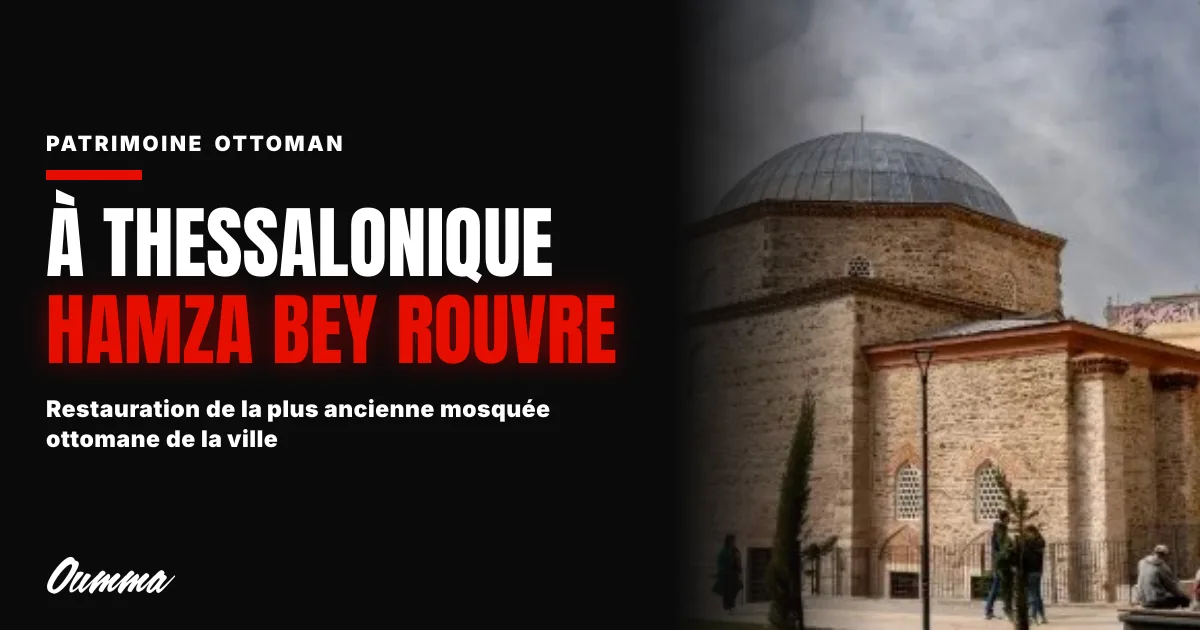
In the heart of Thessaloniki, the city’s oldest mosque reopened its doors on October 11, 2026 after decades of closure. Built in the 15th century and later transformed into a cinema, the Hamza Bey Mosque was restored by the Greek Ministry of Culture to host exhibitions. Residents and visitors can once again enter a building which bears witness to nearly five centuries of Ottoman presence in the city.
At the Venizelou metro exit, at the corner of two main streets in the city center, passers-by can finally see the building freed from its scaffolding. The Greek Prime Minister, Kyriakos Mitsotakis, visited there on October 27. The Minister of Culture, Lina Mendoni, presented the work and the exhibition which already occupied the premises, reports the Greek public media ERT.
From the prayer room to the Alcazar cinema
According to the founding inscription cited by the Greek Ministry of Culture, Hafsa, daughter of the Ottoman commander Hamza Bey, had the place of prayer built in 1467 or 1468, less than forty years after the capture of Thessaloniki by the Ottomans. The building then mainly consisted of a square room under a dome. In the 16th century, the addition of a minaret and galleries enlarged the whole. The resulting column-lined courtyard is rare in Ottoman mosques in the Balkans.
The building lost its religious function at the beginning of the 20th century, after the city was annexed to Greece in 1912. Listed as a historic monument in 1926, it then housed shops and a cinema installed in its courtyard. The sessions were first held in the open air, before a roof was placed over the courtyard. The name of the cinema, Alcazar, remained in local usage. Successive transformations and the earthquake that struck Thessaloniki in 1978 weakened the building. The Ministry of Culture took responsibility for it in 2006. The following year, teams began to document the building and consolidate its structure. The restoration continued in stages, with a final phase of work between 2024 and 2026 to restore the interior and exterior.
A first exhibition on the city that grew up around the monument
The project benefited from around 11 million euros from the European recovery fund. The Greek Ministry of Culture led the restoration with the support of the Archaeological Service of Thessaloniki, which supervised the excavations. This service now manages the place with MOMus, the organization which brings together several visual arts museums in Thessaloniki. Upon reopening, a presentation of the site allowed the public to discover the work of the restoration teams.
For its first temporary exhibition, the MOMus chose photographs of Thessaloniki taken from 1960 to 1980 by Pete Marifoglou, a photographer born in the city and based for many years in New York. Some images are shown for the first time. They show the markets, cafes and courtyards of the upper town, but also the buildings that grew up around Roman, Byzantine and Ottoman monuments.
The contrast shown in these photographs is found at the gate of the Alcazar, where a 15th century dome now stands next to a metro station. The exhibition is open until March 31, 2027, at 49 Egnatia Avenue.
Subscribe to the Oumma letter: our articles, our analyzes and our new programs arrive directly in your mailbox.
Free. One-click unsubscribe. Everything you need to know about Umma’s letter
