
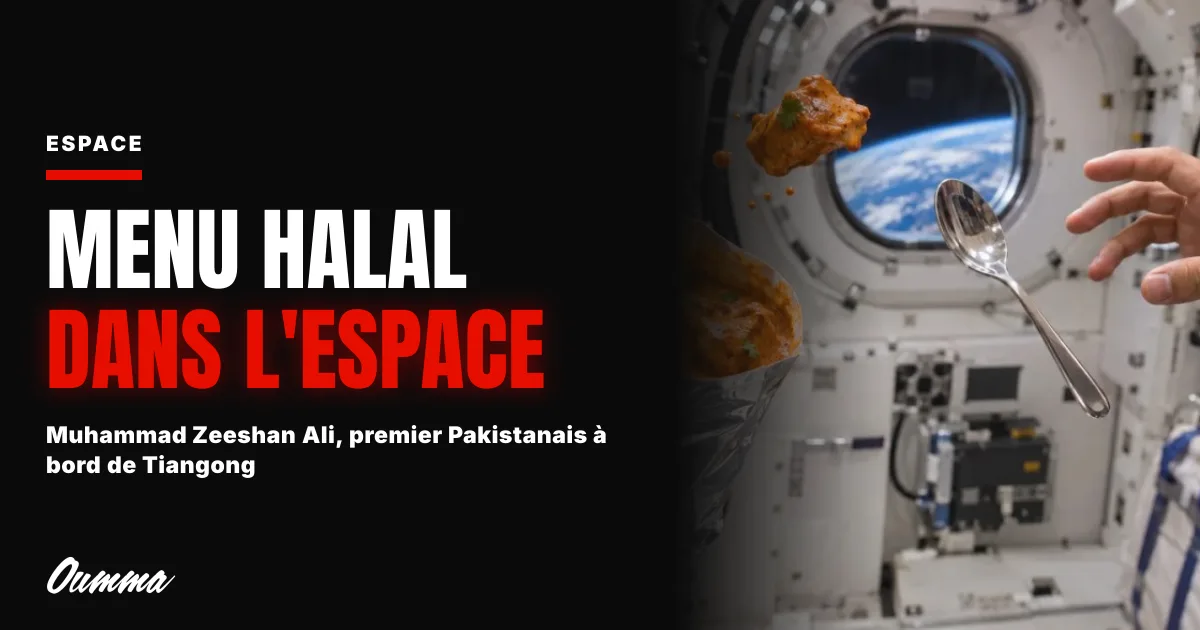
Tiangong: halal menu for a Pakistani astronaut
Butter chicken, beef stew and curry chickpeas are on the menu of Muhammad Zeeshan Ali, a Pakistani air force pilot who arrived on Wednesday November 25 aboard the Chinese Tiangong station. The first Pakistani to orbit the Earth, he will conduct scientific experiments there with the Chinese crew. For its first foreign astronaut, China has planned meals that comply with Muslim dietary rules.
Pakistani dishes and Iqbal verses aboard Tiangong
Muhammad Zeeshan Ali, 40, took off from the Jiuquan base in northwest China with Chinese commander Tang Hongbo and flight engineer Wu Yi. About six hours after departure, the three men joined their colleagues inside Tiangong, the laboratory that China operates in orbit. Ali had prepared for seven months in Beijing, where he took intensive Chinese lessons.
For meals, the Chinese team responsible for preparing the astronauts has developed seven Pakistani-inspired recipes, including nihari, a slow-cooked beef stew, and lamb korma. These recipes are part of a selection of more than a hundred halal options. Chen Junli, a researcher on the team, explained to Chinese public broadcaster CGTN that the preparation respected halal rules at every stage. The recipes have been tested and adjusted to meet the nutritional needs of astronauts while maintaining familiar flavors.
Introducing himself to his colleagues, Ali recited two verses by Muhammad Iqbal, a Pakistani poet and philosopher, in Urdu, then translated them into Chinese. In French, they can be rendered like this: “There are other worlds beyond the stars, and passion still has many trials to go through. »
Pakistan had already achieved a milestone on October 6, 2023. Pakistani explorer Namira Salim had reached space during a flight of Virgin Galactic, an American commercial spaceflight company. Its trajectory, called suborbital, brought it back to the ground after a few minutes in space. Ali’s mission takes place aboard a station that revolves around the Earth.
Forty years of Muslim presence in space
On June 17, 1985, Saudi Prince Sultan bin Salman became the first Muslim to go into space, aboard the American shuttle Discovery. The Syrian Muhammed Faris and the Afghan Abdul Ahad Mohmand then stayed in the Soviet station Mir, in 1987 and 1988 respectively. In September 2006, Iranian-American engineer Anousheh Ansari became the first Muslim woman to reach space, during a stay aboard the International Space Station.
In October 2007, doctor Sheikh Muszaphar Shukor, Malaysia’s first astronaut, joined the International Space Station at the end of Ramadan. The religious authorities in his country had prepared a guide to help him set prayer times and navigate towards Mecca aboard a moving station.
In 2023, Emirati astronaut Sultan Alneyadi spent six months in orbit. Before his departure, he had explained that he benefited from the exemption from fasting provided for travelers. In May of the same year, researcher Rayyanah Barnawi, the first Saudi woman in space, joined the International Space Station with Saudi pilot Ali Alqarni.
On board Tiangong, Ali must study the effects of space flight on quinoa seeds and participate in an experiment on the cultivation of microalgae intended for food. After this short stay, he must return to Earth with two members of the previous crew, aboard the ship Shenzhou-23.
Subscribe to the Oumma letter: our articles, our analyzes and our new programs arrive directly in your mailbox.
Free. One-click unsubscribe. Everything you need to know about Umma’s letter
