
A long history of American subversions and coups: from Mossadegh and Allende to the kidnapping of Maduro
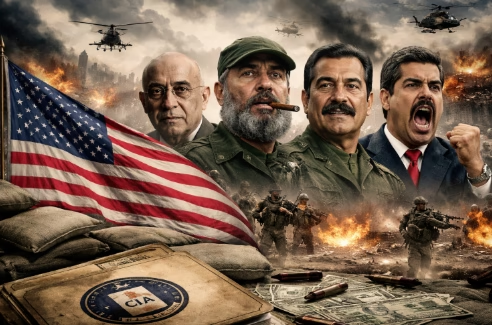
- Understand the historical continuity of American interventions.
- Explore the consequences of coups on the countries concerned.
- Consider the implications of failing to comply with international law.
A well-established imperial mechanism, from the 20th century to the present day
The kidnapping of Venezuelan President Nicolás Maduro is neither unexpected nor exceptional. It is part of a heavy historical continuity: that of an American policy based on subversion, the overthrow of governments and the assumed violation of the sovereignty of States which refuse alignment. What is happening today in Venezuela continues an ancient, methodical and documented practice.
Since the second half of the 20th century, the United States has made regime change a central instrument of its geopolitical domination. Behind official speeches on democracy and freedom, destabilization strategies are deployed: economic pressure, institutional sabotage, clandestine operations, then direct intervention when other means fail. The CIA has long been the preferred tool of this policy.
The Bay of Pigs episode in 1961 constitutes one of the most striking symbols. In Cuba, an armed operation was mounted to overthrow the revolutionary power of Fidel Castro. Mercenaries are trained and financed by Washington. The military failure is bitter, but the logic is clear: no state is tolerated if it escapes American control. In 1973, this same logic hit Chile. Democratically elected President Salvador Allende is overthrown after a long campaign of economic and political destabilization supported by the United States. The coup d’état paves the way for Pinochet’s dictatorship, marked by torture, disappearances and the crushing of all opposition. The human cost is immense.
From coups to open wars, an assumed escalation
Twenty years earlier, in Iran, Mohammad Mossadegh suffered the same fate for having nationalized Iranian oil. The CIA, with British support, overthrows a legitimate ruler and restores the Shah. This coup d’état plunged the country into decades of authoritarianism and paved the way for fractures still visible today. Each time, these operations constitute a flagrant violation of international law. The United Nations Charter, adopted after the Second World War, explicitly prohibits the use of force, interference in the internal affairs of States and any attack on their sovereignty. However, these principles are regularly trampled when American strategic interests are at stake, revealing an international order of variable geometry, where law yields to power.
Iraq, in 2003, marked one of the peaks of this policy of destruction. Under the administration of George W. Bush, the United States invaded the country based on proven lies. The overthrow of Saddam Hussein leads to the collapse of the state, hundreds of thousands of deaths and lasting regional chaos. Venezuela is fully part of this genealogy. Asphyxiating economic sanctions, institutional delegitimization, diplomatic isolation, then kidnapping of the head of state: each step reveals an assumed escalation against a country that refuses submission.
It must be said bluntly: the United States did not sow democracy, but instability, violence and disorder. From Iran to Chile, from Cuba to Iraq, and today in Venezuela, this policy has crushed entire peoples. The kidnapping of Nicolás Maduro is not an accident of history: it is its brutal continuity. As long as these political crimes go unpunished, they will continue to be repeated.
