
According to geopolitical scientist Jean-Antoine Duprat, Washington is trying to hide a failure in Iran
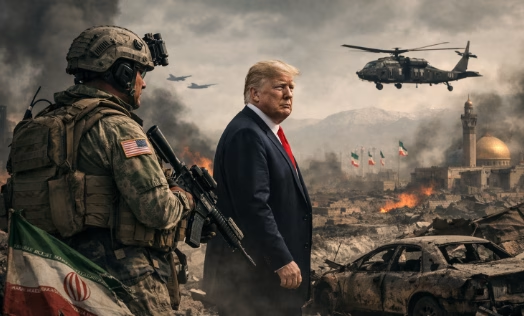
Jean-Antoine Duprat also emphasizes that several arguments put forward by the United States have gradually disappeared from the official narrative. The question of Iran’s regional relays, although presented as a major issue, is almost no longer mentioned. That of the Iranian population only appears marginally. In his eyes, this above all reflects Washington’s growing difficulty in supporting the idea of a strategic victory.
For the geopolitical scientist, the United States is now less interested in convincing people of their success than in preparing their withdrawal. “Above all, we feel that the Americans are trying to find arguments to withdraw from this affair, to get out of the mess,” he explains. He believes that the little music that is going up in Washington consists of saying: we have done the maximum, we have changed the regime, we have sorted everything out. But for him, this presentation does not stand up to the facts.
One of the most serious effects of this war, he adds, is the appearance of a new threat around the Strait of Hormuz, which has become a central point of tension. However, this blockage, he explains, did not exist before with such acuteness.
Editor’s note:
What is at stake here is no longer a simple error of assessment, but an assumed shift in the construction of a story disconnected from reality. Washington is not only failing on the ground: it is constantly reconfiguring its objectives to hide the evidence of its setbacks, in a logic that now resembles organized strategic denial. To present as neutralized a nuclear program which is not, to announce the collapse of ballistic capabilities still active or to suggest a non-existent regime change amounts to substituting communication for the reality of the facts.
This headlong rush reveals a power which, despite its military superiority, has lost control of the dynamics it itself set in motion. Unable to anticipate the cascading effects of its intervention – notably the worsening of tensions around the Strait of Hormuz – the United States appears as an actor which destabilizes without controlling, strikes without resolving and locks itself into a conflict whose objectives become more vague every day.
Even more worrying, the current attempt at disengagement is accompanied by a clear desire to transfer costs and risks to other powers. This posture gives the image of an actor who provokes crises, fails to contain them, then releases them once the situation becomes unmanageable. Beyond the military failure, a strategic and political bankruptcy is taking shape, lastingly weakening American credibility and establishing the idea of an increasingly erratic, disorderly leadership incapable of assuming the consequences of its own choices.
— Oumma.com (@oumma) March 31, 2026
