
Annual Islamic Finance Gala – Oumma Report in Paris
Umma at the heart of Islamic finance in France
On the occasion of the 2nd edition of the annual Gala of Islamic finance players in France, organized on Saturday January 24, 2026 in Paris, the Oumma team was present on site to experience the event from the inside and meet its players.
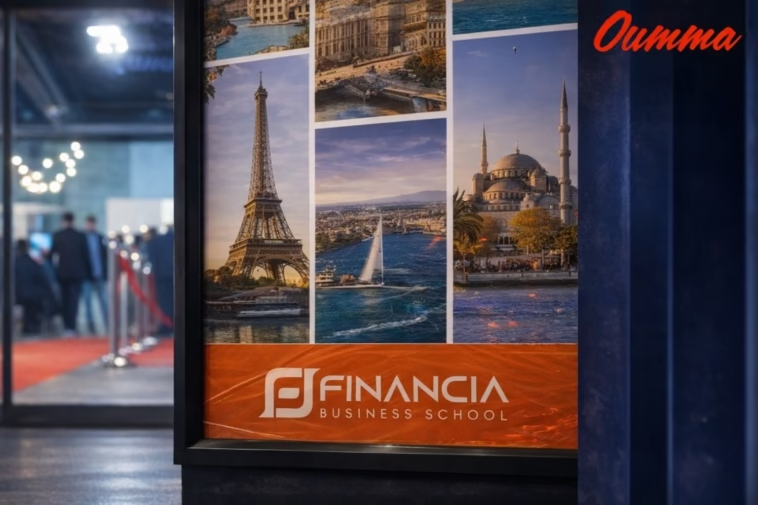
Organized by the Islamic Finance department of Financia Business School, this evening brought together experts, entrepreneurs, managers, insurers and students around a common objective: to better understand and develop Islamic finance in France.
Thanks to the testimonies collected from the guests and professionals present, our report highlights a sector that is still young, sometimes little-known, but driven by real dynamics and a growing demand for more ethical financial solutions. A moment of discussion, reflection and perspectives, which we wanted to share with you.
Understanding the foundations of Islamic finance
Boubacar Correa, former general director of the Islamic Bank of Senegal, recalls the key principles of Islamic finance. This prohibits interest (riba) and is based on risk sharing between the bank and the client. Depositors are considered investors, remunerated based on the bank’s actual performance. Financing is based on concrete operations: sale of goods with known margin, rental or partnerships. For him, Islamic finance is above all “an association between the bank and the client”, based on ethical and transparent rules.
A very real market in France
Adnane El Gueddari, general manager of Ummia Bank, insists on the potential of the French market. According to him, Islamic finance responds to an economic logic above all. Although the demand largely comes from the Muslim community, its values – refusal of speculation, financing of tangible goods, sharing of risks – are universal. He believes that finance based on these principles could appeal to a much wider audience, in search of meaning and stability.
Train and open perspectives
For Kader Merbouh, director of the Islamic Finance department at Financia Business School, training is a central lever. It presents the certificate and MBA programs developed in France and internationally, and highlights the importance of cultural diversity. The presence of players from the Maghreb and West Africa reflects, according to him, the key role of the diasporas in the development of this finance. He also recalls that the gala aims to give visibility to existing actors and to fight against stereotypes.
Nasser Zammit, advisor on international relations and geopolitics, encourages broadening horizons. He invites students and professionals to draw inspiration from Asian or American experiences, emphasizing that the center of gravity of global finance is gradually moving towards Asia.
Relaunch the debate in France
Nasser Hideur, general manager of Al Salam Bank Algeria, recalls that a strong enthusiasm once existed in France for Islamic finance, particularly in the academic world, before a certain slowdown. For him, this type of event makes it possible to relaunch the debate and propose financial alternatives that respect religious and cultural beliefs. It also underlines the universal dimension of this finance, recalling that its principles can contribute to bringing finance closer to the real economy.
Concrete initiatives on the ground
Samuel Badibanga Kamuleta, marketing entrepreneur, discusses the emergence of fintechs inspired by the values of Islamic finance, like MuskePay. He points out that more and more companies are adopting ethical money management. Brahim Mizmani, from Asekkey Assurance, explains that although the offer has clearly developed, it remains incomplete, particularly in home, savings and investment insurance. Mickael Sadoun, insurance agent, finally insists on the urgent need for financial education to raise awareness of existing solutions.
Youth as a relay for the future
Anaïs Iskounnene, an MBA Islamic finance student, is optimistic. She believes that new generations will be able to create bridges between international models and the French context. Popularizing, explaining and supporting will, according to her, be essential to democratize this finance and make it accessible to as many people as possible.
A sector to be structured, a dynamic to be confirmed
In conclusion, Kader Merbouh draws up a lucid but encouraging observation. He recalls that no bank yet directly offers Islamic finance products in France, but that this situation has favored the emergence of a strong entrepreneurial spirit. The gala aims precisely to bring the actors together, consolidate their links and structure a still young ecosystem.
It also highlights the educational guides presented during this edition, intended to better explain concepts such as zakat companies or ethical savings, in order to fight against misunderstandings and prejudices. Satisfied with the mobilization and diversity of the participants, he sees this second edition as a real success and a positive signal for the future. A dynamic which already nourishes the hope of a third edition and confirms that Islamic finance is gradually gaining visibility and legitimacy in France.
