
Assessment 2025: Humanity bankrupt…
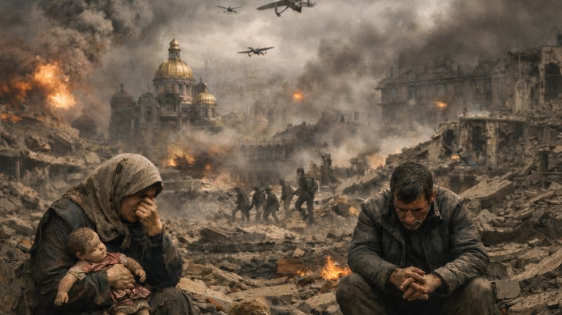
The year 2025 ends with an even more dire observation than the one that preceded it: hundreds of thousands of lives destroyed in conflicts which, for many, could have been avoided. Ukraine and Palestine tragically embody this distress. Once again, economic, military and geopolitical logics have prevailed over the value of human life. This supremacy of interests over humanity has imposed itself with a brutality and a magnitude which shock and shake the conscience of our time.
How did we get to such a degree of desensitization? At this point where we contemplate, on our screens, the open-air carnage of Gaza or kyiv as a simple flow of images among many others. Journalists, let us rather call them complacent commentators, who have maintained the same editorial line throughout these conflicts, strive to trivialize the horror, even to justify it, delivering their binary verdicts to us daily. For Palestine: Israel would have the “right to defend itself”, depriving the Palestinian population of food would constitute a legitimate measure. For Ukraine: it is made to believe that it can defeat Russia, thus prolonging a deadly conflict. In both cases, the same logic: the fault of some, the absolute innocence of others. The first conflict would be attributable to the Russians alone, since they would have “attacked”. The second would be reduced to October 7. As if these wars had no history. As if we could rewrite the past by arbitrarily selecting landmark dates, erasing everything that came before to better legitimize the unacceptable.
Added to these misfortunes which have struck the world is the rise and consolidation in power of leading extremist figures. The return of Donald Trump to the American presidency, carried by the wave of the far right and at the head of the most powerful state in the world, precipitated an already catastrophic situation, institutionalizing cynicism and impunity as principles of governance and injecting further madness into an already faltering world order.
This year 2025, without exaggeration, is the worst that our generation, like that of millions of people around the world, has known. It should have been a moment of hope and celebration. Instead, 2025 leaves behind a sense of heaviness and a bitter taste. The so-called “civilized” world, the one that claims to be Enlightenment, is dying out, revealing a new face: an image that will undoubtedly remain engraved in the history of humanity, that of the collapse of its own values. The extermination of entire populations, women and children without any distinction, the dispossession of land, organized famine, the torture of prisoners, even rape, the open contempt for international law, all carried out under cover of a story forged by the bloodthirsty and legitimized by so-called international legality, with almost general indifference. The humanist principles proclaimed in peacetime have faded in the face of geopolitical interests.
Furthermore, the emergence of the digital world a few years ago could have embodied emancipation and progress and openness towards others. Instead, these technologies, new means of communication, have also liberated the words of the devil, and censored the words that unite and which appeal to reason have turned into instruments of war and surveillance, giving birth to a new form of post-ideological techno-populism, based not on ideas but on the algorithms developed by the engineers of chaos, as Giuliano da Empoli points out in his work The Chaos Engineers.
The advent of artificial intelligence has taken this drift to an unprecedented level. In Palestine, Israel deploys systems like “Lavender” and “Gospel,” artificial intelligence that generates target lists and optimizes strikes. According to testimonies from former military officials, these algorithms analyze thousands of data points to designate who should die, transforming assassination into an automated process. Harop drones and autonomous surveillance systems are turning Gaza into an open-air laboratory for algorithmic warfare.
In Ukraine, both sides use “smart” suicide drones, AI reconnaissance systems, and targeting algorithms that accelerate the decision-making cycle of death. Civilian populations become the involuntary guinea pigs of these lethal technologies. And this is only the beginning: the future undoubtedly contains catastrophes whose scale we do not yet understand.
If human beings have abdicated their humanity in these conflicts, artificial intelligence is only the amplified reflection of this decline. The machine has no soul: it only executes, with formidable efficiency, the will of those who designed it to kill. A new paradigm thus emerges where technology, far from bringing people together, perfects the means of destruction. It adds an additional layer of coldness and dehumanization to an already bloodless world. As if humanity, on the brink of the abyss, deliberately chose to pour the poison that will complete its fall.
It is important to remember that what is taking place in Palestine has been described as genocide by the UN, numerous human rights organizations and a large majority of specialists. This is a campaign of mass killings on a scale unprecedented in contemporary history. Even after the announcement of a ceasefire in October 2025, more than 300 Palestinians still died. And we dare to speak of improvement, simply because previously, this number of victims fell every day.
We have reached that point of despair where the deaths of hundreds of human beings seem almost insignificant. The tragedy has turned into routine, and our collective heart, anesthetized by media and digital news, has become dangerously accustomed to these macabre assessments. The bombings followed one another at such a pace that we barely had time to comment on one before it was already eclipsed by the next, in an infinite spiral that saturated the media and cognitive scene, plunging the world into a mixture of astonishment and helplessness.
Worse still, those who dare to denounce this horror are silenced, imprisoned, criminalized. By imposing this macabre daily life on us, by normalizing the unspeakable, empathy is eroded. Something essential, something profoundly human, breaks within us.
The year 2025 has us witnessing a macabre race, even more intense than the previous year, towards the most sinister of all prize lists: who will have exterminated the most lives, massacred the most populations, condemned the greatest number to starvation? Who will have deployed the most lies, perfected the art of manipulation? This competition in abomination recalls this sentence attributed to Dostoyevsky: “Rest assured, hell is big enough for everyone; it doesn’t deserve all this fierce competition to see who among you will be the worst. »
And on the other side of the abyss, 2025 will also leave the memory of those who persevered in their passive contemplation, complicit spectators of the unspeakable. Because they too abdicated, during this disastrous year, what made them human beings. Between those who act and those who silently observe, the difference has been reduced to nothing.
Faced with this moral debacle, a nagging question arises: how can we rebuild what has been destroyed? How can we regain this humanity that we have collectively abdicated? History teaches us that major humanitarian disasters leave indelible scars, not only on bodies but on consciences. Yet never before has the collapse been so methodically documented, disseminated, normalized. We are witnesses to an era where horror no longer hides in the shadows but is displayed in broad daylight, legitimized by empty legal discourses and geopolitical rationalizations.
Perhaps this is precisely where our ultimate responsibility lies: to refuse this normalization. Refuse to allow massacres and famine to become a simple column in the evening newspaper. Refuse to allow the death count to become abstract statistics. Because if we accept this state of affairs, if we allow this moral anesthesia to take hold definitively, then 2025 will not only be the year of the collapse of humanist values - it will be the year in which we will have consented to our own dehumanization, perhaps even to the beginnings of the disappearance of the human species, threatened by nuclear proliferation and the madness of men. Does this grim assessment still leave the possibility of reversing the trajectory and taking back control of our destiny?
With deep sadness at the end of this year, let us nevertheless preserve a spark of hope for those who still believe in it. May 2026 bring relief to those who mourn a father, a mother, a child, sometimes an entire family, murdered and tortured by the supposed superiority of evil.
To those who have been dispossessed of their land and whose homes have been razed. To those who, at this very moment, are shivering in the cold without shelter or bread. May they regain what humanity stole from them with the complicity of our silences: dignity, peace, a home…
Nabil MATI
Teacher at Paris University
EHESS – (Anthropology)
