Decolonizing humanitarian work: the experience of the Palestinian organization Sa7ten in Gaza
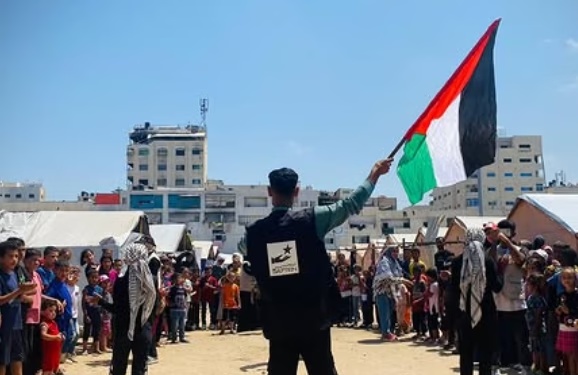
Born in Paris in 2023, the Sa7ten initiative stands out today as a form of humanitarian aid deeply anchored in Palestinian solidarity and the decolonization of field practices. Supported by Palestinians in the diaspora and a local team in Gaza, Sa7ten acts both to respond to vital emergencies and to strengthen collective autonomy. Faced with the systematic erasure of Gaza and the limits of traditional NGOs, Sa7ten offers another path: that of Palestinian solidarity, anchored in the field and freed from the colonial logic of humanitarian aid. Meeting with Emilie, one of the founders, who discusses the genesis, philosophy and daily challenges of their commitment to Gaza.
How was the Sa7ten initiative born and what urgent need was it seeking to fill at the time of its creation?
Sa7ten was founded in February 2023 by two Palestinians located in Paris, thinking about how they could directly help people in Gaza. The association’s first events were fundraising dinners and concerts that helped evacuate several families from Gaza. The evolution of Sa7ten was characterized by a desire to also act on site, for those who could not or did not want to leave. A team of volunteers was then formed organically in Gaza, and our role since then has been to support them on all levels – financial, political and human.
You talk about “decolonization of humanitarian aid”. Concretely, what does this approach mean and how does it differ from traditional NGOs?
Sa7ten places the decolonization of so-called “humanitarian” aid at the center of its practice, by promoting inter-community field leadership and responding directly to the needs identified by those on site. The last two years in Gaza have revealed to us more than ever the dysfunction of traditional NGOs which, once the borders close, can no longer act. Our approach is anchored in a knowledge of the field that only those living on site can master. What this means in practice is that our team always manages to manage, whether it’s finding food or establishing ways to distribute it safely. This knowledge allows us to take paths, certainly non-traditional or institutional, but which nourish the autonomy of the Palestinians in Gaza.
What are the main types of actions carried out by Sa7ten on the ground in Gaza today?
The recent ceasefire represented a hope of being able to resume activities beyond the survival and primary needs of Gazans. However, in the immediate future, bombings continue. Our team is therefore focused on cooking as much as possible and sharing these meals. These meals are the result of reflections on the choice of foods that can restore physical strength for as long as possible. Our last cooking and distribution activity was on October 20.
The word “Sa7ten” means “two healths”. Can you explain the symbolic significance of this name and what it says about your vision of collective well-being?
The choice of the name of our organization is not trivial. By naming it “two healths”, we wanted to play on the fact that we launched this initiative with dinners, and because what we want to nourish above all else is a spirit of community. As much for the Palestinians in Gaza as for the Palestinians in the diasporas coming together around the desire to help. By choosing the name Sa7ten, we have chosen to commit to care, autonomous organization and the preservation of human dignity. This is also evident in the actions we support, such as the construction of a community center and a first aid room during the beginning of 2025.
What challenges does your team encounter on a daily basis in a context of occupation, war and systematic erasure of Gaza?
Obviously now, the primary difficulty for our team is the supply of resources on site, whether it is drinking water, food, wood to cook the food or diesel to transport all of this. Beyond material resources, the difficulty also lies in the lack of human, psychological or political support, which inevitably leaves its mark. Even when our team members manage to obtain supplies, we then have to distribute the resources, which, without a ceasefire, is an immense ordeal.
Israel deliberately targets everyone who sustains life in Gaza – the journalists, the civil defense teams, the paramedics who risk everything to keep people alive, the doctors. In a context of incessant bombing, sending anything is a danger, and this is precisely what our team constantly faces. However, it persists, continues its missions and nourishes an unparalleled spirit of resilience, as during the last invasion of Gaza City in September 2025.
How can people outside of Palestine concretely support or get involved in your approach to solidarity and autonomy?
To support us, you can make a donation from our website. Every penny sent reaches Gaza in the most direct and efficient way possible. It is also important for us to place our initiative in a broader solidarity movement, which is why we also encourage people to join the popular Palestinian movements mobilizing in the streets and to boycott institutions and businesses complicit in this violence.
Comments collected by the Oumma editorial staff
