
Diversity and tolerance: why reread Ibn Arabi today
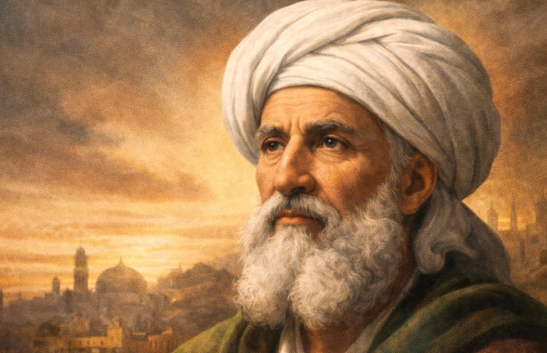
In an era marked by identity tensions and religious fractures, Ibn Arabi’s thought appears to be a rare breath of fresh air. Born in Andalusia in the 12th century, this great master of Sufism developed a vision of the world centered on what he calls wahdat al-wujûdthe unity of being. Behind this expression, there is a simple but profound idea: everything that exists finds its origin in the same divine reality. This vision may seem distant, but it resonates strongly today, at a time when differences are often experienced as irreconcilable oppositions.
Contrary to what one might believe, this unity does not mean that everything is the same or that differences should be erased. Ibn Arabi, on the contrary, insists that diversity is part of the divine plan. Languages, cultures, religions, sensitivities: all of this contributes to the same richness. Each tradition is not an error or a deviation, but a particular way of expressing a larger truth. In this sense, diversity is no longer a problem to be solved, but a reality to be understood and welcomed. This way of seeing can profoundly transform our relationship with the world. It invites us to move away from a logic of confrontation and enter into a logic of understanding. Instead of seeking to impose a single vision, it pushes us to recognize that reality is broader than our own frameworks. In increasingly fragmented societies, this idea opens up a space for peaceful reflection.
An invitation to humility in the face of the truth
In a world where everyone is tempted to defend their convictions as absolute, Ibn Arabi’s thought acts as a reminder to humility. It shows that truth can never be totally enclosed in words, doctrines or affiliations. Even religious discourses, however sincere they may be, remain human attempts to approach an infinitely larger reality. This does not mean that all beliefs are equal or that there are no longer any benchmarks. But this involves recognizing our limits. We always understand part of reality, never all of it. This awareness profoundly changes the way we interact with others. It avoids falling into rapid judgment or systematic condemnation.
From this perspective, the other is no longer just someone who thinks differently. He becomes a person who can teach us something. His experience, his tradition, his way of believing can shed light on aspects that we do not see. This posture opens the way to a more sincere dialogue, far from sterile debates or ideological clashes.
Seeing others differently in a divided world
One of Ibn Arabi’s most significant contributions is this idea that the relationship with others can become a spiritual experience. Meeting someone is not just about exchanging ideas or coexisting in the same space. It is also, in a certain way, encountering another manifestation of the divine. This vision gives new depth to human relationships.
It goes beyond simple tolerance, which often consists of accepting others without really understanding them. Here, it is about going further: recognizing the dignity of others in who they are, even when they are different. This requires an inner effort, work on oneself, but this is also what makes this thought demanding and valuable. In a world riddled with religious tensions, identity conflicts and misunderstandings, this approach offers another path. It does not deny disagreements, but it prevents them from becoming definitive ruptures. It reminds us that behind visible differences, there exists a deeper unity.
Rereading Ibn Arabi today is not looking for ready-made answers. It’s learning to look differently. It means accepting that reality is complex, that others are not a threat, and that diversity can be an asset. In a context often marked by fear and withdrawal, this thought opens a calmer, but also more demanding, path.
