
Eva de Vitray-Meyerovitch, the French intellectual who embraced Islam to reveal its mystical and universal depth
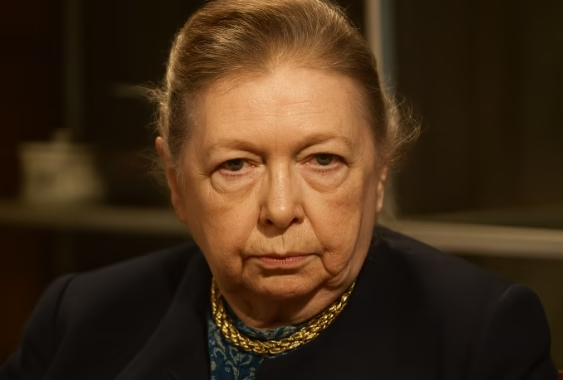
Eminent French intellectual of the 20th century, Eva de Vitray-Meyerovitch, born in 1909 and died in 1999, from a bourgeois and Catholic family, embraced Islam around 1950, responding to an intimate call which made her say: “We do not convert to Islam. We embrace a religion that contains all the others. » Specialist in Mohammed Iqbal and Muslim mysticism, this writer, translator and researcher discovered Islam through Reconstructing Islamic religious thoughtthe founding work of the spiritual father of Pakistan.
In a report filmed in 1992 (see video) below, Eva de Vitray-Meyerovitch, then aged 83, looks back on her intellectual and spiritual journey. Doctor of philosophy, former director of the human sciences department of the CNRS, project manager in Iran, Pakistan and Turkey, she also taught at the University of Cairo. It was through the great voices of Persian mysticism that she entered Islam: “It is these great thinkers that I discovered from Rumi, from Iqbal, from Ghazali and all these great thinkers at the time completely ignored in the West, who made me discover a fundamental Islam, which has absolutely nothing to do with the kind of caricature that we see today. »
Her fascination with Jalâl al-Dîn Rûmî, which she helped to make known in France, was decisive. She evokes, in amazement, the visionary depth of the 13th century spiritual master: “Rumi spoke of nuclear fission and its dangers, knew that there are nine planets… even spoke of the repercussion of a vibration made by a man (…) in galaxies not yet discovered. We think we’re dreaming. This is still five centuries before Galileo. »
In Rumi, she saw an astonishing concordance between mystical intuition and modern science, a harmony that “amazed” her.
The testimony of Eva de Vitray-Meyerovitch sheds light on a singular moment: the one where a French intellectual, at the height of her academic career, turned to an Islam stripped of the stereotypes and political readings that already enveloped it in the 1990s. Her words remind us that the encounter with this religious tradition can go through the quest for meaning, poetry and inner experience, far from identity debates. By promoting figures like Rûmî, Iqbal or Ghazali, she defends the idea of a universal Islam, deeply humanist, and in resonance with contemporary questions. His voice, calm but determined, continues to serve as a valuable counterpoint to the reductive visions still dominant today.
Eva de Vitray-Meyerovitch, the French intellectual who embraced Islam to reveal its universal depth
Eminent French intellectual of the 20th century, Eva de Vitray-Meyerovitch, born in 1909 into a bourgeois and Catholic family, embraced Islam around 1950,… pic.twitter.com/cCQYxWZXPw
— Oumma.com (@oumma) November 23, 2025
.
