
Fall of the Iranian regime: an external earthquake with global consequences
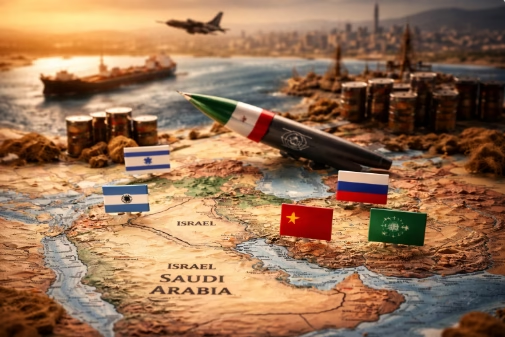
The fall of the Iranian regime would not be a simple change of power in Tehran. It would cause a major external shock, capable of profoundly reconfiguring the regional and international balance of power. For more than forty years, Iran has occupied a central place in the architecture of tensions in the Middle East, serving at the same time as a strategic rival, a diplomatic scarecrow and a political alibi for many actors. Its political transformation would bring down an essential pillar of this artificial balance, brutally revealing the responsibilities, the double standards and the lies maintained in the name of “security”.
Israel: when the enemy disappears, the story falters
For Israelthe fall of the Iranian regime would be a hard blow, not primarily military, but political and ideological. For decades, the “Iranian threat” has been used as a central pillar of Israeli security discourse. It helps justify occupation, permanent militarization, repeated violations of international law and an aggressive foreign policy presented as defensive.
The disappearance of an openly hostile Iranian regime would deprive Israel of a convenient enemy, almost essential to the legitimization of its strategic choices. In the short term, Tel Aviv would invoke chaos, instability and nuclear risk to maintain pressure and maintain a posture of strength. But in the medium term, the narrative of the existential threat would dangerously crumble.
A less ideological Iran, refocused on its internal affairs and open to international cooperation would expose a reality that is difficult to hide: Israel is no longer a “besieged” state, but a dominant military power, equipped with nuclear weapons, refusing all transparency and all international constraints. The fall of the Iranian regime would inevitably shift the focus towards the Israeli nuclear arsenal, kept out of control by a Western silence that is now increasingly indefensible. In this scenario, Israel would no longer appear as a potential victim, but as one of the main factors of regional imbalance, sheltering behind threats that it itself helps to maintain.
Nuclear power: the end of double standards?
The nuclear issue would immediately become central. The fall of the Iranian regime would raise a question that Western chancelleries carefully avoid: is non-proliferation a universal principle or a political tool reserved for adversaries? An Iran accepting reinforced inspections and a strictly civilian program would shatter the logic of selective sanctions. It would expose an international order quick to punish Tehran, but incapable — or refusing — to demand the slightest transparency from its allies, starting with Israel.
The Iranian transition would then become a test of credibility for an international system discredited by its own contradictions, and increasingly perceived as an instrument of domination rather than regulation.
Saudi Arabia: weakened rival, imperative stability
For the‘Saudi Arabiathe fall of the Iranian regime would be greeted with a mixture of relief and caution. The rivalry between Riyadh and Tehran has structured a number of regional conflicts, often at the cost of major human disasters.
The end of a revolutionary Iran would reduce pressure on these indirect fronts. But a prolonged collapse of the Iranian state would represent a major danger for the Gulf. Saudi Arabia would therefore have every interest in a controlled, stabilizing transition, rather than lasting chaos likely to threaten energy routes and regional balance.
The oil market: the energy weapon changes sides
On an energy level, the impact would be immediate. The announcement of the fall of the regime would cause strong price volatility, fueled by fear of disruptions around the Strait of Hormuz, a vital artery of world trade.
In the medium term, an Iran freed from sanctions could massively return to the oil market. This reintegration would redistribute the cards within theOPECweakening current balances and putting dominant producers under pressure. For the major importing economies, this return would be a breath of fresh air. For certain rentier states, a source of strategic concern.
China and Russia: the end of a constrained partner
For the ChinaIran is above all an energy supplier and a strategic point of support against the West. Beijing has taken advantage of Iranian isolation to strengthen an asymmetrical relationship. A normalized Iran, reintegrated into the international game, would be less dependent and more demanding.
Same logic for the Russia. The Iranian-Russian relationship, essentially tactical, would lose part of its strategic usefulness. Above all, the return of Iranian oil and gas would increase competition on global markets, to the detriment of Russian interests.
The fall of the Iranian regime would guarantee neither peace nor justice. But it would bring down a major smokescreen. It would expose those who have built their policies on the permanent demonization of Iran, those who have thrived on fear, and those who have assumed the right to violate the rules they impose on others. In this new landscape, Israel could no longer hide behind the Iranian threat to justify occupation, repression and impunity. The great powers could no longer hide their double standards behind security discourse.
The fall of the Iranian regime would then be less a conclusion than a moment of truth: one where the balance of power, hypocrisies and real responsibilities would finally appear without mask.
