
Ibn Arabi, a major figure in Muslim mysticism
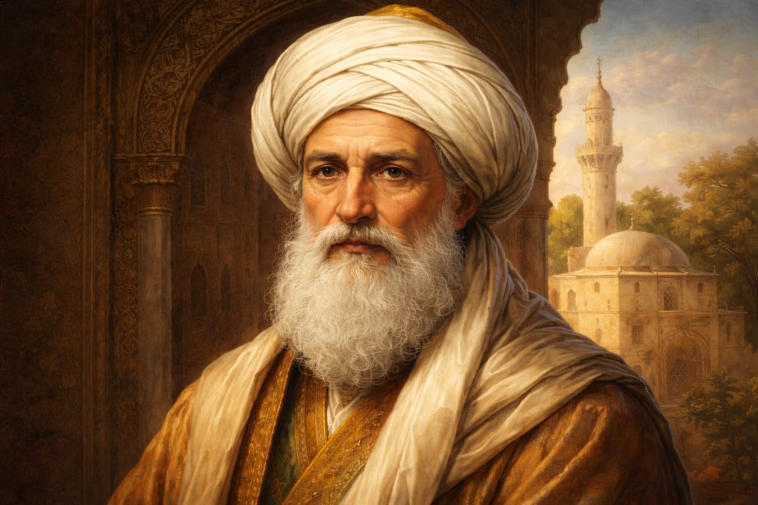
- Discover the immense work of Ibn Arabi and his contributions to Islamic spirituality.
- Explore the doctrine of the oneness of Being and its vision of religious diversity.
- Understand the controversies surrounding his thought and contemporary legacy.
Ibn Arabi, born in 1165 in Murcia, in al-Andalus, and died in 1240 in Damascus, is one of the great figures of Islamic spirituality. Known as al-Shaykh al-Akbar“the greatest of masters”, he had a profound impact on Sufism through a very vast body of work, combining poetry, philosophy and religious reflection. Its influence is not limited to the medieval Muslim world: it continues to inspire researchers and thinkers to this day.
An immense and demanding work
More than three hundred works are attributed to Ibn Arabi, many of which have been preserved. Two of them are particularly important: The Illuminations of Mecca (Al-Futûhât al-Makkiyya) And Wisdom Kittens (Fusûs al-Hikam). These texts are neither classic religious treatises nor simple spiritual writings. They offer an inner reflection on the link between God, the world and human beings.
In The Illuminations of MeccaIbn Arabi mixes metaphysical thoughts, commentaries on the Koran, stories of visions and spiritual teachings. He affirms that true knowledge does not consist of accumulating knowledge, but of allowing oneself to be transformed internally. For him, spiritual knowledge is above all a lived experience.
An open and plural spirituality
Ibn Arabi is best known for the doctrine of wahdat al-wujûdoften translated as “the uniqueness of Being”. According to him, there is only one true Being: God. The world and creatures are not separate from Him, but are multiple manifestations of Him. This vision does not erase divine transcendence; on the contrary, it affirms that all reality bears a trace of God. The universe thus becomes a set of signs leading to divine knowledge, provided that the inner gaze is purified.
Ibn Arabi is also famous for his thoughts on religious diversity. In an oft-quoted poem, he explains that his heart can accommodate all forms of belief. This idea is sometimes understood as a call for tolerance, but above all it refers to a spiritual experience: each sincere faith reflects an aspect of divine truth. God manifests himself differently to everyone, according to their inner capacity. No belief can therefore claim to contain God on its own.
Controversies and legacy
Such a bold thought caused a lot of criticism. Some theologians have accused Ibn Arabi of vagueness, even of heresy, believing that his ideas risked confusing God and creation. However, he never wanted to leave the framework of Islam. He constantly draws on the Koran and the example of the Prophet, and reminds us that true spiritual knowledge leads to humility. For him, knowing God also means recognizing his own limits.
Today, Ibn Arabi is widely recognized as one of humanity’s great spiritual thinkers. In a world marked by identity tensions and rigid readings of religion, his work invites an inner faith, deep and open, where the quest for God passes through self-knowledge and respect for human diversity.
