
Ibn Khaldoun: why do civilizations collapse?
An ancient question, a contemporary concern
Why do certain civilizations dominate their era for centuries, before disappearing or losing all influence? Why do once-powerful societies end up weakening, dividing, and then depending on others?
These questions are not just about the past. They resonate strongly today, particularly in the Muslim world. Everywhere, we observe political crises, internal tensions, economic difficulties and a loss of collective reference points. Many have the vague feeling that something has weakened, that the bond between individuals has become looser, that the common project is no longer as clear. Faced with this observation, it is tempting to blame only external factors: international balance of power, interference, geopolitical injustices. These elements exist, of course. But they are not enough to explain, on their own, the depth of the uneasiness.
This is precisely what Ibn Khaldoun allows us to understand. As early as the 14th century, he already laid the foundations for lucid reflection on the birth, power and decline of civilizations.
How civilizations are born and disappear
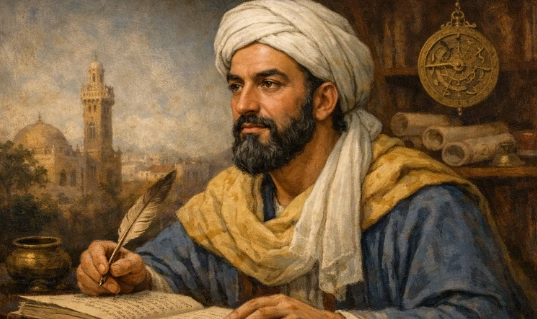
Born in 1332 in Tunis, Ibn Khaldoun was not only a man of knowledge. He was at the heart of power, in contact with leaders, crises and political rivalries. He has seen dynasties rise and fall. This direct experience allowed him to develop a very concrete vision of history. In his major work, the Muqaddimahe explains that civilizations do not develop randomly. They follow cycles. They are born in difficulty, grow thanks to strong cohesion, reach a peak, then gradually decline.
At the center of this process, he places an essential idea: asabiyya, that is to say solidarity between the members of a group. Initially, this solidarity is strong. It unites individuals, gives them a common goal and pushes them to surpass themselves. It is this collective force that makes it possible to build a State, stabilize a territory and bring about the emergence of a civilization. But this dynamic does not last forever. Over time, generations change. Those who arrive later do not know the sacrifices of the beginning. They inherit comfort, stability, sometimes wealth. Little by little, the collective spirit weakens.
The elites are detached from the rest of society. Power becomes a personal issue. Internal rivalries take over. What initially united begins to disappear. And this is where the process of decline begins.
This decline is not sudden. It is progressive, often invisible at first. But it becomes inevitable when society loses what made it strong: its cohesion.
A reading grid to understand the Muslim world today
If we look at the current situation through this analysis, the parallels are striking. In many countries of the Muslim world, internal divisions run deep. Political, social or ideological tensions weaken societies. Elites are sometimes cut off from realities on the ground, and populations struggle to recognize themselves in the proposed projects.
Added to this is an economic or strategic dependence on external actors, which limits the ability to act freely. But, as Ibn Khaldoun points out, this dependence is often the consequence of an older internal weakening. What seems most worrying is the loss of confidence. Trust in institutions, in leaders, but also between citizens themselves. When this trust disappears, the social bond becomes fragile. Everyone withdraws into their own interests, and the idea of a common destiny becomes more difficult to defend.
From this perspective, the current crises are not only political or economic. They are also moral and social. They affect the way a society thinks of itself and its ability to remain united in the face of difficulties.
A lesson for our times
What Ibn Khaldun teaches us is that decline is never caused solely by external forces. It almost always starts from within. It is when solidarity disappears, when the sense of the collective fades and when individual interests take over that societies become vulnerable. But this analysis is not a condemnation. It also opens up a possibility. If the decline comes from the loss of cohesion, then reconstruction involves strengthening this bond. This involves restoring justice, rebuilding trust and giving meaning to the idea of the common good.
It is not just about technical reforms or institutional changes. This is a deeper work, which touches on the way in which individuals relate to each other and project themselves into the future. Ibn Khaldoun thus reminds us of an essential truth: no civilization is eternal, but none is doomed in advance either. Everything depends on the capacity of a society to renew itself, to rediscover what makes it strong and to rebuild a shared project.
Ultimately, the question is not only about understanding why civilizations collapse. The real question is whether we are capable, today, of avoiding this collapse — and above all whether we are prepared to change what needs to be changed to achieve it.
