
India: Turkman Gate mosque spared during demolition which degenerated
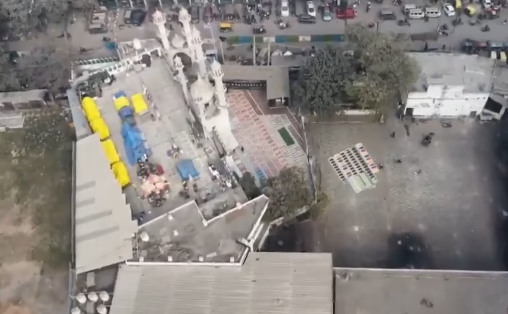
Drone images broadcast after a demolition operation in Delhi confirm that the mosque Faiz-e-Elahi Masjid was not damaged, contrary to rumors which circulated on social networks and caused violent clashes. The intervention, carried out on January 7 by the Municipal Corporation of Delhitargeted constructions deemed illegal near Turkman Gate, not far from Ramlila Maidan. A diagnostic center, a guest house and a community hall were destroyed as part of this court-ordered operation.
However, the situation degenerated after messages were broadcast falsely claiming that the mosque was one of the targeted buildings. More than 200 people gathered, some throwing stones and bottles at the police. Five police officers were injured and police used tear gas to disperse the crowd. Ten people were arrested and a minor detained.
The authorities assure that coordination meetings had nevertheless taken place in advance with local and religious leaders in order to avoid any incident. The police are now calling for vigilance in the face of unverified information and have announced that they are investigating several influencers accused of fueling the rumor. The neighborhood, usually very lively, remained largely closed for the second day in a row, while security forces remained heavily deployed to prevent any further tension.
More broadly, this episode highlights a now well-established mechanism: in a climate of persistent community tensions, rumor circulates faster than established facts and is enough to inflame a local situation. The demolition operation, although limited to illegal constructions and supervised by a court decision, turned into a security crisis under the effect of misleading information relayed on social networks. The use of drone images to reestablish the facts says a lot about the times: visual proof has become essential to compensate for the growing distrust of institutional speech. In the background remains a central question, rarely addressed: as long as urban policies and so-called “anti-encroachment” operations mainly concern working-class neighborhoods and minorities, each intervention will be experienced as a symbolic threat, whatever its formal legality.
Full truth about Delhi demolition revealed @MainaBismee shares details with @shivaroor pic.twitter.com/O73oZAcvT4
— NDTV (@ndtv) January 8, 2026
