
Israel crosses new threshold: death penalty for Palestinians sparks global outrage
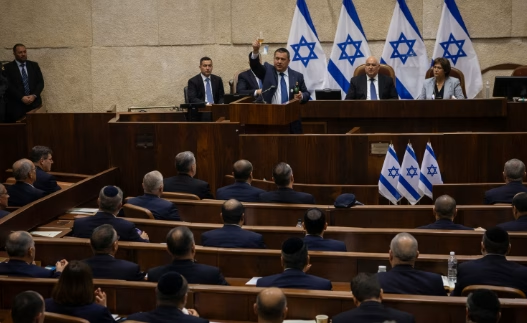
Israel’s parliament has passed a law introducing the death penalty for Palestinians accused of killing Israelis, sparking global outrage.
WHY READ:
- Understand the implications of this new legislation.
- Discover the reactions of international organizations and Palestinian authorities.
- Analyze the political and legal context of this decision.
Israel’s Parliament passed a law establishing the death penalty as the default sanction against Palestinians accused of killing Israelis. Led by far-right minister Itamar Ben-Gvir, the measure is denounced as a brutal, racist drift and openly contrary to international law. For human rights organizations, this legislation is not a simple penal toughening: it institutionalizes two-tier justice, where an entire population is targeted on an ethno-political basis. The fact that it applies specifically to Palestinians in the occupied territories reinforces the accusations of a system already described by several NGOs as apartheid.
Fascist Ben Gvir drank champagne in a sickening scene to celebrate a law passed by the Knesset that could allow the execution of Palestinian prisoners. pic.twitter.com/bUkW9OCcm1
— Oumma.com (@oumma) March 31, 2026
From Amnesty International to the UN, condemnations are pouring in. All point to a flagrant violation of international standards, in particular the ban on cruel and discriminatory punishment. The United Nations human rights office warns of a text which “institutionalizes discrimination” and legitimizes practices comparable to extrajudicial executions.
On the Palestinian side, the anger is total. The Palestinian Authority speaks of a “dangerous escalation”, while several officials denounce a law which reveals, according to them, an assumed shift towards an authoritarian and colonial system. Even in the West Bank, where this law applies, mass arrests and violence are already increasing, raising fears of an acceleration of abuses.
What this law reveals is not only political radicalization: it is the exposure of a system which no longer even seeks to conceal its logic of domination. By inscribing in legal stone a capital punishment reserved almost exclusively for a population under occupation, Israel ratifies a hierarchy of human lives, where those of Palestinians become explicitly less protected, less dignified, more easily expendable. It is no longer a question here of occasional excesses or security excesses, but of a coherent political project: to sustainably govern a people without rights, under military control, with a legal arsenal designed to crush any form of resistance. This law only formalizes a reality that has already been denounced for years: that of a regime which administers two populations according to radically different rules, one benefiting from full rights, the other locked in a permanent system of exception.
Calling this apartheid is no longer a militant stance, but a description that is increasingly difficult to challenge. When a state legalizes discrimination, normalizes institutional violence and establishes inequality as a principle of government, it crosses a historical line. The most worrying thing, beyond the law itself, remains the feeling of total impunity that accompanies it: that of a power convinced that no international pressure will really come to stop it.
