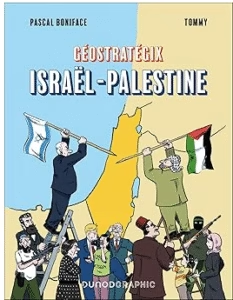
Israel-Palestine: the comic strip that says what the media keep quiet — Interview with Pascal Boniface
In an interview with Oumma, the director of IRIS, Pascal Boniface, reveals Géostratégix: Israel-Palestinehis new volume of comics created with the designer Tommy and published by Dunod. After exploring global geopolitics, international relations since 1945 and the Olympic Games in previous volumes, this new publication tackles one of the oldest, most sensitive and most distorted conflicts of the contemporary era. By choosing the comics format, Pascal Boniface displays a clear ambition: to make a subject of extreme complexity accessible, particularly to the youngest, without ever sacrificing historical rigor. Through a collaboration based on intellectual complicity and a keen sense of pedagogy, the author offers a clear, documented and essential tool for understanding an issue where preconceived ideas thrive faster than the facts.
A read that we highly recommendas it offers an intelligible, nuanced and salutary entry into a debate too often obscured by caricatures and passions.
Report of the interview with Pascal Boniface
A collaboration based on true intellectual complicity
The author explains that working with Tommy is based on a real intellectual complicity. The geopolitologist develops a rigorous text, respectful of historical chronology and careful not to neglect any fundamental event. Tommy then brings his knowledge of geopolitical themes, his ideas for staging and above all his humor, which makes it possible to lighten the narration without sacrificing precision. The work is therefore the result of constant back and forth, of a continuous dialogue between text and image in order to offer an educational and lively story.
Comics as a tool against preconceived ideas
Asked about the ability of comics to deconstruct certain misconceptions widely disseminated in the media, Boniface recalls that everything depends on the intention of the authors. A comic strip can serve propaganda as it can enlighten a misinformed public. Concerning the Israeli-Palestinian question, he underlines the extent of the manipulations and denialist discourses circulating: some deny the realities experienced in Gaza, others present the Israeli army as seeking at all costs to avoid civilian losses, or ignore what is happening in the West Bank. The challenge, for him, is to restore the facts, nothing but the facts.
The essential historical stages to understand
Pascal Boniface highlights the key steps that young people must understand to understand current issues. It all began at the end of the 19th century with the birth of the Zionist movement, nourished both by the Jewish national ideal and by the rise of anti-Semitism in Europe. During the interwar period, the Jewish population in Palestine increased from 10 to 30%.
Then came the creation of the State of Israel in 1948, the first Israeli-Arab wars, then the major rupture of 1967, when Israel conquered East Jerusalem, Gaza, the West Bank and the Sinai. The Oslo Accords opened a period of hope which was shattered by the assassination of Yitzhak Rabin and the Hamas attacks. Since then, the situation has continued to deteriorate, while the Abraham Accords have maintained the illusion of an outdated conflict. For Pascal Boniface, as long as a just peace is not found, the region will remain exposed to new outbreaks of violence.
Social networks, an alternative to dominant media
Finally, the author returns to his activity on social networks, particularly on TikTok where he has enjoyed great success. Boycotted, he says, by several mainstream media, he sees in the networks an essential alternative allowing him to address the public directly, without filter. Oumma, he recalls, was also a pioneer in this direction.
A comic book to give young people solid guidance
Pascal Boniface concludes by recalling that Géostratégix: Israel-Palestine aims above all to provide young readers with solid reference points to understand a conflict that some still try to simplify or obscure.