
Mohammed Harbi is dead, a free consciousness of Algerian history dies
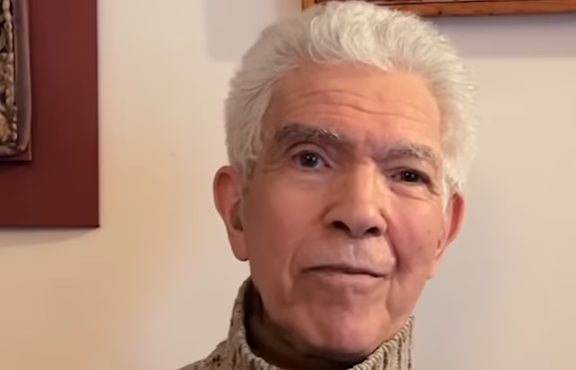
Mohammed Harbiborn June 16, 1933, died yesterday, leaving behind a major work and a lasting imprint on Algerian, Arab and international intellectual history. His death marks the loss of a rare voice: that of a rigorous historian, a committed intellectual and a profoundly free spirit. Former FLN activist and actor in the struggle for independence, Mohammed Harbi very early on chose a demanding path: that of critical lucidity. Refusing official stories and fixed mythologies, he endeavored to understand and make people understand the real mechanisms of Algerian history, including their most disturbing aspects. This choice of truth earned him exile, isolation and sometimes incomprehension, but never silence.
Breaking with official history
Historian of the Algerian War and the power resulting from independence, Mohammed Harbi played a decisive role in the renewal of Algerian historiography. His work, based on the analysis of archives and a demanding scientific method, made it possible to move beyond a fixed official history to open a field of critical reflection, essential to any society in search of political maturity. Beyond the historian, Mohammed Harbi was an intellectual deeply attached to the idea of emancipation. He considered that history is not an instrument of glorification, but a tool of understanding and liberation. His constant commitment against authoritarianism, the confiscation of memory and the abuses of power testified to a rare loyalty to the ideals of justice and dignity carried by the anti-colonial struggle.
A work destined to last
Until the end, he never stopped writing, transmitting and dialoguing, convinced that critical thinking is a vital necessity for societies in the South as well as those in the North. His words, calm but firm, have enlightened generations of researchers, activists and citizens. Mohammed Harbi leaves, but his work remains. It will continue to disturb certainties, open the archives of the past and question the present. This is the characteristic of great consciences: to survive their disappearance by the force of their ideas.
Here are some major works written by Mohammed Harbiwhich today are a reference for understanding the political history of contemporary Algeria:
-
The FLN: mirage and reality (Editions Syllepse)
A fundamental book in which Mohamed Harbi deconstructs the official narrative of the FLN and analyzes its internal contradictions, from the liberation struggle to the exercise of power. -
At the origins of the FLN (Editions Bouchène)
A rigorous study of the political, ideological and social currents which led to the creation of the National Liberation Front. -
The Algerian War, co-written with Benjamin Stora (Editions Hachette)
A clear and solidly documented work of synthesis, which has become an essential reference for understanding the military, political and memorial issues of the Algerian War of Independence. -
A standing life (Éditions La Découverte)
His intellectual and political autobiography, where he looks back on his commitment, his exile, his ruptures and his constant fight for historical truth.
Through these books, Mohamed Harbi bequeathed much more than the work of a historian: a method, an ethic and a permanent invitation to think about history against dogmas and falsifications.
