
MSF refuses to transmit the list of its staff to the Israeli authorities
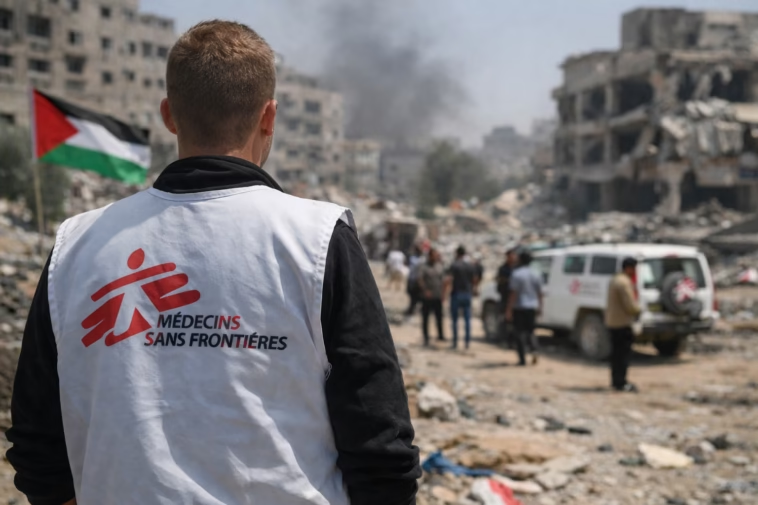
The NGO MSF refuses to transmit the list of its staff to the Israeli authorities, citing security concerns.
WHY READ:
- Understand security issues for humanitarian workers in Palestine.
- Discover the potential consequences for medical aid in Gaza.
- Analyze MSF’s position in the face of Israeli demands.
The humanitarian organization Doctors Without Borders (MSF) announced Friday that it refused to transmit to the Israeli authorities the list of its Palestinian and international staff, for lack of sufficient guarantees concerning their security and the independence of its operations in the Palestinian territories.
According to a press release from the NGO, this decision comes after “many months of fruitless exchanges” with the Israeli authorities, who had demanded in March 2025 that humanitarian organizations provide detailed personal information on their employees as part of their registration procedure.
MSF says it immediately expressed its concerns, recalling that humanitarian and medical workers have been “intimidated, arbitrarily detained and attacked” since the start of the war. Since October 2023, around 1,700 health workers have been killed, including 15 MSF employees, according to the organization. On December 30, 2025, Israeli authorities informed MSF that its prior registration had expired, giving it 60 days to cease its activities. In an effort to maintain its operations, the NGO says it offered on January 23 to share, on an exceptional basis, a partial list of names of its staff members, subject to clear commitments on their protection.
“It became obvious that no dialogue was possible to obtain the necessary guarantees,” said MSF, specifying that these guarantees concerned in particular the strictly administrative use of information, the maintenance of its autonomy in terms of human resources and supplies, as well as the end of communications deemed defamatory against it. MSF recalls that, in accordance with international humanitarian principles, the protection of medical and humanitarian personnel constitutes an obligation in times of armed conflict. The organization believes that any administrative requirement likely to compromise the safety of teams or impartial access to care contravenes international humanitarian law and hinders aid intended for civilian populations.
In the absence of such commitments, the organization claims to have transmitted “no information” about its staff to the Israeli authorities.
MSF denounces an “impossible choice” imposed on humanitarian organizations: share sensitive data on their employees or stop providing vital medical care to the Palestinian population, while the humanitarian crisis worsens Gaza. The NGO warns that a possible expulsion of Gaza and of West Bank would have “devastating” consequences. She emphasizes that essential infrastructure is largely destroyed and that the health system is “virtually at a standstill”, while nearly 500 people have been killed since October 2025.
In 2025, MSF claims to have provided around 800,000 medical consultations, assisted one in three births and supported one in five hospital beds in the Palestinian territories.
The organization, however, says it is ready to continue discussions with Israelprovided that they make it possible to guarantee the continuation of its essential medical activities Gaza and in West Bank.
