
Neom: when Saudi excess collapses
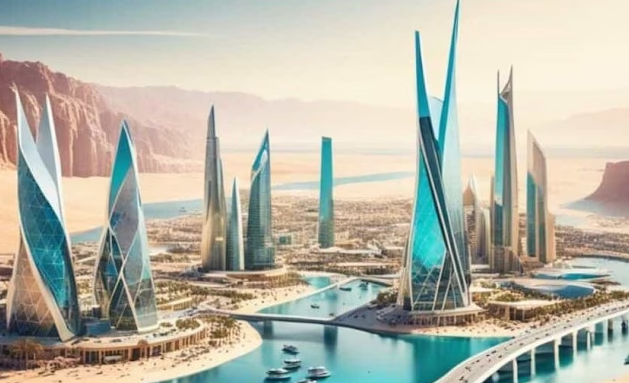
Neom was to embody the Saudi Arabia of the future. A new, ecological, ultra-modern city, capable of making people forget about oil and attracting the whole world. Presented as a visionary project, Neom is today becoming the symbol of authoritarian governance blinded by excess. After having devoured tens of billions of dollars, Riyadh now recognizes that this giant city built in the desert is neither controlled nor viable. Announced at $500 billion, Neom was among the most expensive urban projects ever imagined. Its heart, The Line, was to extend over nearly 200 kilometers. Two giant walls 500 meters high, intended to accommodate up to 9 million inhabitants. A spectacular promise, but totally unrealistic. This project has never been the subject of public debate. No independent study has been made public. The decision was imposed from above, in a system where contestation is non-existent.
Nearly $50 billion has already been spent. However, work is now slowed down, sometimes at a standstill. The 2030 deadline is now out of reach. A Saudi official eventually admitted that the state had “spent too quickly.” A late recognition which changes nothing at the root of the problem. This is a major political failure, caused by a logic of prestige and communication, and not by serious reflection on the needs of the country.
While these billions were disappearing into the sand, Saudi Arabia was facing much more concrete realities: falling oil revenues, budget deficits, persistent youth unemployment and deep social inequalities. The contrast is stark between the money invested in a technological showcase and the daily difficulties experienced by a large part of the population.
A project designed for the image, not for the population
The official discourse highlights ecology and sustainability. But this facade does not mask the reality. Neom led to forced displacement of local populations, expelled from their land without any real choice. The desert environment, fragile by nature, has been profoundly transformed. Building a supposedly “green” megastructure in such a hostile environment is an obvious contradiction. To date, only Sindalah has opened. It is a luxury seaside resort, reserved for a wealthy and international clientele. It was delivered three years late and well over budget. This fact alone sums up the spirit of the project: Neom was never designed for the population, but for the image of the regime and for an elite.
The problem is not the total absence of public services in Saudi Arabia, but their unequal distribution and their social fragility. Public health and education exist, but they are often saturated, especially outside large cities. There is a lack of accessible housing, particularly for young people and the middle classes. Social assistance remains limited and conditional. Many families still depend on private or family networks to get by. In this context, devoting tens of billions to Neom reveals a clear political choice: investing in prestige rather than everyday life.
The situation is even harsher for migrant workers, who represent an essential part of the country’s economy. Millions of workers from Asia and Africa occupy the most arduous jobs, particularly in construction. Many work for very low wages, live in precarious housing and have few protections. The sponsorship system limits their freedom and exposes them to abuse. On Neom construction sites, testimonies indicate difficult and dangerous working conditions. These workers remain invisible, without real rights and without a voice.
The current reduction of the Neom project does not mark an ideological change. It is imposed by economic reality. Neom will remain as one of the most striking examples of limitless authoritarian ambition, where excess serves power, not the public interest.
