New world order: the Muslim world lagging behind History
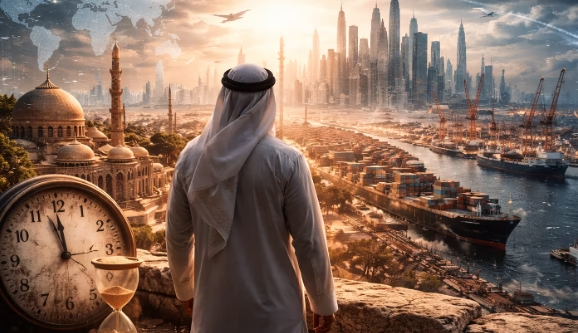
The Muslim world is behind history, lacking unity and innovation.
WHY READ:
- Analysis of contemporary challenges in the Muslim world.
- Importance of democracy and plurality.
- Call for intellectual and theological reform.
The world is turning upside down. The balance of power is shifting, alliances are being recomposed, the implicit rules that have structured the international order for decades are being called into question. New powers are asserting themselves, old ones are seeking to preserve their influence, while technological, economic and geopolitical competition is intensifying. At this pivotal moment in history, a question arises: where is the Muslim world located?
The answer is uncomfortable. He arrives late. One billion eight hundred million inhabitants, a large youth population, major energy and strategic resources, a central geographical position linking Asia, Africa and Europe. However, no real collective force emerges. No common vision, no shared strategy, no capacity to influence decisively the course of world events.
Absent innovation and technological, economic and strategic stalling
Added to this political delay is a profound disconnect in the key areas that structure contemporary power. The Muslim world is not at the origin of the great technological, economic or scientific innovations that are shaping the 21st century. He imports them, sometimes adapts them, but rarely produces them. Research effort is marginal, investment in innovation insufficient, and industrial ecosystems remain weak or dependent. Economically, it participates very little in international competition and the global industrial battle. It consumes more than it creates, imports more than it exports with high added value. This structural dependence results in an almost total absence of economic, technological and military sovereignty, making Muslim states vulnerable to external pressures and incapable of sustainably defending their strategic interests.
Cultural delay and lack of influence
On a cultural level, the finding is just as worrying. The Muslim world no longer shines as a force of intellectual, artistic and symbolic production on a global scale. It has little influence on contemporary imagination and shapes neither grand narratives nor global cultural references. Cinema, literature, universities, human sciences, creative industries, international media: the contribution remains marginal, fragmented and often dependent on external frameworks. Lacking intellectual freedom, support for critical creation and recognition of pluralism, culture retreats into repetition, nostalgia or defensive reaction. However, without cultural power, there is no soft power, no ability to make one’s voice heard in the world, no possibility of influencing the definition of international values and standards.
New world order: the great backwardness of the Muslim world
The world is reorganizing itself. The balance of power is changing. The powers are advancing. Meanwhile, the Muslim world watches history pass by. Despite its immense potential, it remains without a credible common project pic.twitter.com/tH3QNJWEEz
— Oumma.com (@oumma) January 7, 2026
Without democracy, no lasting power
It must be said bluntly: without a democratic system, nothing is possible. No lasting sovereignty, no solid political legitimacy, no credible power on the international scene. Authoritarian regimes may maintain apparent stability, but in the long term they produce fragility, distrust and deadlock. Repression stifles societies, prevents innovation and fuels internal fractures.
The illusion of a unity based solely on religion does not stand up to the test of reality. The Muslim world is not a homogeneous bloc. It is crossed by diverse cultures, contrasting national histories, divergent economic interests and often opposing political trajectories. Thinking that a common religious reference would be enough to build a coherent geopolitical project is more of a slogan than an analysis.
Pluralism, intellectual reform and the end of illusions
Without respect for plurality, without freedom of thought, without recognition of minorities and internal differences, no serious collective project can see the light of day. Diversity is not a weakness: it is a reality that must be organized, integrated and protected. To deny it is to prepare for permanent internal conflicts.
Added to this is an essential requirement: an intellectual and theological reform of Islam, carried out from within, with courage and lucidity. Without this in-depth work, societies will remain prisoners of fixed readings, exploited by political power or by extremist actors. Reform does not mean denying, but adapting, clarifying and restoring meaning in a profoundly transformed world.
The new world order will not be built against the Muslim world, but without it if it persists in refusing self-criticism, democracy and reform. Nothing is irreversible. History does not exclude anyone in principle, but it only makes room for those who organize, innovate and embrace their plurality. The Muslim world lacks neither resources nor potential, but political and intellectual courage. As long as freedom is perceived as a threat, criticism as a betrayal and democracy as a danger, he will remain dependent on the choices of others. The moment is decisive: either he initiates a profound transformation to become a sovereign actor in the world to come, or he will continue to submit to its rules as a simple spectator.
