
Nigel Farage and far-right Reform party want to field a Muslim candidate to attract the Muslim vote in England
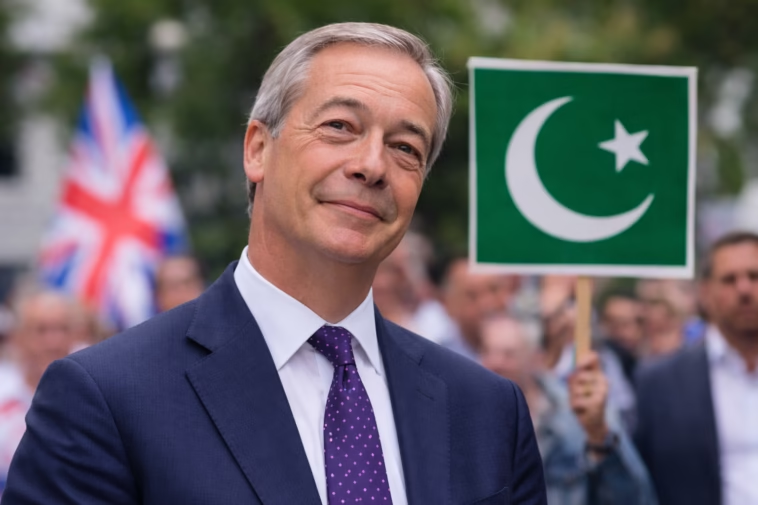
A video widely relayed on social networks shows Nigel Farageparty leader Reform UKconfidently explaining that his party chose a Muslim candidate for the London mayoral election in order to appeal to the Muslim electorate. In this extract, Farage says Reform will field ‘a Muslim woman’ against outgoing mayor Sadiq Khanadding that, contrary to what the Labor Party would have long believed, the Muslim vote would no longer constitute a uniform bloc won by the left. According to him, many Muslims would now be ready to support Reform.
A statement that does not fail to provoke a reaction. On the one hand, Farage seems to consider that the simple nomination of a Muslim candidate would be enough to attract the Muslim vote. On the other hand, he criticizes Labor for thinking that this electorate voted homogenously. An obvious contradiction, which gives the impression of assumed identity politics when it serves its interests.
🚨 NOW TRENDING 🚨
A clip of Nigel Farage admitting he selected a London Mayoral candidate to target the Muslim voting bloc is blowing up — and people are rightly asking: since when did identity politics become the plan?
What’s next? Policy-by-demographic? Amnesties to lock in… pic.twitter.com/5xobgORo8Z
— Sly U (@SlyForTheRight) February 2, 2026
A candidate with a controversial background and comments
The candidate put forward by Reform is Laila Cunninghama British woman of Egyptian origin. A former prosecutor at the Crown Prosecution Service, she then entered politics with the Conservatives, before being elected a municipal councilor in Westminster in 2022. She has since joined Reform, like many party executives from the Tory ranks.
But this choice raises serious questions. Cunningham has in the past made comments deemed Islamophobic. In an interview with Standard Podcastshe claimed that women wearing the burqa should be stopped and searched by police, stating that “if you hide your face, it is for a criminal reason.” She also said that certain areas of London “give the impression of being a Muslim city”, referring to signs in foreign languages and the sale of burqas in markets.
These statements sparked strong criticism. Shaista Gohirdirector of Muslim Women’s Network UKaccused Cunningham of contributing to the insecurity of British Muslims, sending the message that they would not be a full part of society and reinforcing hostile rhetoric against them.
A speech consistent with that of Farage
For many observers, this choice of candidate is a continuation of the speech of Nigel Farage, regularly accused of fueling distrust towards Muslims. The Reform leader has previously claimed that many young people in the UK do not share “British values”, explicitly targeting Muslims. He also relayed a contested interpretation of a study by the Henry Jackson Societysuggesting that a large proportion of British Muslims would support a terrorist organization – a reading considered misleading by many researchers.
In this context, the idea that Muslim voters in London could forget these positions and rally around Reform seems questionable to say the least.
The political positioning of Reform UK
Led by Nigel Farage, Reform UK is clearly positioned on the far right of the British political spectrum, with a populist discourse centered on the fight against immigration, criticism of “elites”, the rejection of ambitious climate policies and the defense of a national identity presented as threatened. Direct heir to the Brexit Party, the party seeks to capture an electorate disappointed by both the Conservatives and Labor, by focusing on security and cultural themes. Reform intends to assert itself during the next major electoral events, in particular the British general elections scheduled for no later than 2029, as well as the election of the mayor of London in 2028, for which it has already nominated its candidate.
For its detractors, Reform uses Laila Cunningham’s candidacy as a showcase, in order to give a more acceptable face to policies and discourse widely perceived as hostile to minorities. Far from embodying a renewal of British political life, the party would thus reproduce well-known strategies: putting forward a figure from a minority group while maintaining a hard line on immigration, identity and security.
Behind the discourse of rupture and novelty, Reform UK appears above all as a party playing with symbols, without really convincing those it now claims to want to seduce.
