
No, the Quran never justified slavery. He fought it.
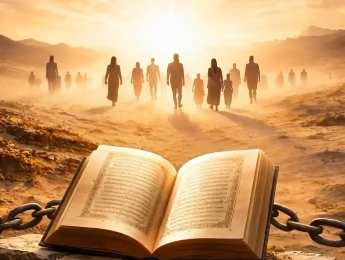
The Quran combats slavery by promoting human dignity and emancipation.
WHY READ:
- Analysis of the Koran’s position on slavery.
- Exploring progressive reform and emancipation.
- Reflection on historical deviations and their disconnection with the Koranic message.
The Koran facing a universal institution
The assertion that the Koran legitimized slavery is regularly put forward as evidence. However, it is based on a superficial, often ideological reading, which confuses a given historical context with a profoundly reforming moral and spiritual project. Because if the Koran addressed a society where slavery existed, it never established it as a norm, nor as an ideal. On the contrary, he gradually undermined its foundations and called into question the logic that made it possible.
In the 7th century, slavery was a universal institution. It structured all human societies, from the Roman Empire to Sassanid Persia, without being seriously questioned on a moral or philosophical level. Pre-Islamic Arabia was no exception. Demanding from the Koran an immediate and explicit abolition of slavery therefore amounts to imposing an anachronistic reading on it, foreign to the historical dynamics of the time. No ancient religious or philosophical text has proceeded in this way or formulated a coherent project of emancipation in a world based on domination.
A dynamic of reform and liberation
The Quran adopts another method: that of progressive reform. He does not create slavery, does not encourage it and never sacralizes it. It acts on two essential levers: the drastic reduction of the entry routes into enslavement and the multiplication of the means of exiting it. Where slavery was previously fueled by raids, debt or the sale of oneself, the Koranic message gradually tightens these practices, while making manumission a highly valued act. Thus, the liberation of slaves is explicitly presented as a major work of piety. The Koran places it at the heart of lived faith: “True piety does not consist of turning your faces towards the East or the West, but true piety is believing in God (…) and freeing the slaves” (Quran, 2:177)
Manumission is also required as spiritual atonement for certain serious sins, making it a central act of moral reparation: “He who kills a believer by mistake must free a believing slave…” (Quran, 4:92). “God does not hold it against you for rash oaths, but He holds against you for deliberate oaths. Atonement consists of feeding ten poor people… or freeing a slave” (Quran, 5:89)
This insistence is neither marginal nor secondary: it structures a true ethic of liberation inscribed in the text itself.
The Koran goes even further by opening the way to the contractual emancipation of enslaved people, by recognizing in them a legal and moral capacity: “And those of your slaves who seek a contract of emancipation, conclude it with them, if you recognize good in them, and give them the goods of God which He has granted you” (Quran, 24:33)
The slave is therefore never described as an inferior being by nature, but as a full human being, endowed with dignity, rights and moral responsibility.
A major anthropological rupture
Even more profoundly, the Koran attacks the ideological basis of slavery: the ontological hierarchy of human beings. It affirms a fundamental equality before God, regardless of social status, origin or condition: “O men! We created you from a male and a female, and We made you peoples and tribes that you might know one another. The noblest among you, before God, is the most pious” (Quran, 49:13)
This break is considerable in a society based on the domination and heredity of ranks.
The Prophet of Islam will explicitly extend this logic in his words and practices. He will say in particular: “Your servants are your brothers. God has placed them under your authority. Whoever has a brother under his charge should feed him with what he eats and clothe him with what he wears. Do not impose on them what they cannot bear, and if you do, help them.”(Sahih al-Bukhari, Sahih Muslim). And in another hadith: “Whoever slaps his slave or hits him, his atonement is to free him” (Sahih Muslim)
These words upset the social norms of their time and made any conception of slavery based on brutality or dehumanization morally untenable.
Founding text and historical deviations
If slavery has persisted in certain Muslim societies, this is not the result of the Koranic text, but of political, economic and cultural choices which have often betrayed its ethics. Confusing these historical practices with the message of the Quran amounts to attributing to a text what its readers sometimes refused to apply.
To say that the Koran justified slavery is to ignore its reforming dynamic, its context of revelation and its moral project. The Koran has never placed itself on the side of oppression, but of human dignity and the progressive liberation of man by man.
No, the Quran never justified slavery. He fought it
Islam did not invent slavery: it attacked it at its roots. Koranic verses destroy all human hierarchy and make emancipation a duty.
What official history prefers to keep silent about… pic.twitter.com/n6s7CvFQWe— Oumma.com (@oumma) January 8, 2026
