Pope Leo XIV: a first tour under the sign of dialogue with Islam
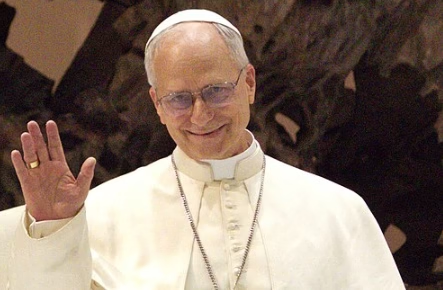
Barely seven months after his election, Pope Leo XIV begins his first trip abroad on November 27, heading to Turkey and then Lebanon. A highly anticipated trip, both for its symbolic significance and for the tone that the new pontiff will choose to adopt. In Türkiye, where he will travel to Ankara, Istanbul and Iznik, Leo XIV wishes to reconnect with the heritage of the first Christian communities. His visit will coincide with the feast of the Apostle Andrew, a major figure in Orthodoxy, and he will meet Patriarch Bartholomew, at the head of a Church long subject to the restrictions of Turkish power.
This first trip to a predominantly Muslim country is seen as a strong gesture. “Many in the Muslim world feel honored,” notes Jesuit Felix Körner, specialist in Muslim-Christian dialogue. For a new generation of young Muslims, tired of seeing religion manipulated by their leaders, the pope embodies another way of exercising spiritual responsibility: by example, words and diplomacy rather than domination.
The second stage, in Lebanon, has an equally symbolic dimension. The country, a mosaic of faiths where Christians and Muslims coexist despite tensions, remains for the Vatican a privileged field of observation of common life. Leo XIV will stop in particular at the port of Beirut for a moment of contemplation, on this site marked by the devastating explosion of 2020.
With this first trip, Leo XIV gives the impression of a man determined to rebuild trust that had sometimes been damaged between religions. His way of moving forward, without rushing or looking for a spectacular gesture, seems to speak to many: he favors listening, coherence and a form of sobriety which contrasts with the presentation of power that we often see elsewhere.
For many actors in interreligious dialogue, this attitude creates a new climate. It shows that a spiritual leader can exert real influence without raising his voice, simply by embodying what he wishes to convey.
