
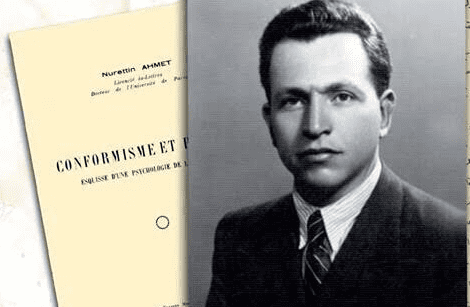
Resurrecting our forgotten thinkers: belief according to the Muslim thinker of Turkish origin Nurretin Ahmet Topçu (II)
- Understand the distinction between belief and simple assent.
- Discover the influence of Scottish philosophy on Topçu.
- Think about the impact of belief on our perception of the world.
In this second part of the discovery of Topçu’s work, we will enter into the heart of his conception of “belief”. Having a poor understanding of belief necessarily means confusing it with a simple vague and vague assent. For many of us, belief is just an emotion when it is true knowledge.. Furthermore, if belief is knowledge, as Topçu will demonstrate, it must necessarily be personal, so there cannot be an identical path for everyone (the destination is the same), any more than there can be a standardized and atomized spiritual progression.
Now we see more and more brotherhoods today giving the same teaching with the same methods to hundreds of poor credulous disciples, whereas as we have just seen, belief is in its very principle necessarily personal and cannot be experienced in the same way by everyone. When you see a brotherhood gathering (or other) which applies the same method for everyone, flee such a gathering!
The authentic master adapts the spiritual method to the specific personality of each disciple. Let us go even further to better present our study on belief: to say that “belief is true knowledge” is not the most radical statement by Topçu, the Scottish school of Sir William Hamilton (d.1856) had said it before him, a school from which our Turkish thinker draws inspiration. Indeed, for the Scottish philosopher “belief is a conviction prior to the knowledge of which it forms the basis. It is therefore a conviction of an authority superior to knowledge; it is the primary fact, knowledge is derived from it: knowledge rests on belief.”
Today, such an affirmation lost in the chaos of the human mind, itself disoriented by so much ugliness in our post-humanist society, is borderline provocative. Hamilton, with whom Topçu agrees to a certain point, specifies in particular that memory “is not a knowledge of the past, but a knowledge of the present and a belief of the past”.
It is true that we do not have effective knowledge of our past moments, and as such we can only believe in them once these moments are no longer present facts; “Memory presupposes belief in the past.” Our Muslim thinker agrees with Hamilton when the latter makes belief “the first condition of reason”. As Topçu rightly points out, when I analyze an object, a situation, I must believe in the reality of this object or this situation; I must believe in the effectiveness of my senses and my reason.
When I imagine the external world I must believe “in its past existence, in its future existence or simply in its possible and desirable existence”. It is so obvious that every time I try to think, meditate, analyze, demonstrate or argue, I must above all believe in my sensitive faculties, in the effectiveness of my five senses and in my intellectual faculties. that I can only resign myself to this simple but radical idea that before knowing I must believe. It is because this argument is so simple that it is radical, even unstoppable. ; it falls under (common) sense.
No one escapes belief, neither kings, nor beggars, nor the true man, nor liars, no one! But Topçu surpasses Hamilton by going even further. Sir Hamilton makes belief and knowledge a kind of hybrid knowledge of which belief is its subjective element and knowledge its objective part. For him, belief and knowledge are equal “each of them presupposes the other” but “knowledge is a certainty based on intimate knowledge, belief is a certainty based on feeling”.
Whereas for our Muslim thinker, the response must be even more radical; “true knowledge” is “that which we call belief”. “Belief is not confusion or confused knowledge” it is “true knowledge, personal knowledge and not imitated”. Familiar with Hallaj’s work, he could not fail to go so far. The Sufis have never ceased to demonstrate that there is, in us, a depth which knows and which is beyond this material and utilitarian reason which of course helps us to describe natural laws but also to make our life plans, our career plans or even our perfidies. Now what does this actually mean for me? How would these affirmations change my view of the world or even my life?
In the age of the Internet and the tyranny of the evanescent moment and compulsive buying, we are obliged to answer these practical questions asked by increasingly busy individuals. First of all, neither our emotions nor our feelings are the belief; this belief which grounds me and “ensures my psychological integrity”. Likewise, when I imitate a rite it is not yet the belief. Belief calls upon the entire being, “one can only go to the truth with the entire being, body and soul”, belief is this knowledge which unites me to the object or being and this is why it is a personal and intimate knowledge. From there, I can say that the more my emotions overwhelm me and the more confusion takes hold of me, the less I believe, in other words the less I know.
This is how we better understand the Word of the Koran which called the Arabs newly converted to Islam to say that they were Muslims subject to the authority of the Prophet rather than brazenly proclaiming “we are believers” because “faith has not yet penetrated your heart”; it is not “the entire being, body and soul” that believes but just the body and only out of clan interest. Topçu only expresses the Koranic point of view in his thesis on the notion of belief. Let us also remember that the Koranic Word always identifies intelligence with the heart, it does not distinguish them, in other words it assimilates knowledge with the depths of the being who believes; “do they not have hearts with which they reflect” asks the Koran?
Belief and knowledge in the Quranic perspective are one and the same. From everything that has just been said, it is quite easy to see where we stand with regard to our belief in a religion or an ideology; we will always judge the tree by its fruits. To be even clearer, within the communities of Islam for example, in France, inside the sanctuaries, we are all called to make the same gestures and to think uniformly, no head must protrude, personality is banned and with it originality, and all this in the name of our “same belief”.
But in reality, it is not belief that drives us and nourishes this tyranny of standardization since true belief is personal and it combats sterile mimicry and repetition.. It is our ego which steals the identity of belief, which seizes its clothing and speaks in its name, it is it which really animates us. The ego is the real imposter, it enjoys making us repeat our impostures. The Koran constantly warns us against it, the worst enemy will forever remain ourselves, or more precisely, that part of ourselves which is petty, courageless and vile.
Furthermore, Topçu rightly points out that since belief is true knowledge, for the reasons we have seen above, it is that which “ensures our psychic integrity”. Mohamed Iqbal had written the same thing in “Reconstructing the Religious Thought of Islam” saying that the deep self guaranteed the unity of the being which could be divided. Topçu rightly reminds us that “we don’t care about our beliefs; they are ourselves. The disorganization of a person’s beliefs results in the disintegration of his or her entire personality. This is what personality illnesses prove. In all psychological illnesses there is an essential element whose dissolution opens the way to the abnormal development of mental function; it is the element of belief which alone can ensure the integrity of psychic life. The facts of internal experience show that in deep crises of consciousness, as in mental alienation, beliefs find themselves attacked and forced.
Thus, it gives us the key to understanding our questions raised in the first part of this study. Anyone who seeks to believe, at a time when beliefs are attacked from all sides by the absolute relativism of modernity, but also by the confusion and profusion of doctrines within religions, risks generating illnesses linked to the mind. What is shocking is that Islam fundamentally demands a pacification of man rediscovering his true metaphysical nature, but it is clear that far too many Muslims project the image of people troubled and driven by a literally hellish conscience..
Our era, unique in its break with traditional civilizations, saw the birth of misbelief, in other words, people no longer evolve but rather “involve” and thereby find themselves moving backwards, thinking they are progressing in religion because the unity of belief is repeatedly attacked. There misbelief creeps in everywhere.
It is this evil which insidiously eats away a significant part of society by destroying, without making any noise, “our psychic integrity” and shattering the unity of our interiority, thus generating increasingly infernal Muslims located at the antipodes of the Koranic doctrine of the pacified soul sowing peace around it: “spread peace among you” insisted the Prophet (sbl).
We would like to end this brief reflection on Belief in Topçu’s thought as we began it, by addressing the readership of the Oumma site: I explain everywhere to anyone who wants to listen in our mosques that the Koran gives food for thought by offering a conception of man and our relationship to the world. Orthopraxy (fiqh) is a necessary lifestyle but the Koran does not only give that but more. The Koran has real conceptual power but you still have to know how to seek it out. Repetition and imitation cannot help us invest the field of debate of ideas, especially since, unfortunately, it is at the moment when we most need to rethink the world that we are, in terms of regenerative ideas, incapable of offering real concepts that are ethical, healthy and strong at the same time.
For what ? Because the Koran is not the talisman or the charm that we have outrageously returned, but the guidance that builds witnesses for their time. Belief is “action-knowledge” so logically, a believer is necessarily an “acting-knower” who can, based on his belief, invest the world and give it meaning by constructing ideas, concepts or keys to understanding, whatever. “There will come a time when there will be almost no more people seeking to understand (fuqaha) the Koran but more reciters (qurra’)” announced the Prophet (sbl). Who can say the opposite today with these (vocal) beauty contests which abound everywhere within Muslim communities while the world advances towards the precipice without Muslims doing anything to help it avoid falling there?
