
Thinking about fraternity beyond borders: legacies and horizons
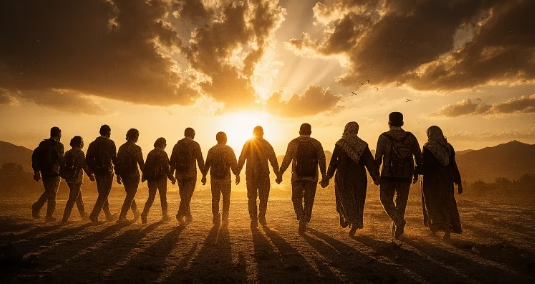
Dialogue between Islam, humanism and social struggles
At a time when wars, identity withdrawals and dehumanization threaten universal consciousness, rethinking fraternity becomes an act of resistance. Between the spiritual heritage of Islam, humanist traditions and social struggles, this reflection questions what connects people beyond borders, cultures and beliefs: a lived, active fraternity, which involves the heart, faith and justice. Faced with the injustices of the world, fraternity appears today as a spiritual and political emergency. Islam, in its universal message, reminds us that human dignity has neither color nor borders. Driven by an ethic of justice and mercy, this fraternity joins the great humanist currents of the world. Between spiritual heritage and social horizon, it remains a call to resist dehumanization, to reweave links between peoples and to re-enchant the idea of a common humanity.
Spiritual legacies: fraternity as a founding principle
In the Islamic worldview, brotherhood is at the heart of the human condition. The Quran teaches: “O men! We created you from a male and a female, and We made you nations and tribes that you may know one another.” (49:13). This word, of universal scope, affirms that diversity is a wealth willed by God and that the encounter of differences is the path to mutual knowledge.
Fraternity, in Islam, is not only a social bond: it is a spiritual attitude. It connects humans to humans, but also to the living world and the divine. Mohammed Taleb expresses it through his ecological and spiritual thinking: fraternity is not a charitable gesture, but a way of living in the world consciously. It invites us to recognize the kinship of all existences, to understand that justice and compassion are not secondary choices, but the very condition of faith.
Humanism and social struggles: forgotten convergences
This spiritual ethic finds a deep echo in modern humanist traditions. The Quran states: “Whoever saves a life, it is as if he had saved all of humanity” (5:32). These words, of absolute clarity, resonate with the intuition of thinkers and writers who wanted to place human dignity above all belonging. But fraternity is not just an idea: it is experienced in struggles. Frantz Fanon recalled this in his own way by seeing in the liberation of colonized peoples the reconquest of a denied humanity. Malcolm X, after his pilgrimage to Mecca, discovered the brotherhood experienced between believers from the four corners of the world, without distinction of color or rank.
These trajectories tell an essential truth: fraternity is not declared, it is built. It is born from shared ordeal, from concrete solidarity, from the refusal of injustice. It is the invisible thread that connects spiritual and social struggles, religious hope and the quest for equality.
Building a political and global fraternity
The Iranian thinker Ali Shariati wrote that faith without action is a betrayal, and that love of God without love of men is only an illusion. In a fragmented world, where economic, ecological and moral crises intertwine, these words sound like a salutary reminder.
Fraternity must once again become a global project, a compass for collective action. It calls for rethinking our lifestyles, our economies and our international relations in the light of an ethics of connection. It is no longer a question of preaching compassion from a distance, but of living it concretely: in the way we share resources, protect nature, welcome refugees or defend the most vulnerable. This planetary fraternity is not a utopia: it is a necessity. It alone can respond to the fragmentation of the world, the anguish of people and the loss of meaning. It commits to reconciling faith and reason, spirituality and justice, humans and living things.
The poet Mahmoud Darwish wrote that “there is on this earth that which deserves life: the face of the woman, the bread and the heart of a people”. These words remind us that fraternity begins with a look, with the recognition of the face of the other as a promise of life. In a time dominated by cynicism and fear, still believing in brotherhood is courage. It does not erase the differences, it connects them. She does not dream of uniformity, but of humanity reconciled with itself.
Thinking about fraternity beyond borders is responding to the call of the Koran: “We have only sent you as a mercy to the worlds” (21:107). It is to affirm that mercy and justice are the two beats of the same heart: that of a humanity which, despite the wounds of history, continues to believe in the possibility of the link.
Bibliography
-The Qurantranslation and commentary by Muhammad Hamidullah, Club Français du Livre, 1959.
-Mohammad Iqbal, The Reconstruction of Religious Thought in IslamLes Éditions du Cerf, 1996.
-Mohammed Taleb, Ecology and Muslim spiritualitySocial Chronicles, 2012.
-Ali Shariati, Man and IslamPayot, 1971.
-Mahmoud Darwish, The earth is narrow to usSinbad, 1987.
