
Venezuela: how oil, China and Iran are challenging the petrodollar system
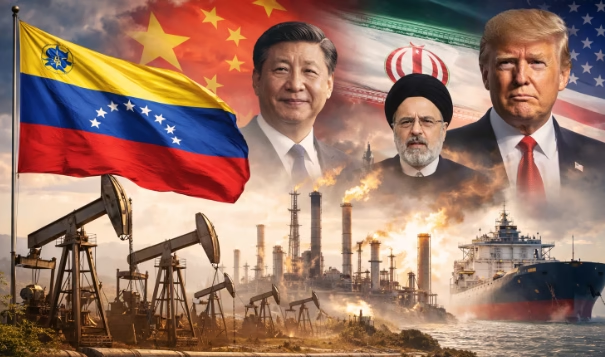
- Understand the strategic role of Venezuelan oil in global geopolitics.
- Exploring energy partnerships between Venezuela, China and Iran.
- Analyze the implications of the questioning of the petrodollar on the American economy.
The Venezuelan crisis cannot be understood if we ignore the essential: oil. Venezuela is not only a country beset by political or economic difficulties, it holds the largest proven oil reserves in the world. This reality makes it a major strategic target, especially since this resource fuels energy partnerships with the China and theIrantwo powers which are increasingly openly contesting the energy and monetary order dominated by the UNITED STATES
Venezuelan oil: a wealth too strategic to be tolerated
The heavy oil of the Orinoco belt represents considerable wealth. In a world still largely dependent on hydrocarbons, this resource gives Venezuela significant geopolitical weight, out of all proportion to its current economic situation. But this wealth is also a vulnerability: it attracts sanctions, pressures and attempts at guardianship. Very early on, the United States understood that the heart of the problem was not ideological. He was energetic. What is disturbing is not so much the regime in place as Venezuela’s ability to freely dispose of its oil and use it as an autonomous cooperation tool.
The petrodollar: pillar of American power
The petrodollar system indeed constitutes a central pillar of American economic power. By imposing the dollar as the almost exclusive currency of global oil trade, the United States guarantees permanent demand for its currency, finances its deficits at lower cost and maintains unparalleled financial domination. This mechanism allows Washington to live beyond its means while transforming the currency into a geopolitical weapon. Any challenge to this system – such as the sale of non-dollar oil by producing countries – directly threatens the balance of the American economy and, beyond that, the very architecture of its global power.
China: oil, financing and gradual exit from the dollar
China has become one of the main customers of Venezuelan oil thanks to long-term agreements, often based on the principle of oil for loans. This mechanism allowed Caracas to finance its economy while ensuring a stable and strategic energy supply for Beijing. With the tightening of American sanctions, however, a growing part of these exchanges took place outside the dollar: reimbursements in barrels, transactions in yuan, circumvention financial arrangements. By selling part of its oil outside the American currency, Venezuela was not only threatening immediate economic interests. It directly affected the petrodollar system, showing that a major producing country could export its oil without going through the dollar.
Iran: an energy partner under pressure
Venezuela and Iran share the same reality: that of heavily sanctioned states. This situation has favored pragmatic and political cooperation in the oil field, based on de facto solidarity between countries excluded from the dominant financial system. Starting in 2020, Iran played a key role in partially maintaining Venezuela’s energy sector, sending essential fuels and petroleum components for refining, while providing targeted technical assistance to some idled facilities. This cooperation has allowed Caracas to preserve minimal activity despite the economic suffocation imposed by the United States, and to show that there are concrete alternatives to the energy system dominated by the dollar.
A Venezuela-Iran-China energy axis in the viewfinder
Venezuelan oil has become a strategic point of convergence between China and Iran. Together, these three actors participate in the emergence of an alternative energy axis, based on South–South exchanges and on the challenge to American monetary domination. Weakening Venezuela means weakening Chinese supplies, limiting Iranian room for maneuver and slowing down any credible attempt to challenge the petrodollar. The message sent to other producing countries is clear: any departure from the energy and monetary framework set by Washington will be sanctioned.
Behind the speeches on democracy or regional stability, a reality emerges: the control of energy remains the basis of world power. As long as Venezuelan oil fuels autonomous partnerships with China and Iran, it will be seen as a strategic threat. Venezuela is therefore not only paying for its political choices. He is paying for his energetic and monetary audacity. Through its oil, the entire geopolitical recomposition in progress is coming to light, in a world where the sovereignty of peoples continues to clash with the logic of domination of the great powers.
