
Why the United States is interested in Greenland and Arctic shipping routes
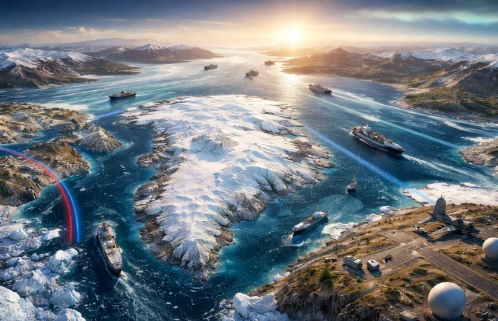
For a long time, the Arctic remained outside the major geopolitical balances. Today the situation has changed. Global warming is gradually reducing the sea ice and making possible, during certain periods of the year, new maritime routes linking Asia, Europe and North America. In this context, Greenland occupies a central place. For the United States, the issue is not territorial in the classic sense, but strategic: securing commercial, military and economic flows that are expected to become increasingly sensitive.
The new maritime routes in the Arctic are primarily of interest to the major commercial powers. In Asia, China, Japan and South Korea are at the front line. These countries export massively to Europe and North America. By passing through the Arctic, journeys can be shortened by 20 to 40% compared to traditional routes, notably via the Suez Canal. This gain in distance explains the growing interest in these roads, even if their use still remains limited and seasonal.
The Arctic, a new front in China’s encirclement
This development is, however, not without risks for China itself. If Beijing sees Arctic routes as a potential lever to reduce its costs and trade delays, this option also increases its dependence on maritime routes located in areas closely monitored by the United States and its allies. In the event of major international tensions, this configuration could constitute a factor of vulnerability for Chinese foreign trade, largely based on the continuity and security of maritime flows.
In this context, Greenland acquires an additional strategic dimension. The American military presence and the integration of the territory into the Western security system offer Washington a capacity for surveillance, or even indirect pressure, on the links linking Asia to the North Atlantic. Without there being any question of explicit blockage, this situation reinforces the strategic asymmetry between the United States and China, by placing part of the emerging trade routes under potential Western control.
On the European side, it is mainly the large industrial and maritime economies that could benefit from it: Germany, the Netherlands, France, the United Kingdom and Norway. Ports like Rotterdam, Hamburg, Le Havre or Antwerp are often cited. In fact, uses remain cautious, because climatic and economic risks remain significant. Arctic routes also concern the United States and Canada, particularly for connections between Asia and the North American East Coast. The Northwest Passage, which crosses the Canadian Arctic and skirts Greenland, would save time compared to the Panama Canal. But this road remains difficult, unreliable and still poorly suited to regular traffic.
Alternatives to Suez and Panama, not replacements
Arctic routes are not intended to replace the main routes of world trade. The Suez Canal remains essential for trade between Asia and Europe, while the Panama Canal remains central for flows between Asia and the Americas. The Arctic is rather seen as an emergency solution, which can be mobilized in the event of a major crisis, blockage or strong international tensions.
Today there are three major Arctic routes. The Northern Sea Route, along the Russian coast, connects Asia to Europe and constitutes the most used route, under close control of Russia. The Northwest Passage, which concerns Canada and Greenland, mainly connects Asia to North America, but remains unpredictable. The transpolar route, in the center of the Arctic Ocean, is not yet usable and is currently a long-term projection.
The riches of Greenland, an often hidden issue
Beyond the maritime routes, Greenland also attracts attention for its natural resources. Its subsoil would contain significant reserves of rare earths, essential for digital technologies, renewable energies, batteries and the military industry. There are also oil, gas, uranium and other strategic minerals, made more accessible by the melting ice. In a context of strong Western dependence on China, these resources represent a major challenge. Behind the discourse on security and stability, a cruder reality emerges: preventing this wealth from passing under the control of rival powers, even if it means making Greenland a new space for economic and strategic competition.
Situated between the North Atlantic and the Arctic, and between Europe and North America, Greenland occupies a unique position. It allows monitoring of maritime routes, airspace and military movements in the region. It is this position which explains the importance given by Washington to securing the territory, even without official control.
The United States is not seeking to annex Greenland. Their strategy is based on indirect control: military presence, cooperation with Denmark and integration of the territory into the Western security system. The Pituffik base already plays a central role in anti-missile warning and surveillance of the Arctic, in conjunction with NATO.
Seasonal but strategic routes
These routes are only usable for a few months per year, mainly between July and October, and require specially adapted vessels. Global warming extends the navigation period, but does not eliminate winter ice or weather risks. Despite these limits, their strategic importance remains strong, particularly in the event of a crisis affecting Suez or Panama.
Arctic sea routes are not yet highways of world trade. However, they constitute a major strategic issue for the decades to come. In this recomposition of international balances, Greenland appears to be an essential geographical lock. The United States does not seek to possess the Arctic so much as to ensure that no other power can use it as a tool of domination, at the risk of transforming this fragile territory into a new field of global rivalries.
